


Finance is changing, quietly but fast. Banks are no longer the only gatekeepers of money and users don’t want to wait days for approvals or pay high fees for basic transactions. That shift is exactly why defi app development is becoming a serious business opportunity in 2026. What started as experimental protocols has evolved into full-scale decentralized finance platforms handling billions in trading, lending, staking and digital assets across blockchain networks like Ethereum, BNB Chain, Polygon and Solana.
At the same time, users are frustrated with slow a cross-border transfers, limited banking access and systems that lack transparency. Decentralized finance application development addresses these pain points through smart contracts, automated market makers, lending protocols and non-custodial wallets that remove intermediaries and automate trust. For CTOs and business owners, the real question is no longer whether DeFi matters, it’s how to build secure, scalable solutions that actually creates long-term value.
What is DeFi App Development?
DeFi app development simply means building financial apps on blockchain instead of relying on banks or other middlemen. Rather than waiting for approvals or depending on centralized systems, these apps use smart contracts to automatically handle transactions and rules. Through blockchain application development and smart contract development, businesses can create platforms like DEXs, lending apps, staking platforms or non-custodial wallets where users stay in control of their funds.
What makes it different from traditional finance apps is that it’s permissionless. Anyone with a crypto wallet can access the platform, no lengthy onboarding process. Running on networks like Ethereum, Polygon, Solana or BNB Chain, decentralized finance application development helps create financial systems that are more open, transparent and in many cases, faster than conventional alternatives.
What Are the Major Types of DeFi Applications?
Not every DeFi app is built for the same purpose. Some focus on trading, others on lending and some are just infrastructure pieces like wallets or stablecoins. So before jumping into development; it’s important to understand what problem you’re actually trying to solve. The product direction changes everything from tech stack to token model.
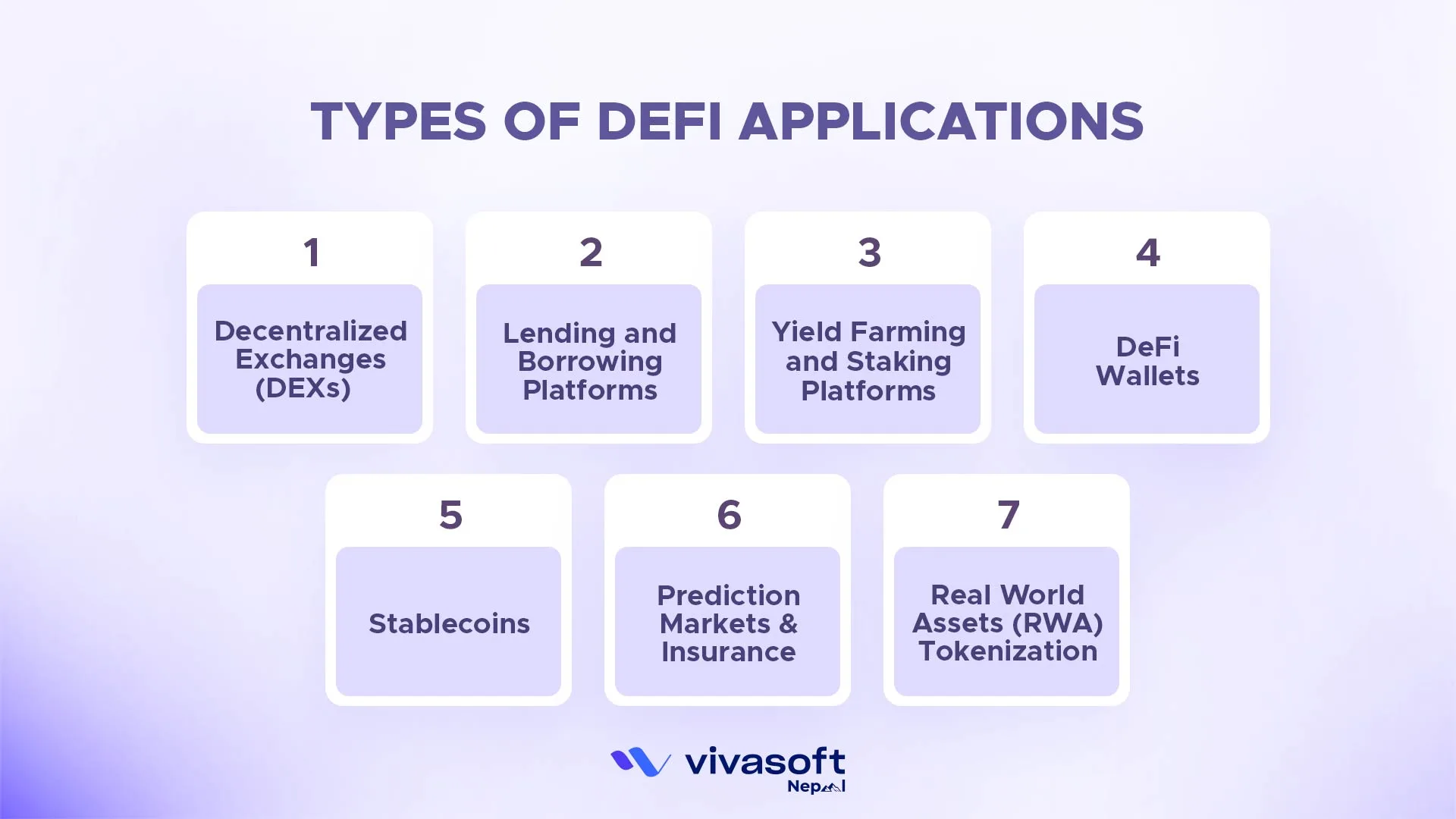
Decentralized Exchanges (DEXs)
DEXs let users trade crypto directly from their wallets. There’s no central authority holding funds. Most of them use Automated Market Makers (AMMs) and liquidity pools instead of traditional order books. It’s simpler in design but behind the scenes the smart contracts are doing all the heavy lifting.
Lending and Borrowing Platforms
These platforms allow users to lend their crypto and earn interest or borrow by locking collateral. Everything runs through smart contracts including liquidation rules. It removes traditional credit checks but risk management still matters a lot here.
Yield Farming and Staking Platforms
Yield farming is about earning rewards by providing liquidity to protocols. Staking usually involves locking tokens to support blockchain network or governance system. Both are used to attract users and keep liquidity inside the ecosystem.
DeFi Wallets
Wallets are the entry point into DeFi. Especially non-custodial wallets where users hold their own private keys. If the wallet experiences is confusing or insecure; the whole platform suffers. So usability and security can’t be ignored here.
Stablecoins
Stablecoins are designed to maintain a stable value usually pegged to fiat currencies. They’re crucial for reducing volatility inside DeFi platforms. Without stable assets, lending and trading become much harder to manage.
Prediction Markets & Insurance
Some DeFi apps go beyond trading and lending. Prediction markets let users bet on outcomes using blockchain contracts. DeFi insurance platforms provide coverage against protocol risks or smart contract failures which, honestly, are not rare.
Real-World Asset (RWA) Tokenization
This is where things get interesting for enterprises. Real-world assets like real estate or invoices can be tokenized and traded on-chain. It improves liquidity and opens new financing models; though regulatory clarity is still evolving.
What Are the Benefits of DeFi App Development?
Building a DeFi app isn’t just about following trend. For many businesses, it is about unlocking new revenue models, improving efficiency and reaching users globally without traditional infrastructure barriers. When done right, DeFi platforms can create real competitive advantages.
- Global Liquidity Access: DeFi platforms are borderless. Users from different countries can participate without going through complex banking systems, which opens access to a much larger liquidity pool.
- Cost Reduction: By removing intermediaries, transaction and operational costs can be reduced. Smart contracts automate processes that would normally require a manual verification.
- Transparency Boost: Transactions are recorded on public blockchains which increases the visibility and reduce disputes. For users, that builds trust.
- Rapid Innovation: DeFi is composable. New features can integrate with existing protocols quickly allowing faster product iterations compared to traditional finance systems.
- User Empowerment: Users maintain control over their funds through non-custodial models. That sense of ownership is a major shift from a centralized platforms.
- Interoperability: DeFi apps can connect with other decentralized applications through shared standards making integrations easier and more flexible.
- Scalability: With Layer 2 scaling solutions and high-performance blockchain networks; DeFi apps can now handle larger transaction volumes more efficiently than before.
What Are the Key Features of a DeFi Application?
Not all DeFi apps succeed. The ones that do usually share a few common traits, they’re secure, easy enough to use and designed with trust in mind. No matter how innovative the idea is, if users don’t feel safe or app feels confusing, they’ll leave. So getting the core features right really matters.
- User-Friendly Interface (UI/UX): DeFi can already feel technical , so the interface shouldn’t make it worse. Clean dashboards, clear transaction previews and simple flows help users understand what’s happening before they sign anything.
- Multi-Wallet Integration: Supporting popular wallets like MetaMask or WalletConnect is essential. The smoother the wallet connection process; the better the onboarding experience.
- Robust Security Protocols: Security isn’t optional here. From secure smart contract logic to backend protection and monitoring tools, every layer needs attention. Even small bugs can lead to serious losses.
- Interoperability: Many successful apps integrate with other DeFi protocols. Cross-chain compatibility and API integrations allow users to move assets more freely across ecosystems.
- Governance Mechanisms: Some DeFi platforms include token -based voting systems. This allows communities to participate in decisions like protocol upgrades or fee changes.
- Risk Management & Slippage Control: Especially for the trading platforms, features like slippage control, liquidation alerts and risk dashboards helps users make informed decisions instead of guessing.
What Are the Challenges in DeFi Development?
DeFi offers huge potential but it’s not risk free. The space is still evolving and mistakes can be expensive, sometimes instantly. Smart contract exploits, regulatory gray areas, liquidity gaps… these are real challenges. Understanding them early is what separates a serious product from a rushed experiment.
1. Security Vulnerabilities
Security is probably the biggest concern in defi app development. Smart contracts are immutable once deployed, which means bugs can’t simply be “patched” like in traditional apps. Flash loan attacks, reentrancy attacks, and even rug pulls have caused major losses across the industry. One small loophole in the logic can be exploited within minutes.
Mitigation
The only practical approach is layered security. Thorough smart contract auditing, internal code reviews, formal verification where possible and bug bounty programs help to reduce risk. Third-party audit firms like CertiK or Hacken are often involved before mainnet launch. It doesn’t guarantee perfection but it significantly lowers exposure.
2. Regulatory Compliance
Regulation is still catching up with DeFi. Depending on the region; KYC/AML requirements may apply; especially if fiat on-ramps are involved. In Europe, MiCA regulation is shaping crypto compliance standards while in the U.S. SEC scrutiny continues to impact token models and lending protocols.
Mitigation
Work with legal advisors early not after launch. Structure token models carefully, assess jurisdiction risks and consider hybrid compliance models if targeting enterprise clients. Regulatory clarity may vary but ignoring it is rarely a good strategy.
3. Scalability and Gas Fees
On some blockchain networks, high congestion can lead to expensive gas fees and slow confirmations. Ethereum for example, has faced this issue during peak activity. If users are paying high fees for simple interactions; adoption drops.
Mitigation
Consider Layer 2 scaling solutions; alternative high-performance networks such as Solana or chains like Polygon and BNB Chain that offers lower transaction costs. Choosing the right infrastructure early can prevent from the major performance bottlenecks later.
4. Liquidity Issues
For platforms like DEXs or lending protocols, liquidity is everything. Without enough liquidity, slippage increases and user experience suffers. Bootstrapping initial liquidity; especially for new Automated Market Makers (AMMs) can be challenging.
Mitigation
Incentive programs such as token rewards, yield farming campaigns and strategic liquidity partnerships can help attract early users. Some projects also collaborate with established liquidity providers to stabilize initial pools.
Business Applications of DeFi App
While earlier we looked at types of DeFi apps, this section is different. Here we’re focusing on how businesses actually use DeFi to solve operational problems. For CTOs and business owners, it is less about crypto trends and more about efficiency, automation and cost control.
- Seamless Cross-Border Payments & Settlements: Traditional cross-border payments can take days and involve multiple intermediaries. DeFi-based payment rails can reduces settlement time to minutes, sometimes seconds, depending on the network. Using stablecoins also help avoid currency conversion friction.
- Supply Chain Finance & Working Capital Optimization: Through tokenization and smart contracts, businesses can unlock liquidity tied up in invoices or goods in transit. Real-world asset (RWA) tokenization allow companies to access financing without traditional loan structures.
- Automated Payment Verification & Auditing: Smart contracts can automatically trigger payments once predefined conditions are met. This reduces manual reconciliation and improves transparency since every transaction is recorded on-chain.
- Streamlined Vendor Onboarding & Compliance: Blockchain-based identity systems and programmable compliance checks can simplify vendor onboarding. Instead of repeated paperwork, verified credentials can be reused securely across platforms.
- Treasury Automation & Workflows: DeFi tools can automate treasury management strategies such as yield generation, liquidity allocation, and portfolio balancing. It gives finance teams more control, though risk assessment is still critical.
- FX Risk Mitigation using Stablecoins: Volatility in foreign exchange markets can impact margins. Stablecoins pegged to major currencies provide a more predictable alternative for settlements and treasury operations.
What Are the Steps to Build a DeFi App?
Building a DeFi app isn’t just writing some smart contracts and launching. The process goes from strategy to deployment and if any step is rushed; the risk increases. A structured approach help to avoid expensive mistakes especially security vulnerabilities that can’t be reversed once the app is live.
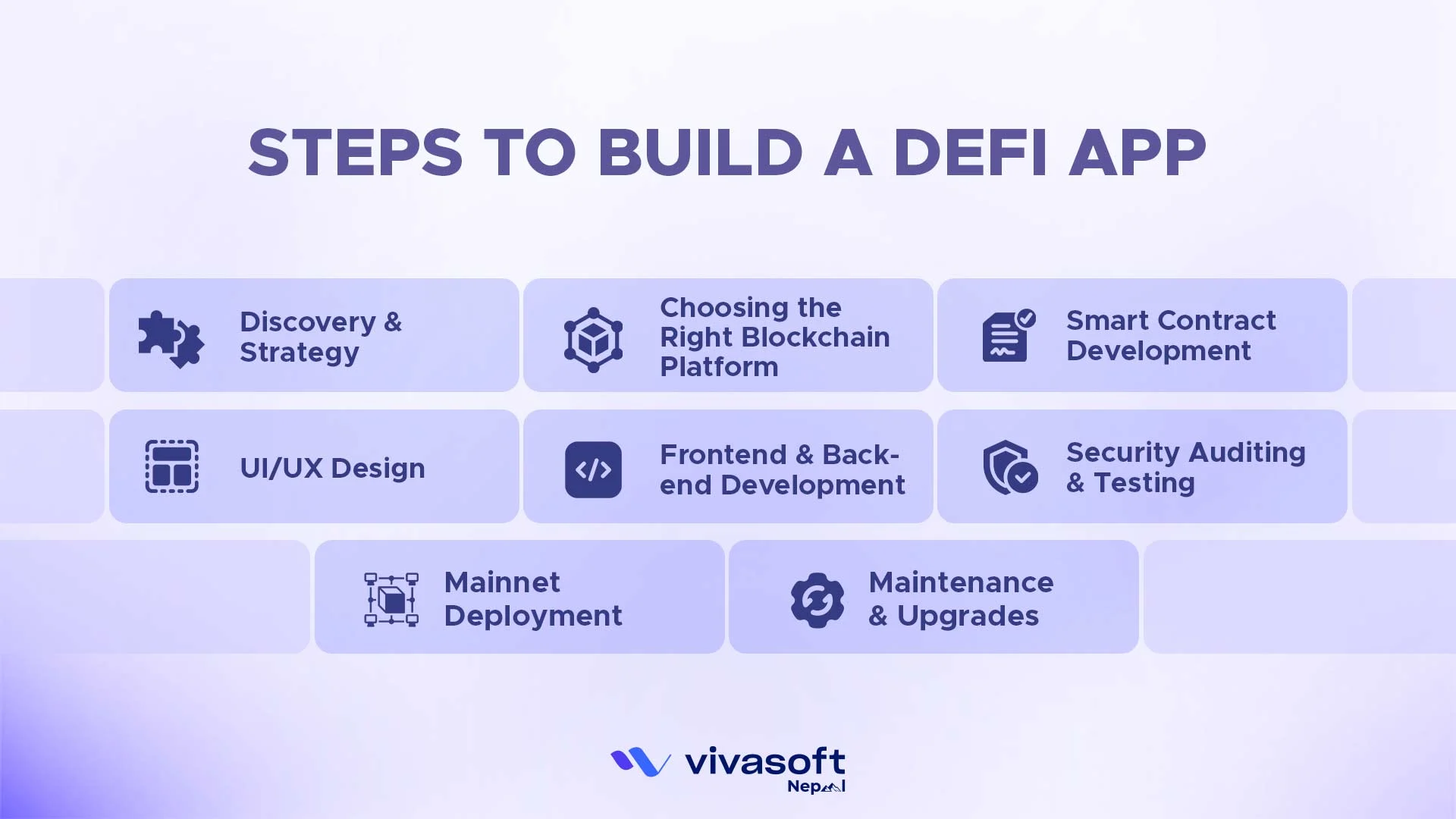
Step 1: Discovery & Strategy
Everything starts here. This phase includes market research, competitor analysis, defining the USP, and shaping the DeFi product roadmap.
Tokenomics design is also critical at this stage. How will tokens be distributed? What incentives attract liquidity? Poor token design can hurt the project even if the tech is solid.
Step 2: Choosing the Right Blockchain Platform
This is probably the most important technical decision. The blockchain you choose affects performance, gas fees, developer ecosystem and scalability.
Comparison of Blockchain Platforms
| Platform | TPS | Gas Fees | Security | Dev Language |
|---|---|---|---|---|
| Ethereum | 15–30 | High | Strong, established | Solidity |
| Solana | 2,000+ | Low | Efficient but newer | Rust |
| BSC | 100–160+ | Low | EVM-compatible, versatile | Solidity |
Note: Numbers may vary depending on network conditions
Key Factors to Consider
Before deciding, consider a few practical things:
- Location: Regulatory environment can influence blockchain choice, especially for enterprise solutions.
- Tech Stack Choice: Developer familiarity matters. Solidity vs Rust changes hiring and development speed.
- Number of Features: Complex platforms may need networks with stronger ecosystem support.
- Security Audit: Some ecosystems have more mature auditing tools and frameworks.
- Smart Contract Complexity: Advanced financial logic may require stronger tooling and developer experience.
Step 3: Smart Contract Development
This is where the business logic is written. Every lending rule, AMM formula, staking reward calculation, it all lives inside the smart contracts.
Gas optimization is really important. If contracts aren’t written carefully, users end up paying more than they should. Following good defi smart contract development practices makes the app more efficient, secure and easier on the wallet.
Step 4: UI/UX Design
Wireframes and prototypes come before final coding. DeFi already feels complex to new users so the interface must build trust. Clear transaction previews, transparent fee displays and simple flows make a big difference.
Step 5: Frontend & Backend Development
This stage connects the interface to the blockchain. Wallet integration (like MetaMask or WalletConnect) is implemented here. Backend services may handle analytics, indexing, notifications and off-chain data management.
Step 6: Security Auditing & Testing
Before mainnet, auditing is mandatory. Third-party firms such as CertiK or Hacken often review the smart contracts.
Testing includes:
- Unit testing
- Integration testing
- Testnet deployment
- Bug fixing cycles
Here’s how security layers usually look:
| Security Layer | Implementation | Purpose |
|---|---|---|
| Smart Contract | Code audits, formal verification | Prevent exploits |
| Frontend | Input validation, secure APIs | Prevent phishing & injection |
| Governance (Time-locks) | Delayed execution of upgrades | Prevent malicious changes |
Step 7: Mainnet Deployment
Once everything is tested and audited, the app is deployed to the live blockchain. At this point, contracts are usually immutable, so confidence must be high before launch.
Step 8: Maintenance & Upgrades
Launch isn’t the end. Monitoring tools track performance and suspicious activity. Community governance proposals may introduce upgrades over time. DeFi products evolve constantly.
How Much Does It Cost to Develop a DeFi App?
The cost of defi app development can vary a lot. It depends on complexity, blockchain choice, feature set and most importantly security requirements. A simple MVP will obviously cost less than a full-scale Decentralized Exchange (DEX) development or enterprise-grade lending protocol.
One thing to be clear about: security audits, experienced developers and proper infrastructure are not cheap. Cutting corners here usually costs more later.
Estimated Cost to Build a DeFi App
Here’s a rough idea (actual numbers vary by region and scope):
| Simple DApp (MVP) | $25,000 – $50,000 |
|---|---|
| Medium Complexity (DEX/Lending) | $60,000 – $150,000 |
| Complex Enterprise DeFi Solution | $200,000 – $500,000+ |
Factors Influencing Cost
Several things directly impact the final budget:
- Team Location: Development costs vary significantly between North America, Europe, and Asia. However, lower hourly rates don’t always mean lower total cost, experience matters.
- Tech Stack Choice: Ethereum-based projects may require more gas optimization and deeper Solidity expertise. Cross-chain setups increase development complexity.
- Number of Features: Adding governance modules, analytics dashboards, oracle integration, or Layer 2 support increases scope quickly.
- Security Audit: Professional smart contract auditing can cost anywhere from $10,000 to $50,000+ depending on complexity. But skipping it is rarely an option.
What Are Tech Stack for DeFi App Development?
Building a DeFi app isn’t just about smart contracts. It’s a multi-layered system; blockchain infrastructure, contract logic, frontend interface, backend services and development tools all working together. Choosing the right stack early can save months of rework later.
- Blockchain Platforms (Layer 1 & Layer 2): The foundation is the blockchain itself. Layer 1 networks like Ethereum, BNB Chain, Solana and Polygon power most DeFi ecosystems. To handle higher transaction volumes and reduce gas fees, many platforms also use Layer 2 scaling solutions such as Optimism or Arbitrum. Understanding blockchain layers is key to choosing the right infrastructure for your DeFi app.
- Smart Contract Languages: Most Ethereum-based DeFi platforms use Solidity for smart contract development. Solana uses Rust which has a different development model. The language choice affects hiring, tooling and long-term maintenance.
- Frontend Technologies: The frontend is usually built with React.js or similar modern frameworks. It connects to the blockchain using libraries like Web3.js or Ethers.js. The goal here isn’t just functionality; it’s clarity. Users need to understand exactly what they’re signing.
- Backend & Storage: Even though DeFi apps are decentralized, some backend components are still needed. Indexing services, analytics, notifications and off-chain storage (like IPFS or cloud databases) support performance and usability.
- Development Environments: Tools like Hardhat, Truffle, Foundry and Remix are commonly used for smart contract development and testing. For monitoring and debugging, teams rely on blockchain explorers and analytics dashboards.
Top DeFi Trends for 2026
DeFi moves fast. What worked two years ago already feels outdated. For CTOs and business owners, staying ahead of trends isn’t about hype, it’s about building products that won’t become irrelevant in a year. The space is maturing and the focus is slowly shifting from speculation to real utility.
Cross-Chain DeFi
Users no longer want to stay locked inside one blockchain ecosystem. Cross-chain bridge development and interoperability solutions are becoming essential. Platforms that allow assets to move between Ethereum, BNB Chain, Polygon and Solana smoothly will likely see stronger adoption. But security in cross-chain bridges remains a big focus area.
Institutional DeFi
Institutions are entering the DeFi space more carefully now. Instead of fully permissionless systems, we’re seeing hybrid models with compliance layers. Enterprise-grade custody, on-chain reporting and regulatory alignment are becoming part of serious decentralized finance platforms.
AI Integration in DeFi
AI is starting to play a role in DeFi analytics, fraud detection and automated trading strategies. Some platforms are experimenting with AI-driven risk scoring for lending protocols. It’s still early but the direction is clear, smarter automation.
Real-World Asset (RWA) Tokenization
Tokenizing real estate, commodities or invoices is gaining momentum. It connects traditional finance with blockchain infrastructure. For enterprises, this could unlock liquidity in ways that weren’t easily possible before.
Decentralized Identity Solutions
Identity is becoming important, especially for compliance and enterprise adoption. Decentralized identity systems allow users to verify credentials without exposing unnecessary personal data. Blockchain identity management plays a key role in making this possible within DeFi platforms.
Conclusion
DeFi is no longer just an experiment running on the edge of crypto Twitter. It’s slowly becoming a serious financial infrastructure layer. From DEX development and lending protocols to staking platforms and stablecoin systems, the opportunities are real but so are the risks.
For CTOs and business owners, defi app development is not just about launching a token or copying an existing protocol. It’s about building something secure, usable and sustainable. Strong smart contract auditing, clear tokenomics, thoughtful UI/UX, and proper risk management modules make the difference between a short-lived project and a long-term platform.
If you’re considering entering the space, choosing the right development partner matters. Working with leading DeFi development companies that understand blockchain architecture, security best practices and enterprise-grade implementation can make all the difference before making your move.
Frequently Asked Questions (FAQ)
How long does it take to develop a DeFi app?
It depends on complexity. A basic MVP with limited features might take around 3–4 months. A full-scale DEX, lending protocol, or cross-chain platform can take 6–12 months, especially if security audits and compliance layers are involved. Rushing this process usually creates more risk than speed is worth.
How to integrate NFTs and stablecoins into my DeFi app?
NFTs can be integrated through smart contracts that follow token standards like ERC-721 or ERC-1155. They’re often used for staking rewards, governance access or asset tokenization. Stablecoins, on the other hand, are usually integrated as liquidity pairs, collateral assets or payment rails. In some cases, businesses also explore custom stablecoin development depending on their model.
How to integrate wallets in DeFi apps?
Wallet integration typically involves connecting the frontend to wallet providers like MetaMask or WalletConnect using Web3 libraries. The app requests transaction signatures directly from the user’s wallet, meaning funds stay under user control. Smooth wallet integration is critical because it’s the main gateway into the platform.
What are the most popular DeFi apps?
Some widely known DeFi platforms include Uniswap (DEX), Aave (lending), MakerDAO (stablecoin protocol), Curve (liquidity pools) and Lido (staking). These platforms helped shape modern decentralized finance platforms, though new models continue to emerge each year.