


A DeFi exchange platform is a blockchain-based system that lets users trade crypto directly with no central authority involved. The market is growing at a pace traditional finance has never seen. The global DeFi market was valued at $26.94 billion in 2025 and is projected to reach $1,417.65 billion by 2033 with a CAGR of 68.2%.
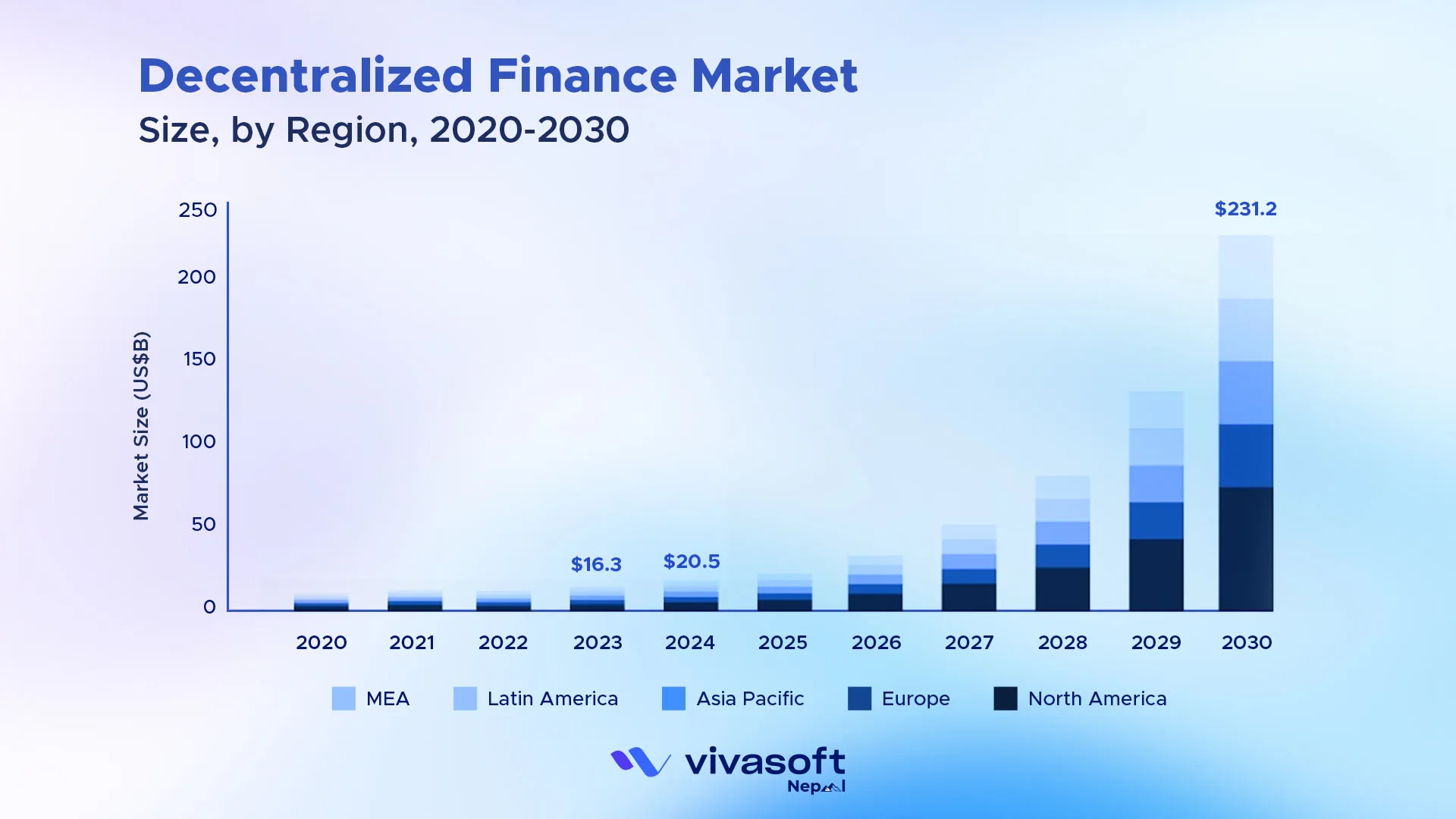
Businesses are actively heading to this market due to some undeniable advantages. DEXs allow users to keep their private keys in their own wallets, which eliminates the risk of platform-wide freezes or insolvency.
Beyond security, businesses are attracted by the lower operational costs and borderless accessibility. However, the overall success depends on how professionally you build the DeFi exchange platform for your business purpose. Read on for an expert Defi exchange platform development guide to learn every nook and cranny about this platform.
What Is DeFi Exchange Platform?
A Decentralized Exchange or DEX is a popular peer-to-peer marketplace where users basically trade cryptocurrencies directly without the need for any central authority or intermediary. It is far different from traditional platforms, where a DEX uses self-executing smart contracts that help manage the transactions. Here, users can retain full control over their private keys and funds. This significantly reduces the risks associated with centralized hacks or management failures.
The platform works as a financial marketplace of the decentralized internet in the Web3 system. Since there are no banks, brokers, or centralized exchanges in the middle, users can freely trade assets. Even more clearly, the financial system becomes more open and transparent. The blockchain code itself handles the liquidity and order matching. Once deployed to the blockchain, the code cannot be easily changed, and ensures that operations remain consistent.
How DeFi Exchanges Differ from Centralized Exchanges?
Decentralized exchanges notably differ from the centralized exchanges as they end the need for central authority control. Users maintain full custody of their funds and preserve their privacy throughout the trading process. On the other hand, CEXs require users to deposit funds into the platform. The platform follows KYC verification and relies on a third party to manage every transaction.
Have this quick comparison table to get a clear idea:
| Factor | Decentralized Exchanges or DEXs | Centralized Exchanges or CEXs |
|---|---|---|
| Control of Funds | Users keep full custody of their assets and private keys. | The exchange holds and manages user funds (custodial). |
| Authority | No central authority; smart contracts manage trades. | Operated and controlled by a company or organization. |
| Privacy | Usually requires little or no personal information. | Most platforms require KYC identity verification. |
| Transaction Process | Trades execute automatically through blockchain smart contracts. | The platform processes and approves transactions internally. |
| Liquidity | Typically, higher liquidity due to large user bases. | Often, lower liquidity depends on the trading pair. |
| Trade Speed | May be slower due to blockchain network confirmation. | Faster trade execution through internal systems. |
| Security Model | Users control security by managing their own wallets. | Platform security protects funds but also creates a central risk point. |
| Accessibility | Anyone with a crypto wallet can trade. | Users must create an account and follow platform rules. |
Why Businesses Are Investing in DeFi Exchange Platform Development?
Businesses are investing in DeFi exchange platform development to offer secure and transparent financial services. With the DEX spot market share more than doubling from 6.9% in January 2024 to 13.6% in January 2026, companies are gaining the real opportunity to reduce reliance on intermediaries. Moreover, it helps lower operational costs and reach a growing global Web3 user base.
1. Demand for Decentralized Trading
Modern traders increasingly demand privacy and 24/7 market accessibility over traditional hours. Focusing on this, businesses are launching DEXs to capture this global user base. Even DEX trading volume rose ~37% in 2025, with an average monthly volume of around $412 billion.
Users want direct peer-to-peer trading and more flexible access to global markets. To meet this demand, platforms are improving user interfaces and cross-chain compatibility. This makes decentralized trading more accessible for both beginners and experienced traders.
2.Control Over Funds
Users are getting frustrated with centralized exchanges. This not only snatches full access and control over their funds but also increases the risk of platform hacks and withdrawal limits. DeFi removes this problem entirely, allowing users to retain full custody of their assets.
Moreover, with private keys and wallets under their control, users get the flexibility to trade, deposit, or withdraw anytime without any third-party disturbance. A recent survey shows that 59% of crypto wallet users globally in 2025 prefer non‑custodial platforms.
3. Lower Operational Costs
Users often struggle with the hidden fees and overhead costs of centralized exchanges. This includes trading commissions, withdrawal costs, custody fees, and even expensive compliance processes. For example, Binance, the world’s largest CEX, charges $15–$50 per wire withdrawal and €1–€5 per SEPA transfer. More notably, it still requires multiple verified accounts to access full features.
By eliminating intermediaries and automating most functions with smart contracts, DeFi exchanges reduce these pain points. Even smart contracts replace manual processes automatically. The cost advantage provides DeFi businesses with a structurally leaner operation from day one.
4. DeFi Ecosystem Growth
Users often face limitations on centralized platforms. This is like a restriction on access to advanced financial services or lending opportunities. The DeFi ecosystem solves this issue by offering a wide range of interoperable services. Like decentralized lending, borrowing, or staking.
Moreover, as the ecosystem grows, platforms become more connected. Businesses can get higher opportunities for users to maximize returns and access global markets. Businesses are investing in innovation to attract developers and liquidity providers. This improves platform reliability and the overall user experience.
How Does DeFi Exchange Platforms Work?
A DeFi exchange runs entirely on blockchain technology. For instance, the smart contract self-executes under set conditions and records every transaction directly to the blockchain. There is no hassle of human intervention. Even without a central authority, users don’t have to wait for approval.
Smart Contracts
Smart contracts are likely the core for every DeFi trade. They are self-executing code that runs automatically only when the preset conditions are met. Basically, when a trade is placed, the smart contract makes everything ready to verify and execute.
Finally, it records it on the blockchain instantly. The overall process runs without human intervention. This makes every transaction transparent and consistently reliable.
Automated Market Makers (AMM)
DeFi exchanges price tokens without a traditional order book. It utilizes a special mechanism named AMMs. Instead of matching buyers with sellers, this uses a mathematical formula, mainly to price tokens automatically based on pool ratios. Moreover, as demand for the token increases, its price adjusts instantly based on the available supply within the pool. All in all, the whole process is fully automated with no counterparty dependency.
Liquidity Pools
In order for someone to swap one cryptocurrency for another on a DeFi exchange, there needs to be tokens available always. Liquidity pools run this function. For instance, users called liquidity providers deposit equal values of two tokens into a smart contract. In return, they earn a proportional share of every trading fee generated from that pool. However, pools with high trading volume generate more fees, so LPs earn more. This incentive structure keeps pools consistently funded and the exchange fully operational.
Token Swapping
Token swapping is where all components of the DeFi exchange come together. This is like users are connecting their wallets, selecting a token to swap, and the smart contract executes the trade automatically. Here, the AMM calculates the price, and the liquidity pool provides the funds. All done, even in the shortest times. There is no hassle of account registration or intermediary.
Key Components of DeFi Exchange Platform Development
A DeFi exchange platform runs on multiple elements. Such as smart contracts, AMMs, and liquidity pools to ensure secure and automated trading for global users. Get a clear overview:
| Component | Description |
|---|---|
| Smart Contracts | Self-executing code that automatically handles every trade on the platform. When a user starts a trade, the smart contract verifies the conditions. It processes the transaction and records it on the blockchain. |
| Liquidity Pools | Pools of tokens locked into smart contracts by users, called liquidity providers. These pools work as the reserve that powers every trade on the platform. |
| Blockchain Network | The underlying infrastructure that records and validates every transaction on the platform. It is likely a permanent, public ledger that no single party can control or alter. |
| Wallet Integration | The connection point between users and the exchange. Users connect their crypto wallets to access the platform directly. |
| Security Protocols | The connection point between users and the exchange. Users connect their crypto wallets to access the platform directly. |
| Security Protocols | This is the set of technical safeguards that help protect the platform. This includes smart contract audits or multi-signature authorization. |
Key Features of a DeFi Exchange Platform
A DeFi exchange is only as strong as the features powering it. These are the core features that separate such a reliable, high-performance platform from an average one.
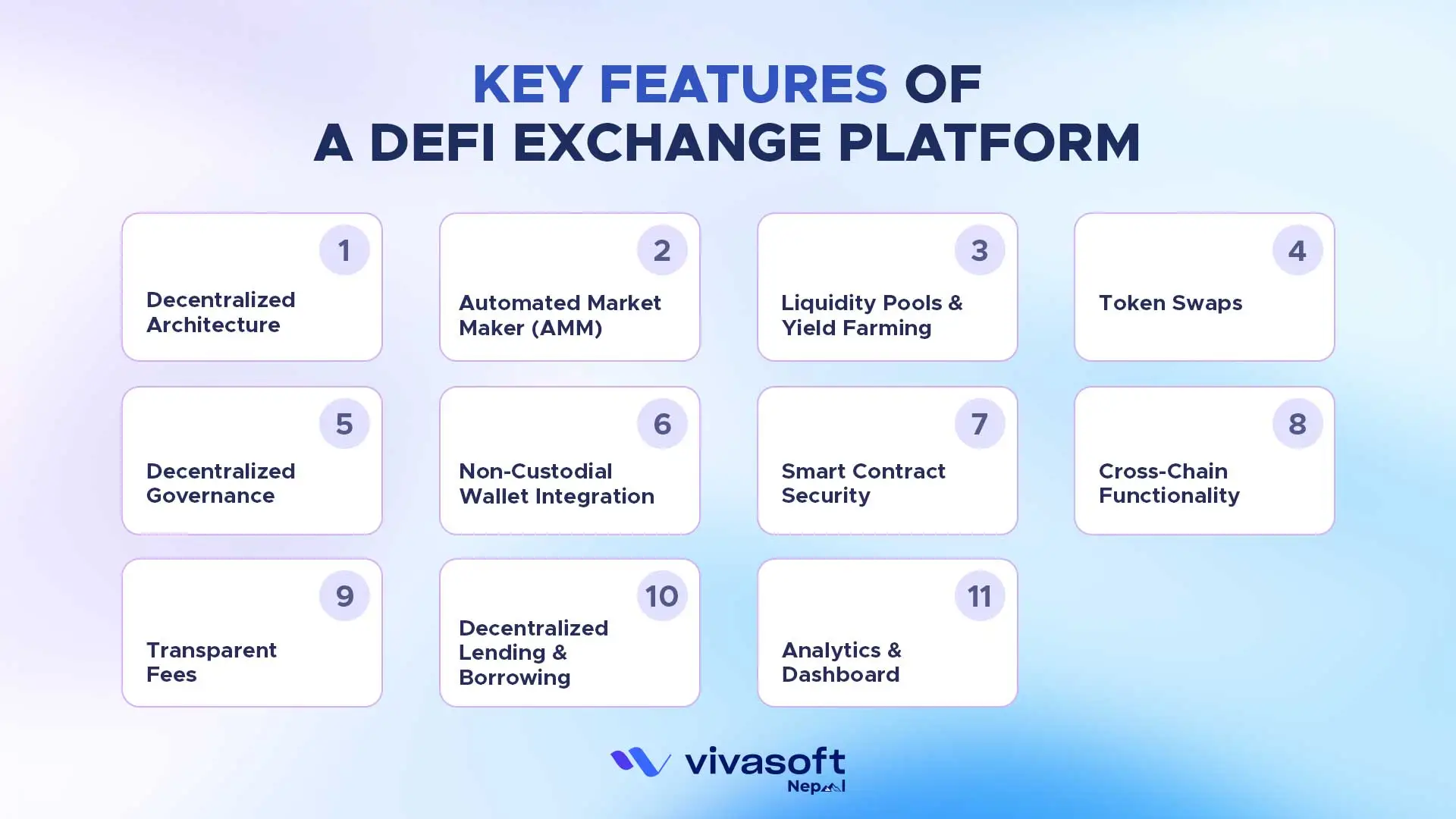
- Decentralized Architecture: The platform mainly runs on a distributed blockchain network with no central server. Every transaction is processed and validated across thousands of independent nodes. This ensures exchanges are operational and fully transparent at all times.
- Automated Market Maker (AMM): This specialized mechanism replaces the traditional order book with a mathematical pricing formula. This helps adjust token prices automatically based on demand and supply availability. There is no chance of delays or mistakes.
- Liquidity Pools & Yield Farming: Users provide token pairs to pools, which supply funds for AMMs. In return, they earn fees or yields and ensure liquidity.
- Token Swaps: Token swaps let users exchange cryptocurrencies instantly. The overall functionality depends on the AMMs and liquidity pools. It offers a transparent and peer-to-peer trading experience for all connected users.
- Decentralized Governance: Token holders have the ability to participate in decisions. They can vote on upgrades, fee structures, and protocol changes. Every vote is recorded on-chain.
- Non-Custodial Wallet Integration: Users connect personal wallets to trade directly and get full control of their funds. This supports all operations, from token swaps to lending.
- Smart Contract Security: Every platform function, whether it is liquidity deposits or governance votes, runs through audited smart contracts. This guarantees that user funds are safe.
- Cross-Chain Functionality: The platform enables asset trading across multiple blockchains. This means users are not restricted to a single network.
- Transparent Fees: All the underlying fees are completely visible and predictable. Users can know the cost details while swapping tokens, providing liquidity, or lending/borrowing.
- Decentralized Lending & Borrowing: Users can lend or borrow directly through smart contracts. The platform utilizes wallet integration and security protocols that make the overall infrastructure efficient and safe.
- Analytics & Dashboard: Users can access real-time dashboards to track trades, liquidity, fees, and yields. They can monitor performance and make informed decisions.
What Are the Benefits of DeFi Exchange Platform Development?
Turning to a DeFi exchange drives your business directly into one of the fastest-growing financial markets today. Your platform will go beyond just generating revenue streams by bringing innovation to how it operates entirely.
- Cost Reduction: DeFi exchanges remove the overhead costs of intermediaries and custodial infrastructure. Smart contracts automate delivery functions directly and reduce operational expenses.
- Enhanced Security: Users’ funds stay secure in personal wallets throughout every transaction. This removes the risks of central attack surfaces that have caused billions in losses on custodial exchanges.
- Global Accessibility: A DeFi exchange is typically accessible to anyone with a crypto wallet and an internet connection. There are no restrictions from geography or banking status, and anyone can participate in financial markets.
- Multiple Revenue Streams: A DeFi exchange generates income through trading fees and liquidity pool commissions. It also generates revenue through yield farming incentives and governance token sales, operating simultaneously from a single platform.
- User Control: Users maintain complete ownership of their assets at every stage of the trading process. This helps build deeper trust and directly reduces user churn over the long term.
- Scalability: DeFi platforms scale without operational challenges. As user volume grows, smart contracts handle the increased load automatically.
- Innovation Potential: DeFi’s open-source architecture allows developers to build new financial products directly on top of the exchange. This composability turns a single platform into a launchpad for lending protocols and entirely new asset classes.
- Transparency: Every single element, from transactions and fees to smart contract rules, is permanently recorded on a public blockchain. Users, auditors, and regulators can verify platform activity at any time.
- Liquidity Provision: Liquidity providers deposit assets into pools and earn continuous fee income in return. This incentive structure attracts capital organically.
- Community Governance: Token holders vote directly on platform upgrades or fee structures. This shared ownership model increases user investment in the platform’s success.
What Are the Common Challenges in DeFi Exchange Platform Development?
DeFi exchange platform development have some notable technical and regulatory challenges:
- Smart Contract Vulnerabilities: Even a single error in the smart contract code can cause the entire platform to be hampered. It is not like traditional software, where you can easily patch deployed smart contracts. This risk can be handled by strong pre-launch auditing through professionals. Smart contract exploits caused $1.42 billion in losses across 149 documented incidents in 2024 alone.
- Scalability Issues: When there are too many transactions on a blockchain at the same time, the chances are that the network becomes overloaded. It slows down the transaction confirmation. Often, it causes higher fees and frustrates the users.
- Regulatory Uncertainty: The rules and laws for the DeFi platforms are still changing. With the regulations change, developers often face challenges to keep the platform fully compliant. Often it is difficult to design a platform that is legally stable for the long-term.
- Liquidity Fragmentation: When liquidity is spread across many pools and different blockchains, it becomes harder to trade efficiently. Traders often face higher prices in that case. Even solutions like Layer 2 networks, which reduce congestion, can split liquidity further and create challenges for connecting different protocols.
- Oracle Manipulation Risks: DeFi platforms run on external data oracles to find the real-world asset prices. This way, attackers can manipulate price feeds and hamper smart contracts. Even many of the largest companies worldwide faced DeFi hacks.
- Impermanent Loss: Liquidity providers face impermanent loss when the price ratio of their deposited tokens changes constantly. This reduces their actual returns compared to simply holding the assets. A November 2025 report by 1inch found that 50% of liquidity providers are losing money due to impermanent loss.
- User Experience Barriers: Beginners may get confused with the DeFi platform and related technical terms. They may struggle with connecting wallets. Often, they lack knowledge on how to handle gas fees and liquidity pools. At worst, they give up before completing their first trade.
- Interoperability Challenges: Most DeFi platforms are developed on a single blockchain. This limits users and assets on other networks. Building an effective cross-chain functionality requires a complex setup. These are often hard to develop and can lead to security risks.
- Security Threats: Beyond smart contract bugs, DeFi platforms face flash loan attacks and often front-running exploits. These threats can result in notable financial losses. It also loses the user’s trust if there is a lack of implementation of the security measures.
- Decentralization Trade-offs: Full decentralization causes slower decision-making. This mostly creates delays in implementing urgent security fixes. The main challenge is balancing community control with operational efficiency.
Step-by-Step DeFi Exchange Platform Development Process
Professional developers go through a structured process to develop an efficient and scalable DeFi exchange platform.
- Step 1: Market Research & Planning: All you need to do is start by analyzing the DeFi market and target users. You also need proper knowledge of the competing exchanges. This way, you will define the core features and other technical requirements before development begins.
- Step 2: Choose the Blockchain Network: Now is the time to select a blockchain that perfectly matches your platform’s goals for speed and cost. Ethereum offers the largest developer support, but at a higher price. But Polygon offers a cost-efficient Layer 2 solution. It is good for high-volume trading platforms.
- Step 3: Smart Contract Development: Next, developers create smart contracts that handle core functions. Such as token swaps, liquidity pools, and governance. A professionally executed smart contract automates transactions and ensures operations run securely.
- Step 4: UI/UX Development: You have to design an intuitive interface that makes trading simple for users. The platform should have a clean dashboard and an easy wallet connection. It helps improve the user experience.
- Step 5: Security Testing & Auditing: Finally, you have to conduct thorough testing and professional audits. This way you can detect vulnerabilities in smart contracts and platform logic.
- Step 6: Deployment & Launch: Once the testing is done, deploy the platform on the chosen blockchain network. When it is live, you can onboard users and start operating the exchange in the market.
Technology Stack for DeFi Exchange Platform Development
The technology stack you choose defines how your platform performs. Here are the major technologies you will need to develop a scalable DeFi exchange platform:
| Layer | Technologies |
|---|---|
| Blockchain Network | Ethereum, BNB Chain, Solana, Polygon, Avalanche |
| Smart Contracts | Solidity, Rust, Vyper, OpenZeppelin, Hardhat, Truffle |
| Frontend | React.js, Next.js, Vue.js, Web3.js, Ethers.js |
| Wallet Integration | MetaMask, WalletConnect, Coinbase Wallet, Trust Wallet, Rainbow |
| Oracle / Data Feeds | Chainlink, Band Protocol, Pyth Network, UMA |
How Much Does DeFi Exchange Development Cost?
DeFi exchange platform development costs typically range between $25,000 to $220,000 or more. The prices vary depending on your development approach, feature set, and blockchain choice. However, a custom-built platform from scratch costs significantly more.
| Development Factor | Estimated Cost |
|---|---|
| Development Tech Stack | $6,000 – $10,000 |
| Platform Type | $3,000 – $4,500+ |
| Liquidity Integration | $4,000 – $25,000+ |
| Complexity & Features | $25,000 – $110,000+ |
| Compliance Management | $1,000 – $10,000+ |
| Security Features | $3,000 – $50,000+ |
| Third-Party Integrations | $1,200 – $3,000 |
| Support & Maintenance | $2,000 – $4,000 / month |
What Are the Factors that Affect the Cost of Developing a DeFi Exchange Platform?
The cost to develop a DeFi exchange platform significantly varies based on some essential factors.
- Blockchain Selection: The blockchain you choose affects development cost and even the speed of the development. Some of the advanced platforms, like Ethereum, require higher gas optimization and security work. On the other hand, you can expect Solana and BNB Chain to offer faster and more affordable transactions for high-volume trading platforms.
- Feature Complexity: The more advanced features your platform includes, the higher the development cost you need to consider. If you are integrating some advanced features like AMMs, staking, lending, and analytics dashboards, it will require additional smart contract logic and testing that increases the price.
- Security Audits: Security audits are a must if you launch a DeFi exchange. Professional auditors will review your smart contract code and identify vulnerabilities and logic flaws. Through this cost consideration, you can ensure the platform remains secure and protects user funds.
- Liquidity Setup: Liquidity is critical for functional trading. You may need to spend an extra $4,000–$25,000 or more to partner with liquidity providers. This usually happens through rewards like yield farming incentives.
Examples of Successful DeFi Exchange Platforms
Several DeFi exchanges have already proven the model works at scale. They are already processing billions in daily trading volume and serving millions of users. Let’s have a quick glance at some real-world cases.
Uniswap
Uniswap is the largest DEX by Total Value Locked and the platform that introduced the AMM model for decentralized trading. As of mid-2025, the platform holds approximately $4.5 billion in TVL across all supported chains. Uniswap’s average daily trading volume in 2025 ranges between $1–2 billion. With its v4 upgrade, it introduces advanced improvements that make it one of the most technically proficient DEXs operating today.
PancakeSwap
PancakeSwap is the leading DEX on Binance Smart Chain, mainly known for its low fees and fast transactions. Utilizing the AMM, it allows users to swap tokens directly and provide liquidity to earn rewards. In June 2025, PancakeSwap broke its own record with $325 billion in monthly trading volume. Beyond that, it recorded 7.4 million unique users in Q2 alone.
SushiSwap
SushiSwap started as a Uniswap fork in 2020 but has now evolved into a fully independent multi-chain DeFi platform. The platform is deployed on more than 30 networks, including Ethereum and Polygon. It allows users to swap tokens and offer liquidity, through which users can earn rewards via staking and yield farming.
Curve Finance
Curve Finance is built specifically for stablecoin and pegged-asset trading. Instead of a traditional AMM formula, Curve uses a specialized bonding curve algorithm. It is designed to keep prices stable and minimize delays during swaps. Due to its efficient design, it has become one of the most efficient platforms for large stablecoin trades.
Future Trends in DeFi Exchange Platform Development
The DeFi exchange platforms are growing at a consistent pace, and there are some new innovations you can expect:
- Cross-Chain Interoperability: Users no longer want to trade on a single blockchain. They demand consistent access to assets across every major network. Focusing on this factor, the platform is kept innovative with technologies. It offers seamless cross-chain swaps and integrated liquidity pools, through which users move assets quickly.
- Layer-2 DeFi Platforms: Layer-2 networks are becoming the go-to place for DeFi projects. It is offering almost the same security as Ethereum but with much lower fees. For instance, Arbitrum holds $16.63 billion in TVL, whereas Base holds $10 billion.
- AI-Driven Trading Protocols: AI is not just fundamentally changing how DeFi exchanges operate. Rather, it involves the platform from the static smart contracts to platforms that optimize autonomously. Aave, Compound, and Uniswap are already integrating AI models to automate risk management.
- Institutional DeFi Adoption: Enterprise businesses are moving to move money through DeFi, and this will change how liquidity works. Major banks, hedge funds, and asset managers are actively building their DeFi strategies. As with the growing entrance, businesses are bringing professional risk management and compliance standards. This improves liquidity and platform security.
DeFi Exchange Platform Development: FAQs
How long does it take to build a DeFi exchange platform?
It typically takes 3 to 9 months to develop a custom DeFi exchange. It varies depending on the complexity of its features and security’s requirements.
How do DeFi platforms generate revenue?
DeFi platforms mainly generate revenue through transaction fees, withdrawal charges, and liquidity provider commissions.
What services are included in DeFi exchange platform development?
There are several stages to developing a DeFi exchange platform. This includes selection, secure smart contract development, intuitive UI/UX design, testing, and many more.
Why is smart contract auditing essential for DeFi exchanges?
A thorough smart contract audit is a must to ensure that the platform’s code is free from serious errors that could lead to a total loss of user funds.
Which blockchain network is best for launching a DeFi exchange?
Ethereum remains the top choice to develop and launch a DeFi exchange, due to smart contract functionality and first-mover advantage.
How do developers ensure liquidity in new DeFi exchanges?
Developers incentivize early users to deposit funds into liquidity pools. They do this with yield farming incentives and trading fee shares, which keep the platform fully operational from day one.
What security practices protect DeFi exchange platforms?
Some of the must-have security practices in DeFi exchanges include smart contract audits, multi-signature authorization, and real-time on-chain monitoring.
How can startups launch a DeFi exchange platform successfully?
Start by selecting a blockchain according to goals, defining platform features, and planning liquidity strategies. The best is that you can work with an experienced DeFi exchange development company to ensure the platform launches with expert auditing.