


Finance is changing fast. DeFi short for decentralized finance isn’t just a buzzword anymore. By 2026, it’s part of how people lend, borrow, trade and even stake money. Decentralized finance is taking off because it removes the middlemen like banks and let people interact directly through smart contracts. This shift isn’t just technical, it is changing the way we think about money and trust.
This makes DeFi smart contract development a key focus for the developers and businesses alike. These contracts handle complex financial logic, ensure trustless operations and automate transactions in a ways traditional systems can’t. Getting them right is critical because even small errors can have a major financial consequences, making smart, secure and efficient DeFi contract development more important than ever.
What Is DeFi Lending Platform Development?
DeFi lending platform development means building a peer-to-peer financial system for lending and borrowing digital assets without traditional intermediaries. These platforms allow users to deposit crypto assets into liquidity pools to earn interest and borrowers to take loans against collateral. Here, smart contracts autonomously govern interest calculation, collateralization, liquidations, and repayments.
From an architectural standpoint, a DeFi lending platform typically consists of
- Liquidity pools
- Smart contracts
- Collateralization mechanism
- Interest rate models
- Price oracles
- Automated liquidation engine
- Governance and risk controls
What Are the Types of DeFi Lending Platforms?
DeFi lending platforms allow users to lend and borrow crypto in a decentralized way. Here, some platforms focus on pooled liquidity, peer-to-peer loans, and some collateral models, or DAO-based governance models.
1. Pooled Liquidity Lending Platforms
It is the most common DeFi lending model. In this model, users supply their assets to share liquidity pools, and the borrowers can borrow from it as long as they meet the collateral requirements. In the pooled liquidity lending platforms, interest rates are automatically set based on the utilization of the pool.
Ultimately, the model supports continuous lending and borrowing without even requiring a direct connection between lenders and borrowers. This model scales well because it does not require direct matching of lender and borrower.
| Traits | Pooled Liquidity Lending Platforms |
|---|---|
| Best for | Lenders seeking passive yield and borrowers requiring instant access to funds |
| Key Features |
|
| How it works | Users deposit funds into a common pool, and borrowers draw from it with collateral. Interest is adjusted based on pool utilization. |
| Development Complexity | Medium to high |
| Examples | Aave, Compound Finance, Venus Protocol, Morpho |
2. Peer-to-Peer (P2P) Lending Platforms
In Peer-to-Peer (P2P) Lending Platforms, lenders and borrowers connect more directly. Here, the terms of the loans, like interest rates, duration, and collateral ratios, are not set by the pool. Instead, they are decided on a case-by-case basis.
That’s why the peer-to-peer DeFi lending platform model is more flexible. However, it is less common due to lower liquidity and additional complexity of connecting counterparties on chains.
| Traits | Peer-to-Peer (P2P) Lending Platforms |
|---|---|
| Best for | Borrowers who want to embrace flexibility and investors wanting reap returns |
| Key Features | Direct decentralization of lending and borrowing between users |
| How it works | Borrowers post loan terms, and lenders choose loans. Smart contracts lock collateral |
| Development Complexity | High |
| Examples | MakerDAO, dYdX, and Fulcrum |
3. Overcollateralized Lending Platforms
In the overcollateralized lending platforms, the borrowers need to provide crypto assets that are worth more than they are borrowing. In this model, borrowers deposit a certain amount of digital assets on the platform as collateral.
As the platform has high volatility of the digital asset prices, these platforms require overcollateralization. Here, borrowers can get a corresponding amount of assets based on the collateral value.
| Traits | Overcollateralized Lending Platforms |
|---|---|
| Best for | Borrowers who want liquidity without selling assets and lenders seeking secured loans |
| Key Features | Collateral deposition is worth more than the loan, Automatic liquidation triggers, Smart contract enforcement. |
| How it works | The user locks crypto as collateral>loan value. The protocol sets a loan-to-value ratio. If collateral drops too low, smart contracts liquidate assets to repay lenders. |
| Development Complexity | Medium-High |
| Examples | MakerDAO, Compound, and Aave |
4. Under-Collateralized Lending Platforms
In under-collateralized or credit lending models, borrowers don’t need to provide traditional collateral. Instead, collateralization depends on their credit history or reputation in the community.
Here, borrowers need to provide credit proof or third-party-backed documents. Although the platform lowers borrowing barriers, it requires a robust and transparent credit evaluation system to ensure success.
| Traits | Under-Collateralized Lending Platforms |
|---|---|
| Best for | Institutional borrowers, businesses, borrowers, or users who lack sufficient collateral. |
| Key Features | Loans with lower-than-loan-value collateral, Credit-based determination |
| How it works | Platforms assess borrower risk using on-chain/off-chain data or reputation systems, and lenders supply capital. |
| Development Complexity | High |
| Examples | Maple Finance, Goldfinch, TrueFi, Teller Finance |
5. Flash Loan Platforms
As for flash loan lending platforms, it’s a DeFi-native mechanism that is generally grouped with lending. In these models, the platform provides uncollateralized loans that use the atomic properties of blockchain transactions. That means if repayment doesn’t happen within one block, the transaction is automatically reversed, so lenders face no loss.
It allows users to borrow large amounts of money in a single transaction. Because of this design, flash loans enable capital-efficient operations like arbitrage and collateral swaps. However, it carries technical and execution risks.
| Traits | Flash Loan Platforms |
|---|---|
| Best for | Advanced traders, arbitrageurs, and DeFi developers |
| Key Features | Uncollateralized borrowing, Instant execution within a single transaction |
| How it works | A borrower requests assets, executes arbitrage, or swaps. Then repays everything in the same transaction, or the loan is canceled. |
| Development Complexity | High |
| Examples | Aave, dYdX, Uniswap flash swaps |
6. Cross-Chain Lending Platforms
Cross-chain lending platforms let users lend and borrow assets across multiple blockchains. They solve liquidity fragmentation by connecting separate blockchain networks. That’s why borrowers and lenders can interact without moving assets manually.
These platforms use secure cross-chain messaging protocols like LayerZero, Wormhole, and Axelar. They track collateral, execute loans, and manage repayments across networks, enabling more efficient multi-chain lending markets.
| Traits | Cross-Chain Lending Platforms |
|---|---|
| Best for | Users needing broader liquidity and multi-chain capital access |
| Key Features | Multi-chain lending, Cross-chain liquidity, Interoperable smart contracts |
| How it works | Assets and loans interact across chains via secure cross-chain protocols |
| Development Complexity | Very high |
| Examples | Radiant Capital, Maple Finance, Cosmos Ecosystem |
7. Isolated Pool Lending Platforms
Isolated pool lending platforms create separate lending markets for each asset or asset pair instead of pooling all assets together. That’s why, in these platforms, risk, liquidity, and collateral requirements are customized to each isolated pool. As a result, problems in one pool don’t affect others.
By segregating assets into isolated pools, these platforms help prevent incidents across DeFi markets. For example, if a volatile token suffers a price crash or exploit, only the isolated pool tied to that asset is affected. The rest of the protocol remains secure.
| Traits | Isolated Pool Lending Platforms |
|---|---|
| Best for | Lenders/borrowers who want asset-specific risk control and protection |
| Key Features | Separate and isolated lending pools for each supported asset, Cross-contamination prevention |
| How it works | Each asset or asset runs its own pool. That’s why risks and liquidity are isolated |
| Development Complexity | High |
| Examples | Silo Finance |
8. DAO-Governed Lending Platforms
DAO-governed lending platforms token holders vote on rules, supported assets, and risk parameters using smart contracts. There is no central team making all decisions. So, these platforms promote transparency and fairness.
By using DAOs, lending platforms can adapt to the community’s needs and manage risk effectively. Users not only lend and borrow crypto but also participate in governance.
| Traits | DAO-Governed Lending Platforms |
|---|---|
| Best for | Crypto users who want a voice in the platform’s decisions. |
| Key Features | Community voting, Transparent governance, Protocol upgrades decided by token holders |
| How it works | Governance token holders propose and vote on changes |
| Development Complexity | High |
| Examples | Uniswap, Aave, Yearn Finance |
Top DeFi Lending Platforms
The following are the leading DeFi lending platforms that allow users to supply crypto to earn interest or borrow assets through decentralized and smart contract-based markets.
1. Aave
- Total value locked: $26.07 Billion
- Supported networks: 11+ blockchains
- Launch year: 2020
Aave is one of the most established and most influential open source protocols, helping you create non-custodial liquidity markets. That means with Aave, your funds remain under your control and managed by smart contracts on the chain. On top of that, it has consistently ranked among the top platforms by total value locked (TVL) with approximately $57.33 billion in assets locked as of January 2026.
It lets you earn interest on supplying and borrowing assets with a variable interest rate. Aave operates across multiple blockchains, including Ethereum, Polygon, Avalanche, Optimism, and others.
Best for
- Users wanting to earn interest on crypto holdings by supplying assets
- Borrowers who need permissionless access to loans
- Advanced DeFi users are using flash loans and composable DeFi strategies.
Strengths
- Operates across many Layer-1 and Layer-2 networks
- Permissionless access
- Passive yield
- Transparency & auditability
- Integrates with DEXs, vaults, and other protocols
Limitations
Over-collateralization required
Smart contract vulnerabilities
Liquidation risk
2. Compound
- Total value locked: $1.396 Billion
- Supported networks: 9 blockchains
- Launch year: 2018
Compound is an algorithmic and autonomous interest rate protocol. It allows users to earn interest from their crypto holdings. Compound was one of the first lending markets on Ethereum, launching in 2018 and helping DeFi’s early growth.
Compound uses algorithmic interest rates based on market supply and demand. Suppliers receive cTokens that earn interest. On the other hand, borrowers need to over-collateralize their loans. The protocol is governed by COMP token holders, who vote on upgrades and risk parameters.
Best for
- Earning yield on crypto by supplying assets
- Borrowers needing permissionless access to loans
- Users interested in decentralized governance via COMP tokens
Strengths
- Verified smart contract audits
- Verified smart contract audits
- No intermediary for lending and borrowing
- Offer farming opportunities
Limitations
- Only supports selected crypto assets.
- Poor decisions by COMP token holders could impact users.
- APY can spike from 5% to 50% during high demand.
3. MakerDAO
- Total value locked: $ 5.510 Billion
- Supported networks: Ethereum
- Launch year: 2017
With more than 400 platforms integrating DAI, MakerDAO showcases the composability superpower of DeFi. That means you built once and integrated everywhere. The protocol lets you mint DAI stablecoins by locking up crypto collateral like ETH or WBTC in Vaults.
Here, loans are over‑collateralized to maintain stability and governed by the governance token MKR. Holders regularly vote on governance proposals and implement them. As DAI is widely used in lending, trading, and earning interest, it makes MakerDAO a key protocol in DeFi.
Best for
- Creating DAI by locking up crypto as collateral
- Using a USD‑pegged token across many DeFi platforms participating in protocol decisions through MKR tokens.
Strengths
- Decentralized governance
- Stablecoin assurance
- Financial inclusivity
- Ethereum-based system
Limitations
- Reliance on blockchain
- Uncertain regulation
- Complex for users
4. Morpho
- Total value locked: $5.707 Billion
- Supported networks: Ethereum and other EVM-compatible blockchains.
- Launch year: 2022
Morpho is another leading DeFi platform offering non-custodial and permissionless infrastructure built on Ethereum. The protocol matches liquidity on a peer-to-peer basis. As a result, it has a 100% capital utilization rate, delivering more efficient rates for both sides. If no direct match exists, the loan is matched with liquidity from underlying lending pools. Thus, it ensures ongoing liquidity and yield generation.
Best for
- Lenders earn higher yields by lending directly to borrowers.
- Borrowers to access loans at lower interest rates.
- DeFi users participate in flexible and customizable lending markets.
Strengths
- P2P matching
- Fallback to pools
- Non-custodial design
- Custom markets support
- Wide token support
Limitations
- Smart contract and liquidation risk
- Network dependencies
- Limited track record
5. Euler
- Total value locked: $508.89 Million
- Supported networks: Ethereum
- Launch year: 2021
Euler is a modular decentralized DeFi protocol that lets you lend and borrow many types of cryptocurrencies without giving up control of your funds. You can supply crypto to earn interest or borrow assets in a flexible and permissionless way.
The protocol also uses algorithmic interest rates that change based on supply and demand. It can also add new token markets without central approval. Euler has risk isolation tiers to prevent problems in one market from affecting others, and EUL token grant holders govern upgrades and risk settings.
Best for
- Lenders who want to earn yield on many different crypto assets.
- Borrowers who need flexible loan options and cross‑asset borrowing.
Strengths
- Customization
- Risk isolation
- Innovative features
- Permissionless listing
Limitations
- Complexity and lower liquidity
- Experimental nature
- Can be difficult to navigate
6. JustLend
- Total value locked: $3.103 Billion
- Supported networks: TRON blockchain
- Launch year: 2020
JustLend dominates the TRON ecosystem as the protocol offers fast and low-cost lending/borrowing across 19 mainstream markets. It lets users supply TRON‑based assets, such as TRX and TRC‑20 tokens, to earn interest and borrow other assets by using crypto as collateral.
Its algorithm automatically adjusts Interest rates. Moreover, the protocol issues jTokens to lenders as receipts that accrue interest. JustLend DAO governs it through the native JST token.
Best for
- Users who want to earn interest by supplying TRON assets
- Borrowers who want to take loans without selling their crypto
- People active in the TRON DeFi ecosystem
- Holders of the JST governance token
Strengths
- Low transaction costs
- Fast processing
- TRON ecosystem integration
- Energy Rental
Limitations
- Network limitation
- Smaller DeFi ecosystem
- Uncertain regulation
- Innovation limitation
7. Maple Finance
- Total value locked: $2.061 Billion
- Supported networks: · Ethereum and Solana
- Launch year: 2021
Maple provides undercollateralized lending for institutions and individuals looking for high-quality yields and capital. The platform offers curated and accessible lending for borrowers and fixed-income opportunities for lenders on the chain.
Maple operates through lending pools managed by Pool Delegates. He assesses credit risk and approves loans, and lenders provide liquidity and earn interest. The protocol also offers a retail-facing arm called Syrup that lets everyday users access yields from institutional-quality credit markets.
Best for
- Borrowers needing access to credit without strict over-collateralization
- Lenders seeking fixed income-style yields
- DeFi users who want exposure to professional lending opportunities via Syrup pools.
Strengths
- Offers institutional-grade lending
- Supports both secure and undercollateralized loans
- Syrup pools offer access to institutional credit
- Cross-chain presence improves accessibility.
Limitations
- Under-collateralized lending carries default risk
- Pool performance depends on the Pool Delegate.
- Limited secondary liquidity
What Makes a DeFi Lending Platform Best?
A leading DeFi platform doesn’t just offer high yields. They offer safety and efficiency at the same time. These platforms perform well even under stress, not only when the market is high.
- Security maturity: Security is the primary criterion of DeFi best platform evaluation. You should look for frequent audits, active bug bounties, and a major exploit-free history. DeFi platforms that survive market crashes show higher user protection.
- Liquidity depth: Deep liquidity in the DeFi platform keeps the lending and borrowing efficient. Moreover, it prevents huge changes in rates when there are large loans. Plus, this consistent liquidity attracts more users and retains more capital.
- Cross-chain support: The best platforms can perform on multiple platforms. Ultimately, it offers you more ways to use your funds. You can move your money between different networks without worrying about complicated bridges. It makes the DeFi platform more connected for both parties.
- Risk management system: A strong DeFi platform doesn’t leave its users exposed to sudden losses. Instead, it efficiently adjusts how much you can borrow and lend based on market changes. Moreover, these platforms use reliable price feeds and automatically handle liquidations when necessary.
- Governance structure: A DeFi platform uses a hybrid governance model. It’s a balanced and multi-layered approach that uses the decentralized and community-driven nature of DAOs. When the governance of a DeFi platform is transparent and balanced, users trust those platforms more. Plus, it can handle problems better.
- RWA integration: Beyond trading and liquidity, some DeFi platforms let you use real-world assets or RWA as a source of security and collateral. Like bonds or real estate. It adds a layer of stability in the DeFi platforms as these assets have a legal and verifiable value. Moreover, it offers you more ways to invest in things other than crypto.
- Institutional compatibility: Naturally, investors on DeFi platforms need efficient adaptation and integration of tools to follow regulations and track their funds properly. So, the platforms with institutional compatibility can safely handle large amounts of money. It makes these DeFi platforms more reliable and attractive for regular users and investors.
What Are the Biggest Problems in DeFi Lending?
Although DeFi lending has transformed how users access credit and earn yield, it still faces significant challenges that hinder wide adoption and long-term stability. Here are the biggest ones.
1. Overcollateralization
Most DeFi platform requires stablecoin collateral at 150–180%. That means borrowers need to deposit $150 worth of crypto to borrow $100. Ultimately, it limits accessibility and capital efficiency. In 2025, the collateralization ratio was around 151–157%.
2. Capital Inefficiency
As the assets need to remain locked as collateral, they can’t be used for other yield-generating activities. Like trading, staking, or investing. It reduces the efficiency of deployed capital where large portions of usable assets sit idle instead of earning additional returns.
3. Exploits
Security risks are also at rise with DeFi platforms. In 2025, DeFi losses from hacks and exploits reached approximately $3.1 billion. Here, flash-loan attacks cause about 58% of all losses, and cross-chain bridge accounts account for roughly $620 million in losses.
4. Regulatory Uncertainty
DeFi operates in a largely undefined legal landscape in many jurisdictions. It creates uncertainty for developers, users, and institutions. Regulators are still figuring out how to enforce compliance with anti-money-laundering (AML) and know-your-customer (KYC) rules.
How Does DeFi Lending Platforms Work?
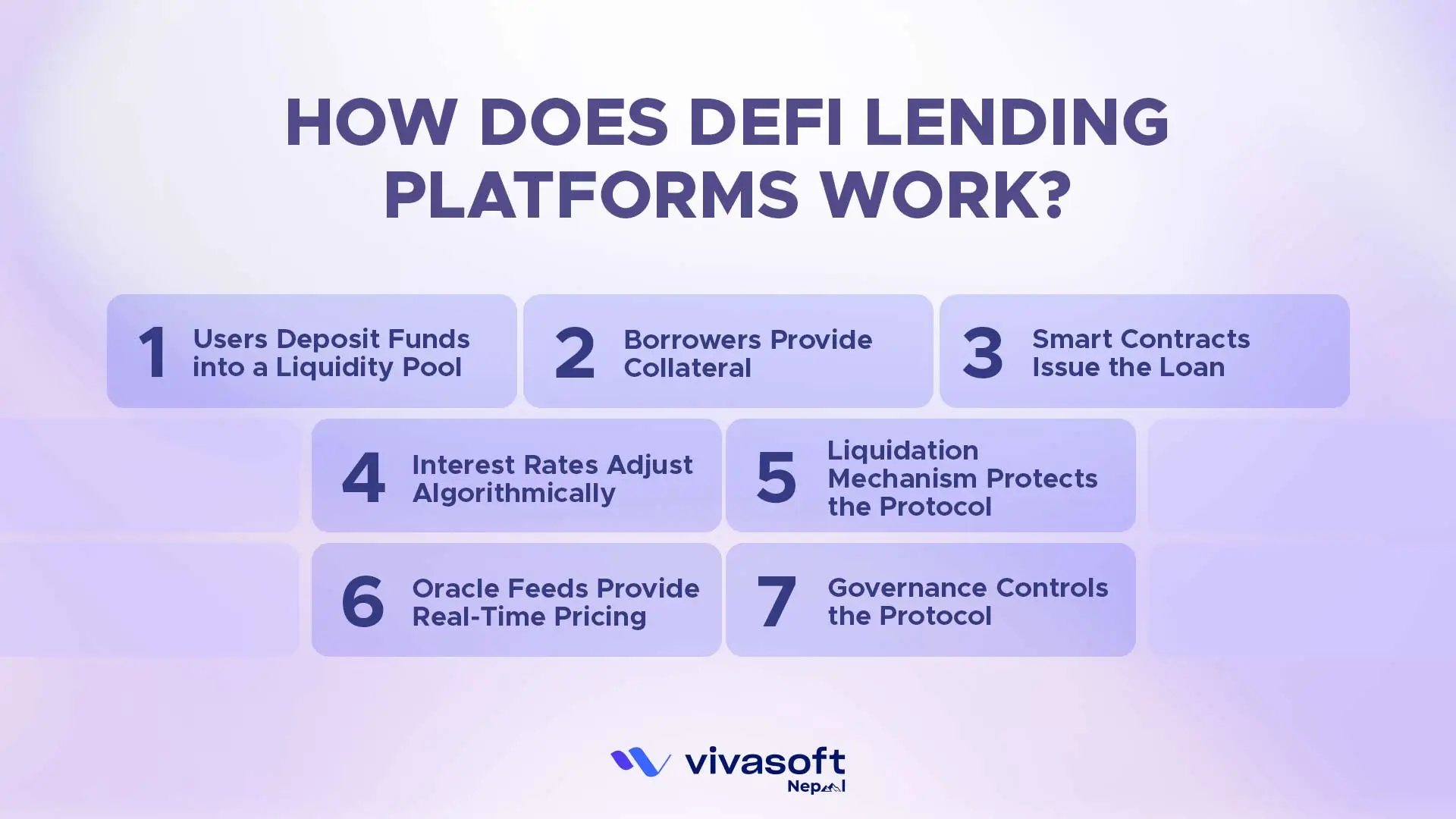
- Step 1: Users Deposit Funds into a Liquidity Pool: Lenders connect their crypto wallets and deposit assets like stablecoins or ETH into a pooled smart contract. This liquidity pool aggregates funds from all lenders, making capital available for borrowers.
- Step 2: Borrowers Provide Collateral: Borrowers lock up collateral that is greater than the loan value. This over-collateralization ensures the protocol remains solvent even if asset prices fall.
- Step 3: Smart Contracts Issue the Loan: Smart contracts verify collateral, calculate borrowing limits, lock collateral, and transfer funds automatically. There is no bank, no manual approval, and no intermediary.
- Step 4: Interest Rates Adjust Algorithmically: Interest rates are often algorithmic. It adjusts automatically based on pool supply, borrowing demand, and utilization rate. It ensures balanced borrowing costs and incentivizes liquidity.
- Step 5: Liquidation Mechanism Protects the Protocol: When the collateral falls below required thresholds, it automatically enables liquidation. Liquidators repay part of the loan and receive discounted collateral, keeping the system solvent.
- Step 6: Oracle Feeds Provide Real-Time Pricing: Decentralized oracles like Chainlink and Pyth Network ensure accurate real-time asset prices to smart contracts. It enables smart contracts, accurate collateral valuation, and liquidations when necessary.
- Step 7: Governance Controls the Protocol
Many DeFi lending protocols include governance mechanisms. It allows stakeholders to vote on interest rate models, supported assets, collateral ratios, and protocol updates. It maintains decentralization and protocol adaptability.
What are the Technology Stack for DeFi Lending Development?
When it comes to building DeFi lending platforms, it requires reliable and multi-layered technology stacks to ensure performance and security. Here’s an overview.
Blockchain Layer (Core Infrastructure)
The blockchain layer is the foundation of any DeFi lending platform, as it’s where smart contracts live and run. So, cost, speed, and security of the platform depend on your right blockchain selection.
Here, Ethereum remains a top choice for most projects as it has a large ecosystem and strong security. However, its gas fees can be high. As for Layer‑2 options, Arbitrum and Optimism offer lower cost while staying compatible with Ethereum. Moreover, you can consider Polygon for cheaper transactions, Solana for fast execution, or BNB Chain for low‑cost rollouts.
Smart Contract Layer
The smart contract layer manages the core DeFi platforms, lending, and borrowing. It includes lending pools, collateral management, interest models, liquidations, governance, and flash loans. The smart contract layer ensures transparency of the platform and removes the need for intermediaries.
Here, most platforms use
- Solidity for Ethereum, BSC, and Polygon
- Vyper for security-focused contracts
- Rust for Solana-based lending.
Developers often rely on Hardhat, Foundry, or Truffle frameworks to write, test, and deploy these contracts efficiently.
Oracle Integration
In DeFi lending, oracles offer reliable real-time price data to smart contracts. It ensures correct collateral valuation and triggers liquidations when necessary.
In this regard, Chainlink, Pyth Network, and Band Protocol are the leading oracle providers. They feed external data securely on-chain and prevent manipulation. Moreover, Oracle integration helps maintain the stability and trustworthiness of the lending platform.
Backend & Indexing Layer
Even though the core logic of a DeFi platform runs on-chain, it relies on backend services for efficient performance. Backend services handle data indexing, analytics, dashboard updates, notifications, and off-chain governance.
Developers generally choose Node.js, Python (FastAPI/Django), and Go backend technologies for DeFi. As for indexing tools, The Graph, custom indexers, and subgraphs make it easier to get and organize on-chain data efficiently.
Frontend (Web & Mobile Interface)
Like backend, frontend is essential for user adoption in the DeFi platforms. Frontends ensure clear design and responsive interfaces for the users to deposit, borrow, and track assets very easily.
Common frontend stacks include React.js or Next.js, with optional Vue.js and Tailwind CSS for styling. Platforms use Web3.js or Ethers.js to connect directly to the blockchain. Users connect MetaMask, WalletConnect, or Coinbase Wallet to manage their funds. They can also use hardware wallets to secure and access assets easily.
Security & Audit Tooling
Security is a non-negotiable requirement of the DeFi platform. Here, developers run static analysis tools like Slither, MythX, and Echidna to catch vulnerabilities early. Moreover, they test smart contracts with unit tests, fuzzing, and formal verification.
On top of that, platforms also work with audit firms and run bug bounty programs. Teams manage funds through multi-signature wallets to prevent unauthorized access and keep assets safe.
DevOps & Infrastructure
DeFi platforms are decentralized. Still, it needs a reliable infrastructure to operate efficiently. The team uses AWS, Google Cloud, or DigitalOcean for hosting. Moreover, they use Docker and Kubernetes to manage containers.
As for continuous integration and delivery, DeFi lending platforms generally use GitHub Actions or GitLab CI to keep updates fast and secure.
Optional Advanced Components
Advanced DeFi lending platforms also integrate extra features to stand out among the competitors. For instance, Cross-chain bridges and AI-based risk scoring. They allow assets to move between blockchains and enhance lending decisions simultaneously.
Platforms can also include on-chain analytics dashboards, DAO governance modules, or real-world asset tokenization layers to enhance functionality and give users more control.
How to Build a DeFi Lending Platform (Step-by-Step)?
Well, it may sound complex to build a DeFi platform; however, understanding the steps clearly can make the process manageable. Check the step-by-step guide below.
Step 1: Market Research
First off, do extensive research and understand the market. It helps to ensure your platform meets the real user needs and stands out from the competitors. Here’s what you need to look for:
- Know your competitor: Understand the competitors of your chosen niche. Study what they are doing right or where they’re falling short.
- Understand your user needs: Identify whether you’re targeting everyday users, retail investors, institutions, or crypto enthusiasts. Customize the features around their expectations.
- Check for regulations: Check for local and global rules. Ensure to consider compliance early as it’ll help to avoid legal headaches down the road.
Step 2: Tokenomics Design
Tokenomics is like the engine of your DeFi platform. It’ll keep the platform running efficiently and will motivate the users to participate. Here, a good model answers two critical questions: Why would someone use your token? How will it keep value over time?
That means a solid tokenomics design combines utility and incentives. So, first define the purpose of the token, like governance tokens, reward tokens, or utility tokens. Then, set incentives that encourage users to participate and carefully plan distribution.
Step 3: Smart Contract Development
Smart contracts handle every function of a DeFi lending platform like lending, borrowing, calculating interest, and managing collateral. So write contracts that are secure, organized, and easy to upgrade. Then choose a strong blockchain like Ethereum with Solidity, as it has a reliable ecosystem and good tools.
Now you’ve added features to lock collateral, calculate interest, and handle liquidations. Lastly, connect your contracts to price feeds and test everything carefully using internal and external audits.
Step 4: UI/UX Development
A good UI/UX makes your DeFi platform easy and comfortable to use. So, design your layout in a way that users can quickly find main actions like lending or borrowing.
Moreover, show interest rates, collateral requirements, and fees clearly so users always know what’s actually happening. You can also add tooltips, short explanations, and FAQs to guide your users without overwhelming them.
Step 5: Security Audit
Have a security audit of your DeFi platform’s smart contracts and architecture for bugs, vulnerabilities, or hidden risks before launch. In this step, auditors review code and run automated tools to find common issues. For instance, logic errors, reentrancy, or weak access controls. Audits enhance platform security and build trust as it ensures no major flaws remain undetected.
Step 6: Deployment
The debut of your platform requires careful planning so that everything runs efficiently after launch. Before deployment, you can run beta tests and engage your community early. It’ll help to gather feedback and build excitement. Plus, ensure your liquidity pools are ready for smooth transactions.
On launch day, monitor performance and fix issues quickly. You can offer rewards or airdrops to attract early users. Lastly, share the launch extensively on social media, forums, and newsletters.
How Much Does It Cost to Develop a DeFi Lending Platform?
As for the DeFi lending platform development cost, it can be anywhere from tens of thousands to hundreds of thousands of dollars. However, the price varies widely depending on architecture, multi-chain capability, liquidity logic, flash loan integration, external audits, and the level of security and governance you need.
Here is an overview of the typical DeFi lending platform development cost.
| Type | Typical Cost Range (USD) | Features |
|---|---|---|
| MVP | USD 80,000 to USD 120,000 | Basic lending and borrowing, Simple collateral logic, Limited tokens supported, Single-chain deployment, Basic wallet connection |
| Mid Scale | USD 120,000 to USD 250,000 | Multi-asset pools, Dynamic interest, Basic governance, Improved dashboards, Advanced collateral management |
| Enterprise Grade | USD 250,000 to USD 450,000+ | Cross-chain support, DAO governance, Institutional modules, Complex risk engines, Extensive security audits |
Legal and Regulatory Considerations for DeFi Lending Platforms
DeFi lending platforms operate on rapidly changing legal requirements, but the rules around them are still catching up. Regulators are trying to adapt financial laws to decentralized systems that lack a central authority.
- AML/KYC Compliance: Anti-money laundering (AML) and Know Your Customer (KYC) obligations are central to financial regulation. Global bodies such as the Financial Action Task Force (FATF) expect jurisdictions to assess illicit finance risks from DeFi arrangements and apply AML/CFT requirements.
- Securities Laws: DeFi tokens and financial products may fall under securities regulations if they meet criteria similar to traditional securities. International bodies such as IOSCO work to apply existing securities principles and investor protection standards to decentralized products and services.
- Licensing Requirements: DeFi platforms may be required to get financial licenses or register with regulatory bodies that offer financial services, including lending or custody. Moreover, they require ongoing compliance with AML and reporting rules.
- Tax Reporting: DeFi transactions can also have tax implications for income recognition on interest earned or capital gains on assets. Regulators are requiring clear reporting standards for users to comply with national tax laws.
- Consumer Protection: Regulatory frameworks aim to protect users by encouraging clear disclosures about fees, risks, and rights. Although traditional consumer laws apply to centralized financial services, regulators increasingly consider disclosures and fair practices in DeFi products also.
- Smart Contract Audits: Smart contracts automatically execute lending and financial operations. However, audits are not mandated by law everywhere yet. Still, regulators and standards bodies recommend third-party security assessments to ensure code compliance and reduce the risk of failures.
- Jurisdictional Geofencing: As DeFi platforms operate globally, and even without a central office, platforms may voluntarily implement geofencing. It helps to comply with local laws and prevent users in restricted regions from using services.
- Data Privacy: DeFi platforms that collect personal information for AML/KYC must also comply with the data protection laws of the respective regions. It includes rules on how personal information is collected, stored, and used on the platforms.
- DAO Governance: Decentralized Autonomous Organizations (DAOs) operate many DeFi protocols. It may raise questions about liability and accountability in legal disputes. That’s why regulators check how DAOs make decisions and follow the law.
- Oracles and Stability: Oracles provide external data to smart contracts. And here, manipulated oracle data can destabilize lending markets. That’s why regulators emphasize the need for reliable oracles to protect users and maintain market integrity.
How Vivasoft Nepal Helps You Build a DeFi Lending Platform?
Vivasoft Nepal brings real experience in DeFi lending platform development with deep industry insights and customer-centric approaches. By taking advantage of agile development, secure smart contracts, and scalable DeFi architecture, Vivasoft Nepal creates platforms that are both reliable and user-friendly.
Trusted by 50+ global companies, the team handles everything from DAO integration to Layer 2 scaling. On top of that, the company provides post-launch support to keep platforms running efficiently and on budget. With hands-on experience, the DeFi development service of Vivasoft Nepal helps businesses launch DeFI lending platforms with confidence.
DeFi Lending Platform Development: FAQs
What are the biggest technical risks when developing a DeFi lending platform?
Mistakes in the smart contracts, errors in lending or borrowing logic, or problems with price updates pose the biggest risk for the DeFi platform development. These can cause losses or stop the operation completely.
How do DeFi platforms prevent cascading liquidations during market crashes?
DeFi uses fast liquidation incentives and frequent price updates from oracles to mitigate the risk of cascading liquidations. Moreover, it employs circuit breakers to pause liquidations during severe market turbulence.
What role do oracles play in DeFi lending protocols?
Oracles in the DeFi platforms bring real-world data like prices or events into the platform. It allows DeFi applications to create more complex and flexible financial products for users.
How do DeFi platforms ensure scalability as user demand increases?
DeFi platforms use efficient blockchain networks and layer‑2 solutions in this regard. Moreover, they optimize smart contracts and infrastructure so that they can handle more users and transactions without slowing down.
What is the long-term outlook for DeFi lending?
DeFi lending platforms have strong long-term potential as their adoption is continuously growing. In 2026, the DeFi market is growing at a CAGR of 26.43% and is expected to reach USD 770.56 billion by 2031.
How Do DeFi Lending Platforms Make Money?
DeFi lending platforms have strong long-term potential as their adoption is continuously growing. In 2026, the DeFi market is growing at a CAGR of 26.43% and is expected to reach USD 770.56 billion by 2031.