


The internet has changed a lot over time. It started with simple websites in Web1 then moved into the social media and platform heavy world of Web2. Now, things are shifting again with Web3 which is trying to make the internet more open and less controlled by big companies.
At the center of this shift is decentralized finance or DeFi which is slowly changing how people send, store and manage money around the world. You’ve probably heard these terms being mentioned more often lately but understanding what they actually mean can still feel confusing. This guide will helps to break things down in a simple way and show why this new phase of the internet matters.
What Is Web3 and Decentralized Finance?
Web3 in simple terms is the next generation of the internet; one that runs on blockchain technology and is built around the idea that users should actually own their data, their assets and their digital identities. Right now in the Web2 world we’re all used to companies like Google, Meta or Amazon are essentially holding everything for you. Your photos, your contacts, your purchase history; it all lives on their servers. Web3 tries to flip that. Instead of trusting a company to hold your stuff, ownership is built into the system itself through decentralized networks where no single entity is really in charge.
DeFi short for decentralized finance is the financial system that’s been built on the top of Web3 infrastructure. Think about everything a bank does : savings accounts, loans, currency exchange, investments. DeFi tries to recreate all of that but without the bank. Instead of a loan officer approving your application, a smart contract handles it automatically. Instead of waiting for business hours, everything runs 24/7. And instead of needing a good credit score or a specific nationality, anyone with a crypto wallet and internet access can participate. It’s not a perfect system; there are real risks but the core idea is pretty straightforward: financial services that are open to everyone.
Web3 vs Traditional Finance
These two systems are built on completely different foundations; one requires trust in institutions, the other is designed to work without that trust entirely.
| Development Phase | Maximum Estimated Cost (USD) | Minimum Estimated Cost (USD) | Time Estimate |
|---|---|---|---|
| Discovery & planning | $5,000 | $15,000 | 1–2 weeks |
| UI/UX design | $8,000 | $20,000 | 2–4 weeks |
| Smart contract development | $15,000 | $60,000 | 4–8 weeks |
| Backend & API integration | $12,000 | $40,000 | 4–7 weeks |
| Frontend development | $10,000 | $30,000 | 4–8 weeks |
| Blockchain integration | $8,000 | $25,000 | 3–6 weeks |
| QA & security audits | $10,000 | $50,000 | 2–5 weeks |
| Post-launch support & updates | $5,000 | $20,000+ | Ongoing |
The Relationship Between Web3 and DeFi
If Web3 is the operating system then DeFi is one of the most powerful apps running on it. The blockchain itself is the infrastructure , it’s a shared, tamper resistant ledger that records every transaction without needing any central authority to verify things. That’s the foundation. On top of that, smart contracts act as the execution engine. They’re essentially programs that run automatically when certain conditions are met; no one needs to approve anything manually, no one can really interfere once the contract is deployed.
Put those two things together and you have everything you need to recreate financial products like lending, borrowing, trading, earning interest without any of the traditional infrastructure. No headquarters, no compliance department, no customer service hold music. Just code running on a decentralized network.
Key Difference Between Web3 vs DeFi
A lot of people use these terms like they mean the same thing but they don’t; not exactly. Web3 is the whole ecosystem; DeFi is just one part of it, specifically the financial part.
Is DeFi a Subset of Web3?
Yes DeFi is a subset of Web3 but Web3 is a much bigger thing. Web3 also covers NFTs, decentralized social networks, on-chain gaming, supply chain verification, identity systems and a bunch of other stuffs that has nothing to do with finance directly. DeFi is specifically focused on the money side of things : lending, trading, earning yield, derivatives, stablecoins all the financial stuff.
A simple way to think about it Web3 is the city DeFi is the financial district. The city has hospitals, schools, parks and a residential neighborhoods. But the financial district runs on the same infrastructure and follows the same basic rules as everything else.
Quick Comparison Between Web3 and DeFi
| Development Phase | Maximum Estimated Cost (USD) | Minimum Estimated Cost (USD) | Time Estimate |
|---|---|---|---|
| Discovery & planning | $5,000 | $15,000 | 1–2 weeks |
| UI/UX design | $8,000 | $20,000 | 2–4 weeks |
| Smart contract development | $15,000 | $60,000 | 4–8 weeks |
| Backend & API integration | $12,000 | $40,000 | 4–7 weeks |
| Frontend development | $10,000 | $30,000 | 4–8 weeks |
| Blockchain integration | $8,000 | $25,000 | 3–6 weeks |
| QA & security audits | $10,000 | $50,000 | 2–5 weeks |
| Post-launch support & updates | $5,000 | $20,000+ | Ongoing |
Why Web3 and DeFi Are Disrupting Traditional Finance?
Traditional finance has worked the same way for a very long time and honestly, it works fine if you’re in the right country with the right document and the right bank account. For a lot of people, though , it doesn’t work well at all. That’s the gap Web3 and DeFi are filling.
The Traditional Finance Bottleneck
- Slow settlement: A cross-border wire transfer can take 3 to 5 business days. That’s because it moves through multiple correspondent banks, each doing their own reconciliation. DeFi transactions settle in seconds sometimes minutes.
- Geographic restrictions: There are roughly 1.4 billion unbanked adults worldwide. Most of them aren’t unbanked by choice; they’re excluded because banks don’t find them profitable to serve. DeFi protocols don’t make that calculation.
- Intermediaries: Every financial product you’ve ever used such as a mortgage, a stock trade, a savings account passed through multiple layers of middlemen. Each one takes a cut. Those costs add up and they’re ultimately paid by the end user.
How Web3 Powers Decentralized Finance?
- Borderless capital: A user in Nigeria and a user in Germany interact with the exact same smart contract, on equal terms. There’s no geographic tier system in DeFi.
- Tokenized assets: Physical assets like property, commodities, even shares in a company can be represented as tokens on a blockchain making them easier to fractionalize, trade and use as collateral.
- Programmable money: Smart contracts let you program rules directly into financial transaction. Automatic loan repayments, yield distributions, governance decisions all of it happens without anyone pressing a button.
What Are the Core Components of the Web3 DeFi Ecosystem?
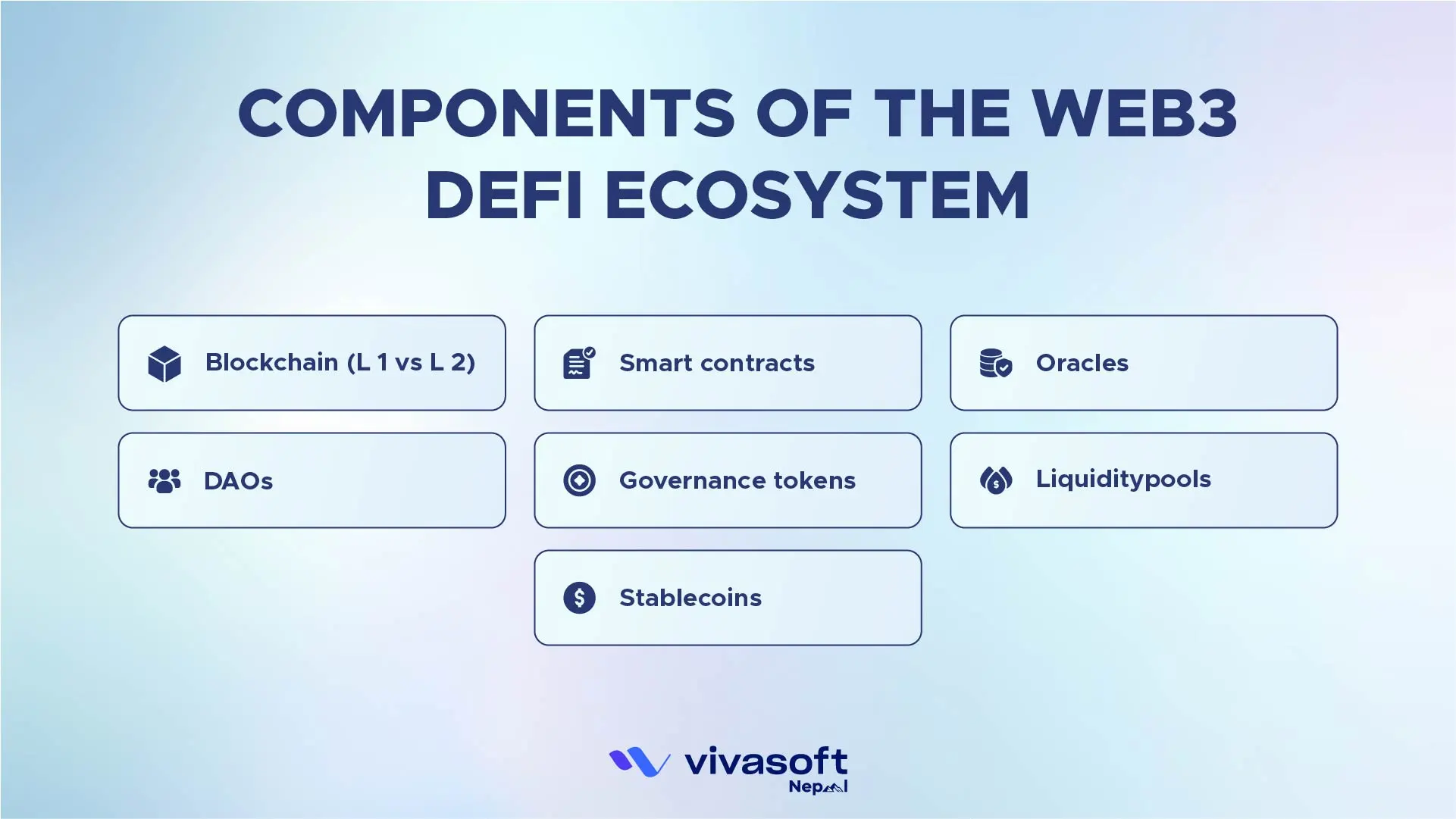
DeFi isn’t one product or one platform it’s an interconnected set of components, each doing a specific job. Understanding what each piece does makes the whole thing a lot less confusing.
1. Blockchain (Layer 1 vs Layer 2)
Layer 1 is the base blockchain Ethereum being the most used for DeFi. It is secure and decentralized but it can get slow and expensive when there’s a lot of traffic. Layer 2 networks like Arbitrum, Base, and Optimism are built on top of Layer 1 to process more transactions at lower cost. Most active DeFi users today are doing at least some of their activity on Layer 2.
2. Smart Contracts
Smart contracts are the core building block of every DeFi protocol. They’re programs that live on the blockchain and execute automatically when condition are met. Once deployed, they generally can’t be changed which makes them reliable but also means bugs can be catastrophic. Every time you interact with a DeFi platform, you’re interacting with a smart contract.
3. Oracles
DeFi smart contracts often need real-world data like the price of ETH, or the current yield on US Treasuries. But blockchains can’t access external data on their own. That’s what oracles do; they’re services that pull real world information and feed it to smart contracts. Chainlink is the most widely used. Oracles are critically important and, honestly, often underappreciated when people assess protocol risk.
4. DAOs
A DAO Decentralized Autonomous Organization is how DeFi protocols govern themselves. Instead of a board of directors or a CEO making decisions; token holders vote on proposals. Changes to fee structures, protocol upgrades, treasury spending; all of it goes through the DAO. It’s a genuinely different model of governance, though it has its own problems, including low voter participation.
5. Governance Tokens
Governance tokens are what give you voting rights in a DAO. They often also have economic value; sometimes significant value. Common examples are UNI for Uniswap, AAVE for the Aave protocol and COMP for Compound. Holding these tokens mean you have a say in how the protocol evolves.
6. Liquidity Pools
Instead of matching buyers and sellers like a traditional exchange, many DeFi platforms use liquidity pools. These are pools of tokens locked in a smart contract. When you want to swap one token for another, you’re trading against the pool, not against another person. People who deposit tokens into these pools earn a share of the trading fees.
7. Stablecoins
Stablecoins are tokens pegged to a stable asset usually the US dollar. USDC, USDT and DAI are the most widely used. They let user stay in the DeFi ecosystem without holding volatile assets like ETH or BTC. Pretty much every DeFi strategy involves stablecoins in some way.
What Are the Risks Associated with Web3 Decentralized Finance?
DeFi is genuinely exciting but it carries a real risks and some of them are serious. Understanding what can go wrong is honestly more useful than just knowing what can go right.
1. Smart Contract Vulnerabilities
Every DeFi protocol runs on code and code can have bugs. When a smart contract has a vulnerability, attackers can sometimes exploit it to drain funds and because transactions on the blockchain are irreversible, there’s no getting that money back. Even protocols that have been professionally audited have been hacked. The Poly Network exploit drained over $600 million in 2021.
2. Rug Pulls and Exit Scams
A rug pull is when the people behind a project usually anonymous developers deliberately abandon it and take user funds with them. It’s more common with newer, unaudited tokens. The warning signs are usually there if you know what to look for: anonymous teams, unrealistic APY promises, no audit, concentrated token ownership.
3. Oracle Manipulation
If an attacker can manipulate the price feed that a smart contract relies on, they can trick the protocol into doing things it shouldn’t. Flash loan attacks often work this way; borrow a massive amount of capital, distort a price momentarily, exploit the distortion, repay the loan. All in one transaction.
4. Cross-Chain Bridge Exploits
Bridges let you move assets between different blockchains, and they’ve been targeted more than almost any other part of the DeFi stack. The Ronin bridge hack in 2022 resulted in a $625 million loss. Bridges are complex and often newer than the protocols they connect which makes them inherently riskier.
5. Regulatory and Legal Uncertainty
Regulators around the world are still figuring out what DeFi actually is and how to handle it. Some countries have moved to restrict access others are building out frameworks. This uncertainty creates real risk; a protocol you use today might become inaccessible in your jurisdiction tomorrow.
6. Gas Fees and Network Congestion
When Ethereum gets busy, transaction fees spike. During peak periods, simple swaps have cost hundreds of dollars in gas. Layer 2 networks help a lot, but fee management is still something DeFi users need to understand and account for.
7. Security Best Practices Checklist
- Use a hardware wallet for significant holdings
- Only interact with audited, established protocols
- Revoke unused token approvals regularly
- Never share your seed phrase with anyone, ever
- Verify contract addresses through official channels
- Start with small amounts when trying new protocols
How to Start with Web3 DeFi?
Getting into DeFi for the first time can feel overwhelming; there are a lot of moving parts. But if you take it step by step; it’s more approachable than it looks.
Step 1: Choose a Non-Custodial Web3 Wallet
Non-custodial means you hold your own private keys; the exchange or app doesn’t hold them for you. MetaMask and Rabby are popular browser based options for beginners. If you are planning to hold significant value; a hardware wallet like a Ledger or Trezor is worth considering. When you set up your wallet you’ll receive a seed phrase of 12 or 24 words that act as the master key to your funds. Write it down on paper. Store it somewhere safe and offline. Do not take a screenshot, do not type it anywhere, do not share it with anyone.
Step 2: Fund Your Wallet
The easiest way to get started is to buy crypto on a centralized exchange like Coinbase, Binance or Kraken are all commonly used and then transfer it to your wallet. If you’re new and not ready to deal with price volatility, start with a stablecoin like USDC. It stays at $1 and lets you explore DeFi without the stress of watching your balance swing 20% overnight.
Step 3: Connect Wallet to Web3 DeFi Apps
Most DeFi apps have a “Connect Wallet” button somewhere prominent on the page. Click it, choose your wallet, approve the connection. From there, when you interact with the protocol making a swap, depositing funds, whatever it is; you’ll be asked to sign a transaction in your wallet. Take a second to actually read what you’re signing before confirming. For businesses or developers looking to build on this infrastructure; a DeFi app development partner can help bring more customized solutions to life.
Step 4: Understand Gas Fees and Network Selection
Ethereum mainnet can be expensive, especially during busy periods. Most beginners are better off starting on a Layer 2 like Arbitrum, Base, or Optimism, where fees are a fraction of mainnet, and most of the same protocols are available there. You’ll need to bridge your assets to the Layer 2 network first, which itself costs a small fee. Think of Layer 2 as the place to learn; mainnet is where you go when you need to.
Step 5: Make Your First DeFi Transaction
Start with something simple; swapping one token for another on Uniswap is a good first step. Once you’re comfortable with that, try depositing assets into a lending protocol like Aave to earn some interest. From there, staking is another option worth exploring. A good DeFi lending platform can help you put idle crypto assets to work without giving up custody.
How Do People Earn in Web3 Decentralized Finance?
One of the things that draws people to DeFi is that idle assets can actually earn returns. Here’s how the main earning strategies work.
1. Crypto Lending in Web3 DeFi
Lending in DeFi works similarly to a savings account, except the rates are often much better and everything is managed by smart contracts. You deposit an asset, say, USDC and borrowers draw from that pool, paying interest. That interest gets distributed back to depositors. Platforms like Aave and Compound are the most established in this space. Rates fluctuate based on supply and demand, so they’re not fixed the way a bank’s savings rate would be.
2. Staking in Web3 DeFi
Staking involve locking up tokens to support a network or protocol and earning rewards in return. Ethereum staking; for eg. currently yields roughly 3% to 5% annually. Liquid staking protocols like Lido let you stake ETH without running a validator yourself and you get a liquid token in return that you can still use in other DeFi applications. DeFi staking platforms have made this process significantly more accessible for everyday user.
3. Yield Farming and Liquidity Pools
Yield farming is the practice of moving assets between the different protocols to chase the best available returns. It can be quite lucrative but also pretty complex. Liquidity providers deposit pairs of tokens into pools on platforms like Uniswap or Curve; earning fees from every trade that passes through. Many protocols also offer additional token rewards on top of that. The main risk to understand here is impermanent loss when the price of your deposited tokens diverges, you can end up with less value than if you’d just held them.
4. Stablecoin Yield Strategies
For people who want exposure to DeFi yields without the volatility; stablecoin strategies are probably the most accessible entry point. Depositing USDC or DAI into a lending protocol can generate anywhere from 4% to 8% APY often considerably more than traditional savings account. The risk is lower than other DeFi strategies, though it’s not zero, smart contract risk and depeg risk still exist.
What Are the Best Web3 DeFi Platforms and Protocols?
With hundreds of protocols out there competing for liquidity, knowing how to evaluate them matters more than just knowing the names.
Categories of Top Protocols
- DEX: Uniswap, Curve, dYdX; for the swapping tokens without using a centralized exchange.
- Lending: Aave, Compound, Morpho; for depositing assets to earn interest or borrowing against collateral.
- Staking: Lido, Rocket Pool; for liquid staking of ETH and other proof-of-stake assets.
- Derivatives: GMX, Synthetix; for leveraged positions and synthetic asset exposure.
- RWA: Centrifuge, Ondo Finance; for tokenized real world assets like Treasury bills and private credit
Evaluation Metrics
- TVL: Total Value Locked is a rough measure of how much users trust a protocol, more TVL generally means more confidence; though it’s not the whole story.
- Security audits: Look for audits from firms like Trail of Bits, OpenZeppelin or Certik before depositing meaningful amount
- Tokenomics: Understand how the protocol’s token is distributed heavily concentrated supply is a red flag
- Governance: Is the DAO actually active and decentralized or is one team still making most decisions?
- Chain support: Multi-chain protocols offer more flexibility and tend to attract more liquidity overall
Advanced Innovations in Web3 DeFi
The space is moving fast and several emerging developments are changing what DeFi can actually do.
- Real-World Assets (RWA): Protocols are increasingly tokenizing physical and financial assets; US Treasury bills, real estate, private credit. Ondo Finance, for eg. offers tokenized Treasury yields on-chain. This is one of the fastest growing segments in DeFi right now.
- Synthetic Assets and Derivatives: Platform such as Synthetix allows user to gain on-chain exposure to stocks, commodities or forex pairs without ever leaving the DeFi ecosystem. It’s a way to access traditional markets without traditional brokers.
- Cross-Chain DeFi: As DeFi activity spreads across Ethereum, Solana, Avalanche and others, interoperability is becoming more important. Cross-chain messaging protocols are making multi chain strategies increasingly viable.
- Zero Knowledge Proofs: ZK technology lets you verify that a transaction is valid without revealing the underlying data. This enables both privacy preserving transactions and faster, cheaper Layer 2 rollups.
- Modular Blockchain Architecture: Rather than building everything into one blockchain; the modular approach splits different functions like execution, settlement, data availability, consensus into the specialized layers. This design allow for much greater scalability and lets developers pick and choose components based on what their application actually needs.
- AI in Web3 DeFi: AI agents are starting to appear in DeFi; handling things like portfolio rebalancing, yield optimization and risk monitoring. Some projects are experimenting with fully autonomous agents that manage DeFi positions without human input. It’s still early and most of it is experimental but the groundwork is being laid now.
- Decentralized Identity: Decentralized identity lets users carry verifiable credentials on-chain without relying on a central database or revealing personal information unnecessarily. In DeFi, this matters because it could enable reputation based lending and undercollateralized loans; things that aren’t really possible today because the system can’t verify anything about who you are.
Institutional Adoption and Regulation of Web3 DeFi
Institutional Adoption Trends
Big institutions are no longer just watching from the sidelines. BlackRock launched a tokenized fund on Ethereum. Franklin Templeton has an on-chain money market fund. JPMorgan runs its own blockchain platform for institutional transactions. These aren’t experiments anymore they’re operational products. Institutional DeFi is moving from something people speculated about to something that’s actually happening.
Regulatory Landscape
The regulatory picture varies a lot depending on where you are. The EU’s MiCA regulation provides the most structured framework so far, giving crypto businesses relatively clear guidelines to work within. The US has taken a messier path the SEC and CFTC have both claimed jurisdiction over different parts of the space and the resulting uncertainty has pushed some projects to incorporate elsewhere. Emerging markets are all over the map; from outright bans to open-arms adoption.
Legal Considerations
DAO legal status is genuinely unclear in most places many operate in a kind of legal gray zone. Token classification whether a given token is a security or a utility; is still actively being litigated in multiple jurisdictions. Anyone participating in DeFi, especially in a significant way, should have at least a basic understanding of local tax obligations. Yield income and capital gains from token swaps are generally taxable events, even if no one sends you a form.
Hybrid Finance (TradFi + DeFi)
The distinction between traditional finance and DeFi is getting blurrier. Some banks are now using public blockchains for settlement. Some DeFi protocols are adding optional compliance layers for institutional users. The hybrid model DeFi efficiency combined with traditional regulatory compliance; is probably where a significant portion of finance ends up, at least in the medium term.
Future of Web3 and Decentralized Finance
1. Scaling Solutions
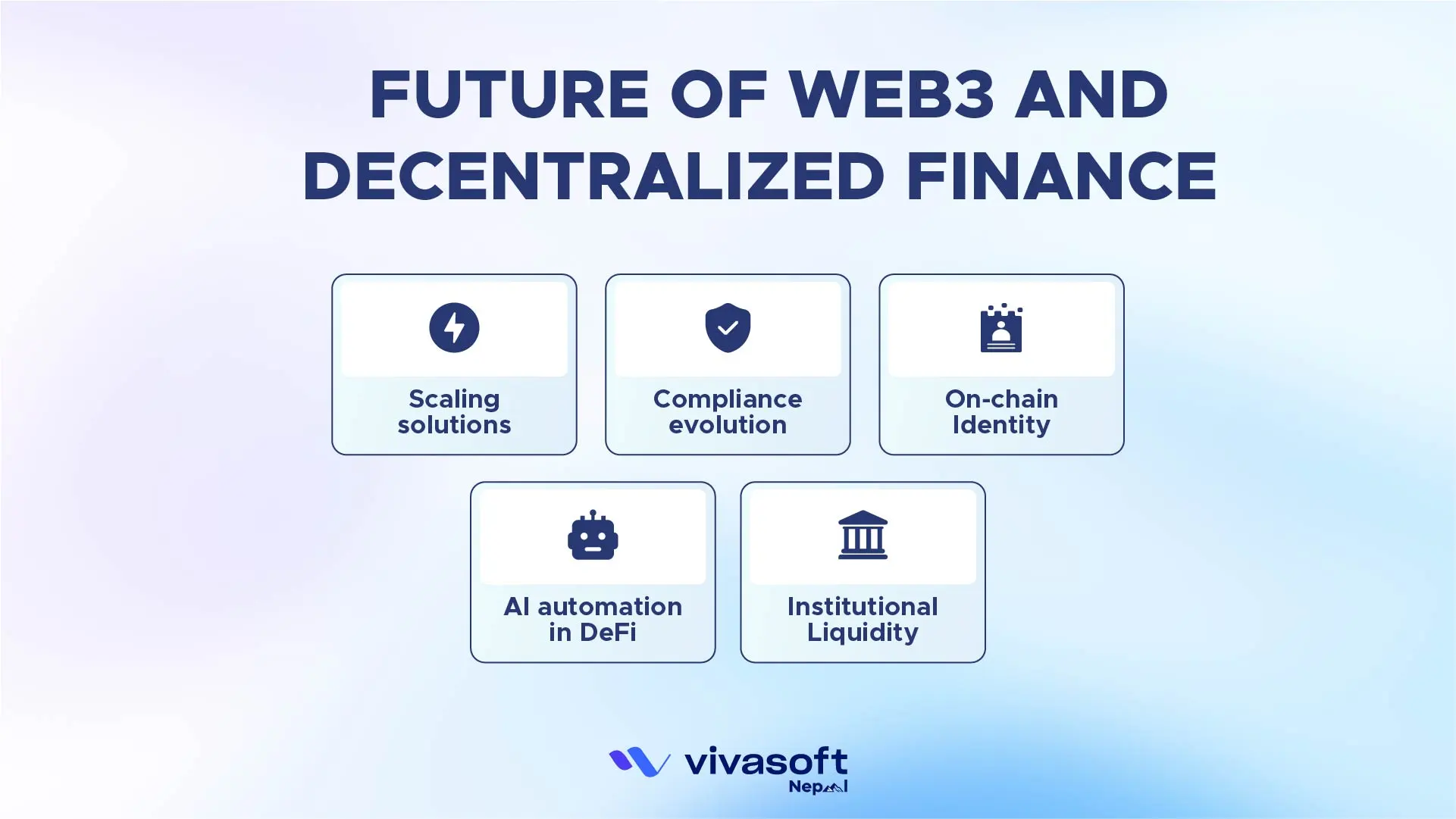
Layer 2 rollups are maturing quickly. As ZK rollup technology improve; Ethereum could eventually process thousands of transactions per second at minimal cost which would make DeFi viable for everyday micro transactions in a way it currently isn’t. Scaling is arguably the single biggest technical challenge still standing between the DeFi and mainstream adoption.
1. Compliance Evolution
The next generation of DeFi protocols will likely include built-in compliance options like optional KYC modules, on-chain sanctions screening, jurisdiction filters. This isn’t necessarily a retreat from decentralization; it’s more of a recognition that institutional participation requires some regulatory accommodation.
1. On-Chain Identity
As decentralized identity systems mature, DeFi users will be able to prove things about themselves; creditworthiness, professional credentials, compliance status without revealing sensitive personal data. This changes the loan calculus significantly. Overcollateralization is a limitation of the current system; on-chain identity is one of the more credible paths around it.
3. Institutional Liquidity
As more institutional capital enters DeFi protocols, market depth will increase. That means less slippage on large trades, tighter spreads and generally more efficient markets. Retail users benefit from this too deeper liquidity makes the whole ecosystem work better.
4. AI Automation in DeFi
The longer term vision involve AI agents that autonomously manage complex DeFi strategies such as monitoring rates, rebalancing positions, managing risk and compounding yields all these without the user needing to do anything. Most of the current implementation are still pretty limited but the infrastructure to support more sophisticated AI driven DeFi is being built right now.
Frequently Asked Questions
What is the difference between Web3 and DeFi?
Web3 is the broader decentralized internet , it includes everything from NFTs to on-chain gaming to identity systems. DeFi is specifically the financial application layer within Web3 which is focused on services like lending, trading and earning yield.
Is DeFi a part of Web3?
Yes DeFi is a subset of Web3. It operates on Web3 infrastructure but is focused exclusively on financial use cases. Not all of Web3 is DeFi but all of DeFi is part of Web3.
How does Web3 power decentralized finance?
Web3 provides the blockchain infrastructure, wallet systems and a decentralized governance models that DeFi protocols are built on. Without Web3 DeFi as it exists today wouldn’t be possible.
Is Web3 DeFi safe?
It carries real risks like smart contract bugs, scams, regulatory shifts and market volatility among them. That said sticking to well audited protocols and following basic security practices significantly reduces your exposure.
What are the risks of Web3 DeFi?
The main ones are smart contract exploits, oracle manipulation, bridge hacks, rug pulls, gas fee volatility and regulatory uncertainty. None of these are hypothetical they’ve all caused significant losses in practice.
How do beginners start with Web3 DeFi?
Set up a non-custodial wallet, fund it with stablecoins, then connect to an established DeFi platform. Start on a low cost Layer 2 network while you’re learning. Don’t put in more than you can afford to lose while you’re still figuring things out.
What are the best Web3 DeFi platforms?
For trading: Uniswap. For lending: Aave. For staking: Lido. For real-world assets: Ondo Finance. Always evaluate based on TVL, audit history and governance structure not just name recognition.
Can you earn passive income in Web3 DeFi?
Yes through lending, staking, liquidity provision and stablecoin yield strategies. Returns vary widely depending on the protocol and the level of risk involved. Nothing in DeFi is truly a risk free.
What is the role of smart contracts in Web3 DeFi?
Smart contracts handle all the logic like executing trades, managing loans, distributing yield, enforcing rules. They replace the middlemen in traditional finance; operating automatically based on code rather than human decision making.
How is Web3 regulated?
It depends heavily on where you are. The EU has MiCA; the US is still working through it. Most jurisdictions require users to report DeFi income for tax purposes, regardless of how decentralized the protocol is.