


Liquidity depth is not a simple metric in decentralized markets. Instead, it is the variable that directly sets execution quality, capital accessibility, and protocol resilience. Here, the benefits of deep liquidity in DeFi protocols show up as measurable outcomes. For instance, lower slippage, institutional-sized trades without price impact, and reduced volatility during stress. When depth concentrates in price levels, routing becomes efficient. Moreover, arbitrage aligns prices faster, and capital stays productive instead of being idle.
For the lenders or borrowers, the implication is straightforward. Liquidity depth is not just about “more TVL.” It defines how your trades clear, how strategies scale, and whether a protocol can retain flow when markets turn. This article covers those dimensions with a focus on execution mechanics, capital efficiency, and system durability.
What Is Liquidity in Decentralized Finance (DeFi)?
If you’ve used a DeFi protocol, you’ve already interacted with liquidity —even if you didn’t think about it that way. In simple terms, liquidity is about how easily you can swap or move a token without running into delays or big price changes. It’s often described as asset liquidity. Basically, it tells you how quickly a token can be traded at a fair value. Unlike the traditional markets, DeFi doesn’t rely on centralized intermediaries. Instead, liquidity comes from the users who lock their funds into pools, and those pools make the trading possible.
Where it gets more interesting is how liquidity affects what you actually experience when trading. It plays a direct role in trade execution, shapes the token price, and influences overall market efficiency. You can think of it as a chain. Like better asset liquidity makes trade execution smoother, smoother execution helps avoid sharp price shifts, and that’s what keeps token price movements more stable. When liquidity is thin, the opposite happens—trades slip, prices jump, and the market becomes less predictable.
The Core Differences Between Deep Liquidity and Shallow Liquidity
If you’re a protocol builder or investor, knowing the difference between the shallow and deep liquidity will help you understand execution quality and risk of manipulation.
| Aspect | Deep liquidity | Shallow liquidity |
|---|---|---|
| Pool size | Large pool with plenty of capital. Trades hardly move the overall reserves. | Smaller pools. Moderate trades can take a big part of the available liquidity. |
| Slippage | Very little slippage | Higher slippage |
| Price stability | Stay steady even when executing large trades | Fluctuates easily |
| Manipulation risk | Harder | Easier |
| Capital efficiency | Pool capital is used effectively | Capital gets fragmented quickly |
| User confidence | As the execution is predictable and slippage is minimal, traders feel confident. | Traders are less confident as the fact is the opposite of deep liquidity. |
On-Chain vs Off-Chain Liquidity
In the DeFi protocol architecture, your choice between on-chain and off-chain liquidity affects transparency, trust assumptions, and so on.
| Aspect | On-chain liquidity | Off-chain liquidity |
|---|---|---|
| Where it sits | Entirely on the blockchain | Partially or fully off-chain |
| Transparency | Fully visible to anyone | Limited visibility |
| Security/trust model | Trust minimized | Higher trust requirement |
| Speed & cost | Slower and more costly | Faster and cheaper |
| Liquidity depth | On-chain capital limits can constrain liquidity depth | Often deeper |
| Composability | High | Limited |
| Use case fit | Best for trustless swaps, AMMs, lending, and fully decentralized protocols | Best for high-frequency trading, order-book style markets, or bridging large liquidity sources efficiently |
DEX vs CEX Liquidity
As a protocol architect, you decide between DEX and CEX liquidity based on whether your system prioritizes trustless transparency or deep, execution-efficient markets.
| Aspect | DEX liquidity | CEX liquidity |
|---|---|---|
| Structure | Uses smart contracts with AMMs rather than traditional order books | Uses a Central Limit Order Book (CLOB) model that matches buyers and sellers via bid–ask systems. |
| Depth & spreads | Lower depth and wider spreads. | Deeper liquidity and tighter spreads |
| Price impact | Higher price impact (slippage) for large trades | Lower price impact for large trades |
| Transparency | Fully transparent | Partial transparency |
| Trust model | Operates on a "trustless" basis | Built on custodial trust. |
| Speed & cost | Slower and variable cost | Faster execution with lower latency |
| Liquidity source | Liquidity comes from users (LPs) | Liquidity comes from professional market makers, institutions, and exchange incentives |
| Best-fit use case | When you want open access, trade new or less popular tokens, and build within DeFi without middlemen | When you need fast trades, large volumes, easy fiat deposits/withdrawals, and stable prices with low slippage |
Why Is Liquidity Important in DeFi Ecosystems?
Liquidity is like the lifeblood of DeFi platforms. It determines how the trade executes, how the price stays stable, and how protocols interact.
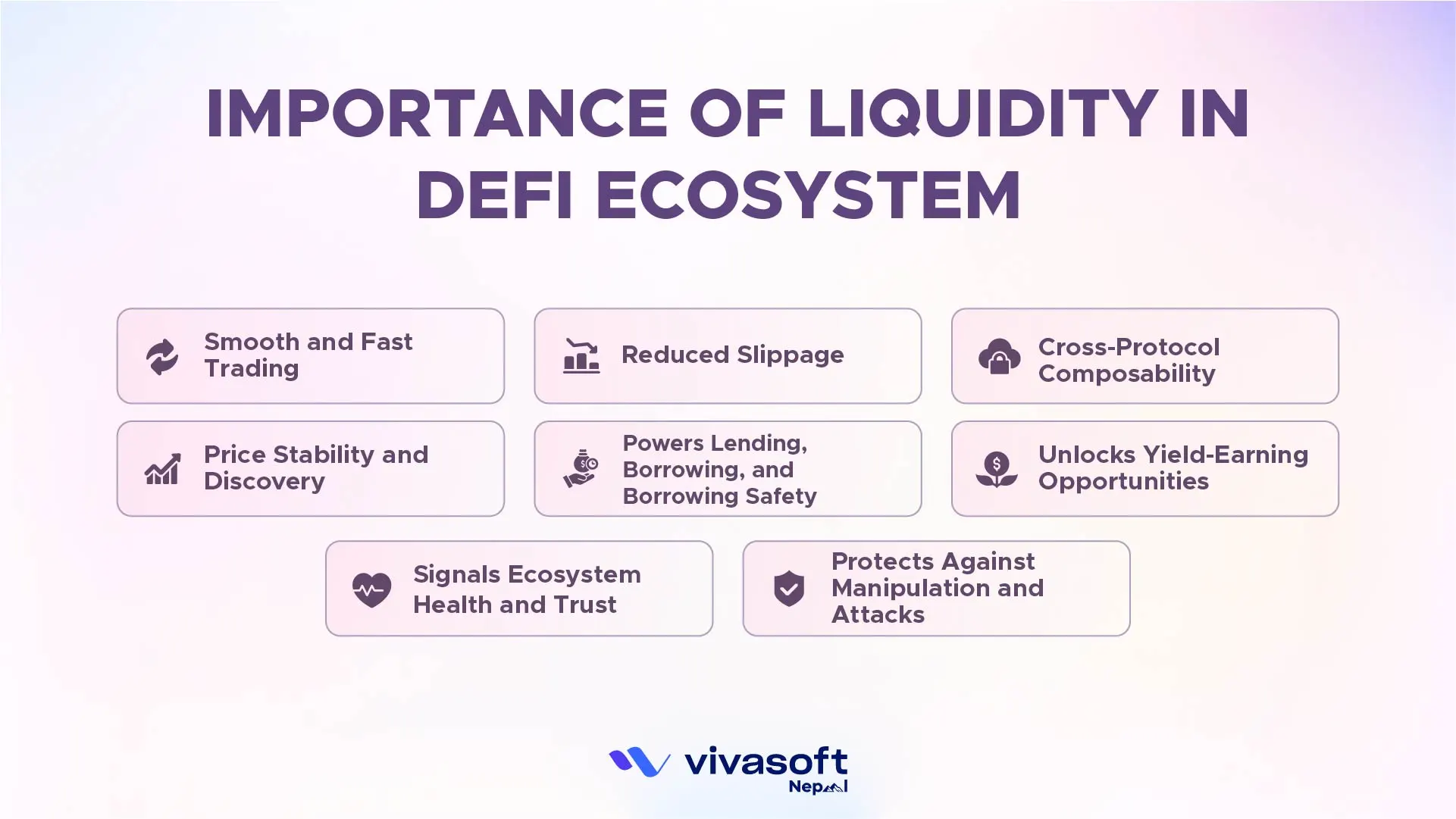
Smooth and Fast Trading
Deep liquidity directly improves how trades execute, and the effect compounds in the system. When pool depth is high, even larger trades only shift the price slightly. It keeps slippage levels low. Lower slippage makes a pool more attractive for aggregators, so it is more likely to be selected during routing decisions. As more trades get routed through these pools, trading volume increases. On top of that, as fee income becomes more consistent here, LPs are more likely to keep their capital in the pool. It ultimately improves LP retention. In practice, it builds a cycle where deeper liquidity improves execution, brings in more trades, and keeps liquidity growing.
Reduced Slippage
Reduced slippage has clear economic value in DeFi platforms. For the trader, lower slippage means a tighter gap between the quoted price and the executed price. It directly lowers the effective execution cost—especially important for larger trades. The protocol pools with lower slippage are more likely to be selected by aggregators during routing. Better execution quality makes these pools more competitive. Higher trading volume translates into more trading fees collected by the pool for Liquidity Providers (LPs). Since fee earnings are distributed based on share, increased volume can improve fee APY.
Cross-Protocol Composability
On-chain liquidity lets multiple DeFi protocols work together in a single transaction, which is called atomic composability. This is something off-chain pools can’t do. When a DEX pool is deep, it can handle larger trades without big price changes. That makes tools like flash loans, liquidations, and moving yields between protocols possible. Deep on-chain liquidity lets protocols connect smoothly. It makes the system faster and more reliable for traders and LPs.
Price Stability and Discovery
When a pool holds a lot of tokens, each trade only moves the price a little. This helps traders get prices close to what they expect and keeps the market steady. Arbitrageurs use these deep pools to match prices between DEXs and CEXs quickly. Because trades don’t swing prices too much, it’s easier to keep prices in line across platforms. Price oracles also benefit. Oracles that pull data from deep pools are harder to manipulate. Shallow pools can show sudden spikes, but deep pools give more reliable price feeds.
Powers Lending, Borrowing, and Borrowing Safety
Lending protocols use the amount of on-chain liquidity to set rules for borrowing. Collateral limits, liquidation points, and liquidation bonuses are tuned based on how much liquidity is in the pools. In a DeFi lending platform, when a pool is deep, the protocol can safely manage larger liquidations without big price swings. So it lowers the borrowing rates for users. Deep liquidity keeps collateral values steady and prevents sudden margin calls.
Unlocks Yield-Earning Opportunities
Liquidity Providers (LPs) earn rewards from multiple sources in a DeFi pool. The main component is the trading fees, calculated using the formula: fee tier × daily trading volume ÷ total value locked (TVL) = fee APY. Higher daily volume or lower TVL increases the effective yield for LPs. Many protocols also add a reward token layer, giving extra incentives to encourage long-term participation. These reward tokens are often distributed proportionally to each LP’s share, boosting overall returns.
Signals Ecosystem Health and Trust
TVL in the DeFi platform shows how much liquidity a protocol has. Analysts and aggregators use it to see how strong or trusted a platform is. When TVL grows, it usually means users feel confident. If it drops, it can signal reduced trust. High liquidity also matters for practical decisions. Wallets and aggregators often choose which protocols to list based on liquidity depth. A protocol with more liquidity allows smoother trading and better access for users.
Protects Against Manipulation and Attacks
Deep liquidity makes it more expensive for attackers to manipulate prices. In pools with high TVL, moving the price significantly requires a much larger capital outlay, which discourages manipulation. Flash loan attacks are also less effective in deep pools. Since large trades have less relative impact on token prices, an attacker cannot easily exploit temporary imbalances to profit. Shallow pools, on the other hand, are more vulnerable because smaller trades can move prices sharply.
What Problems Does Low Liquidity Create in DeFi?
Low liquidity isn’t just inconvenient—it is a structural failure that can destabilize a protocol and undermine reliable trading.
High Slippage and Poor Trade Execution
High slippage happens when a trade executes at a much worse price than expected, as the liquidity pool is too shallow relative to the trade size. On many decentralized exchanges, slippage can range from 0.3 % to over 1 % for low-liquidity token pairs, even for relatively moderate trades. This measurable price impact hurts execution quality. The relationship is direct: lower liquidity → higher slippage → poorer execution.
Increased Price Volatility
Low liquidity means even small trades can trigger large price swings. That’s because there aren’t enough buyers and sellers to absorb orders. In crypto, this can make prices move 15 % or more over 30 days, far above levels seen in traditional markets.
Market Manipulation Risks
Low liquidity makes markets easy to influence. Because small trades can swing prices sharply and be exploited by attackers using flash loans or sandwich trades. For example, flash-loan price manipulation can push a tiny pool’s price far out of line, creating exploitable mispricing that has caused multi-million-dollar losses in DeFi protocols.
Liquidity Fragmentation Across Chains
Low liquidity becomes fragmented when capital for the same asset is scattered across multiple chains and isolated DEX pools. It reduces usable depth on any single venue. For example, a $1M trade can incur 10x the slippage on a fragmented DEX compared to a unified one.
Delayed Settlements and Inefficient Swaps
Low liquidity slows DeFi trade execution because pools lack enough depth to instantly fulfil swaps, forcing routing through multiple pools or repeats. Studies show thin pools execute up to 30 % of trades at unfavorable rates, meaning trades take longer and cost more to complete.
Higher Gas Costs in Thin Markets
Low liquidity forces trades to route through multiple pools or repeat swaps, which drives up gas usage. On Ethereum, this can cost $50–$100 per trade during congestion. Thin markets link directly to higher fees, slower execution, and reduced efficiency for both traders and liquidity providers.
How DeFi Liquidity Works?
Liquidity for the DeFi doesn’t come from traditional buyers and sellers matching orders. Instead, it’s built into the protocol itself through pools and automated systems.
- Automated Market Makers (AMMs): Think of AMMs as smart contracts. It handles the buying and selling of tokens algorithmically. It’s unlike the traditional exchange, where it matches the buyers and sellers. Instead, you trade straight with a pool of tokens. Prices come from a formula like x∗y=k. Here, x and y are the amounts of two tokens in the pool, and k stays constant. When someone buys a token, there’s less of it in the pool. So its price goes up compared to the other token.
- Liquidity Pools: It’s like a shared vault containing pairs like ETH/USDC or WBTC/DAI. Here, users are known as Liquidity Providers (LPs) and add an equal value of each token to the pool. In return for providing the essential services, you earn a portion of trading fees every time someone swaps tokens.
- How Swaps Work: Now, say you want to swap ETH for USDC on an AMM-based DEX. You don’t wait for someone selling USDC for ETH. Instead, you trade directly with the ETH/USDC liquidity pool. You deposit your ETH, and the pool automatically sends you USDC. The exchange rate comes from the AMM algorithm and the current token ratio in the pool.
- Importance of Pool Depth: “Depth” means how many tokens are locked in a pool. Deeper pools can handle larger trades with minimal impact on prices. Shallow pools, with fewer tokens, are more sensitive—modest trades can cause big price swings and higher slippage.
How Do Automated Market Makers (AMMs) and Liquidity Pools Drive DeFi?
Automated Market Makers (AMMs) let you trade tokens directly with a pool. You don’t have to wait for another person to take the opposite side. Here, they rely on the constant product formula (x × y = k). When you make a trade, the price moves based on the pool’s reserves—the bigger your trade relative to the pool, the more the price shifts. All this is done algorithmically. Moreover, Advanced Concentrated Liquidity Market Makers (CLMMs) let Liquidity Providers focus capital within selected price ranges. It increases capital per price tick and allows LPs to earn higher fees per dollar deployed compared to standard CPMMs.
As for the liquidity ecosystem, pools are funded by Liquidity Providers (LPs). LPs deposit token pairs based on factors like expected trading fees, impermanent loss, reward token emissions, and lock periods. Smart contracts track each LP’s share and issue LP tokens as proof of ownership. These LP tokens allow LPs to redeem their portion of the pool, including earned fees. This on-chain liquidity is composable. It enables efficient interaction with lending, derivatives, and stablecoin protocols—something off-chain liquidity cannot provide
How Protocols Build and Maintain Deep Liquidity?
Protocols use a combination of incentives, smart design, and risk management to ensure deep liquidity.
Step 1: Incentivize Liquidity Providers
Protocols attract liquidity providers by combining fee tier selection, reward token emissions, and longer-term alignment models. Fee tiers are usually set based on pair volatility, where reward emissions boost returns. Some protocols use ve-tokenomics, where tokens are locked to gain voting power and a share of fees. Others build protocol-owned liquidity (POL) to reduce reliance on rented liquidity and maintain baseline depth.
Step 2: Implement Efficient AMM Design
Protocols need to choose between Constant Product Market Makers (CPMMs) and Concentrated Liquidity Market Makers (CLMMs) based on their use case. CPMMs (x × y = k) spread liquidity across all price ranges. It makes them simple and reliable but less capital efficient. CLMMs, on the other hand, let Liquidity Providers allocate capital within specific price ranges. It increases capital efficiency and improves fee earnings in active trading zones.
Step 3: Use Liquidity Aggregation
Now protocols tap into multiple liquidity sources instead of relying on a single pool. Aggregators split trades in different pools to reduce price impact and slippage. It ensures traders get closer to optimal rates while high-volume pools remain active. By routing trades efficiently, aggregation channels liquidity where it is most effective.
Step 4: Reduce Fragmentation Across Chains
In multiple chains and pools, liquidity can become fragmented. It can weaken the depth in each location. Protocols resolve such issues through asset bridging, shared liquidity layers, or cross-chain routing. It makes liquidity more approachable.
Step 5: Implement Risk Management Mechanisms
Protocols implement an efficient mechanism to reduce the risk that comes with providing liquidity. For instance, they offer stablecoin or correlated asset pairs, concentrated liquidity options, and some built-in IL protection to reduce impermanent loss. To secure smart contracts, they use measures like MEV protection and commit-reveal or private mempool techniques to prevent manipulation.
How Liquidity Mining and Yield Farming Increase Liquidity Depth?
In the context of decentralized finance, liquidity mining and yield farming are used to pull capital into pools and keep it there long enough to improve trading conditions.
- Incentivizing Deposit of Fresh Capital: Through liquidity mining rewards and yield farming returns, protocols offer extra incentives added to trading fees. It brings in new funds and grows liquidity.
- Concentrating Liquidity in Targeted Pools: Incentives aren’t spread evenly. Teams often push rewards toward specific pairs, so liquidity builds up where it’s actually needed.
- Encouraging Long-Term LP Participation: Many farming programs include lockups or gradual rewards. It keeps liquidity from leaving too quickly and makes pools more stable.
- Enabling Cross-Chain and Protocol-Owned Liquidity: Some liquidity mining strategies extend cross chains and help protocols to build their own liquidity base. It ultimately reduces reliance on short-term external capital.
The Role of Deep Liquidity Across DeFi Sectors
Here is how deep liquidity plays an important role in DeFi sectors.
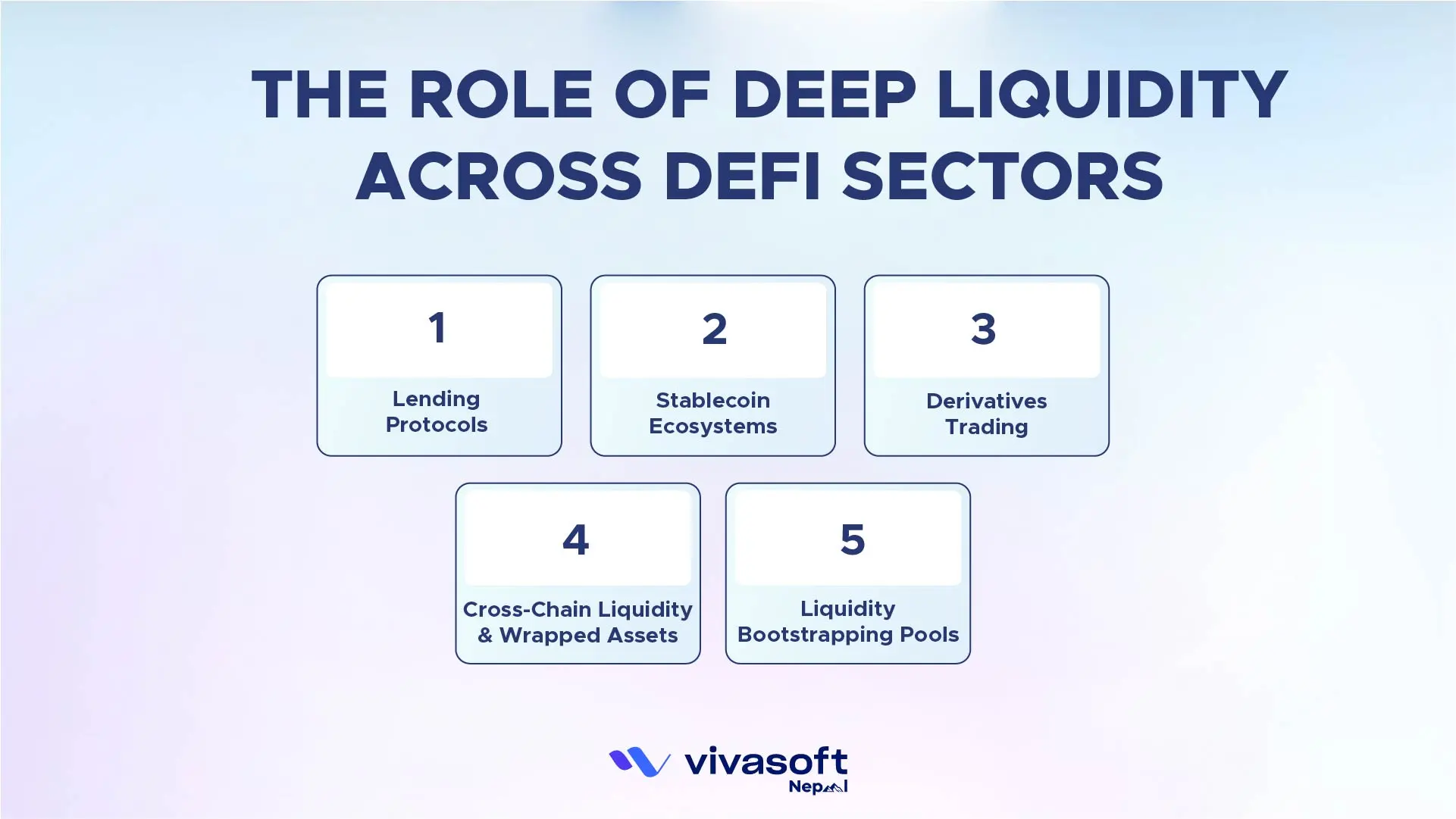
Lending Protocols
Low DEX pool depth harms lending health factors because shallow pools make collateral harder to liquidate at fair prices. When collateral values shift quickly against borrowers, positions can drop toward the liquidation threshold (HF ≤ 1). But deep liquidity supports stable collateral valuation.
Stablecoin Ecosystems
Deep stablecoin pools help keep prices close to their peg. Because they let arbitrageurs absorb imbalances without big price moves. Stronger liquidity correlates with smaller peg deviations, as arbitrage activity can efficiently correct prices.
Derivatives Trading
In derivatives markets, deeper liquidity supports higher open interest as more capital backs outstanding contracts. But shallow markets cap how many positions can be safely built. High liquidity also stabilizes funding rates between longs and shorts, reducing extreme swings.
Cross-Chain Liquidity & Wrapped Assets
Wrapped asset peg stability depends on the bridge liquidity reserve depth. When one asset has multiple wrapped forms in different bridges, its liquidity gets divided into separate pools. It ultimately raises slippage and de-peg risk.
Liquidity Bootstrapping Pools
Initial LBP depth determines fair price discovery or has its launch pool exploited. Well-designed LBPs then migrate capital into permanent DEX pools. If initial depth is low, price discovery fails, and post-launch liquidity can stay thin. It weakens market formation.
Risks and Challenges of Maintaining Deep Liquidity
Here are the risks and challenges of deep liquidity maintenance.
- Impermanent Loss: If asset prices move apart in a pool, you can end up with less value than holding them separately. That’s even after earning fees.
- Smart Contract Vulnerabilities: Generally, liquidity is handled by smart contracts. So, if there is any bug or exploitation, it can cause immediate loss of the funds.
- Regulatory Risks: Rules around DeFi keep changing. Sudden changes can limit access, affect tokens, or disrupt how a protocol operates.
- Capital Concentration Risks: Liquidity often comes from a few large providers. So if they pull out, depth can drop fast, and trading conditions worsen.
- Sustainability of Yield Incentives: Many pools rely on rewards to attract capital. But once incentives fall, liquidity can leave just as quickly.
How Deep Liquidity Attracts Institutional Investors?
Deep liquidity makes it easier for you to trade large amounts quickly and with lower risk. It ultimately attracts institutional investors.
Scalability for High-Value Settlements
You can place large orders without causing major price movement. That matters for block trades and rebalancing, where even small slippage adds up. A thicker order book simply gives you more room to execute at scale without distorting the market.
Reduced Counterparty Risk
Liquidity also affects how quickly you can get in and out of positions. In a liquid market, you’re not waiting for a match. That reduces exposure to failed trades or delayed settlement. If liquidity dries up, counterparty risk rises fast. Deep markets help limit that exposure by keeping transactions flowing.
Increased Market Confidence
You’ll notice institutions tend to cluster where liquidity already exists. That’s not accidental. Tight spreads and consistent execution signal a stable market. It’s easier to trust pricing when trades happen frequently and at volume. Over time, this builds confidence, and more participation follows.
Improved Capital Efficiency
Deep liquidity allows you to allocate and reallocate capital quickly. That flexibility means you don’t need to hold excess cash as a buffer. It also helps with risk management, since you can adjust exposure quickly. In less liquid markets, the opposite happens—you either delay trades or accept worse pricing. Both reduce overall efficiency.
Real-World Examples of High-Liquidity DeFi Platforms
In DeFi, liquidity doesn’t grow the same way on every platform. Different top DeFi development companies solve it in different ways, depending on their design and user base.
- Uniswap Liquidity Depth & Capital Efficiency: With Uniswap, liquidity became more efficient after its introduction of concentrated liquidity (v3). Instead of spreading funds across all prices, LPs can focus on active ranges.
- Curve Finance and Stablecoin Liquidity: Curve Finance takes a different approach. It focuses on stablecoins, where prices don’t move much. Because of that, it can offer very low slippage, even for large trades.
- Balancer Pool Design: Balancer allows multi-token pools with custom weightings. It gives more flexibility in how liquidity is managed and used.
- PancakeSwap & BNB Chain Liquidity: PancakeSwap benefits from lower fees and high transaction speed on BNB Chain. It makes it easier for users to trade frequently.
- SushiSwap Incentive Structures: SushiSwap focuses more on incentives. As the platform offers rewards on top of added fees, it encourages users to move liquidity and keep it there.
- 1inch Liquidity Aggregation: 1inch pulls liquidity from multiple sources instead of building its own pools. It splits trades in different platforms to find better pricing, which helps users access deeper liquidity
- MakerDAO & Ethereum Liquidity Infrastructure: MakerDAO provided its liquidity through its stablecoin DAI on Ethereum. It provides a base layer of liquidity that many other DeFi protocols rely on.
Metrics and Tools to Measure Liquidity Depth
The following are metrics and tools used to measure liquidity depth.
Order Book Depth vs AMM Depth
Order book depth and AMM depth measure the same economic variable—available liquidity—but through structurally different mechanisms. It makes them not directly comparable. In an order book model, depth is discrete. You calculate depth by summing available volume within a defined price range. In contrast, AMMs provide continuous liquidity, not discrete orders provided by the x * y = k constant product formula. In a pool holding Token A (x) and Token B (y), the product k must remain constant. To withdraw Δy tokens, a trader needs to add Δx tokens to satisfy the equation (x + Δx) * (y – Δy) = k.
Visible vs Executable Liquidity
Visible liquidity is what protocols display. Executable liquidity is what traders can actually use. In Order books, visible liquidity is aggregated bids/asks across price levels and Total Value Locked (TVL) or pool reserves for AMMs. executable liquidity = the portion that can be executed at stated prices before slippage exceeds a defined threshold. Here, MEV and front-running are two structural factors that reduce executable below visible liquidity.
Liquidity Depth Metrics
To evaluate liquidity rigorously, you need metrics tied to execution outcomes. For example,
| Slippage percentage | (Execution Price - Expected Price) / Expected Price |
|---|---|
| Price Impact (%) | (Price After Trade - Price Before Trade) / Price Before Trade * 100% |
| Total Value Locked (TVL) | Calculate the total value by multiplying each token reserve by its current price, then add them together using live oracle price data. |
Real-Time Liquidity Analytics Tools
The following tools help traders and analysts assess execution conditions and slippage risk.
| Tool | Core Function |
|---|---|
| Bookmap | It shows the order book as a heatmap, |
| Crypto Bookmap | It lets you follow bid and ask depth in real time, |
| Amberdata | It gives you deeper liquidity data like spreads, slippage estimates, and pricing |
| Empirica Liquidity Analytics Dashboard | It tracks order book activity in exchanges and helps you compare how liquidity changes |
| ExoCharts | It focuses on order flow and depth |
| Velo Data | It pulls together derivatives data such as volume, open interest, and funding rates. |
How DeFi Projects Can Leverage Deep Liquidity?
In practice, deep liquidity makes a noticeable difference. It keeps the trades efficient and reduces sudden price swings. Moreover, it makes the overall experience better for users.
- Smart contract development: When smart contracts interact with deep liquidity pools, trades and lending operations execute more predictably. Reduced slippage and fairer pricing make contracts more reliable for users.
- DEX development: Decentralized exchange platforms perform better when they connect to deep liquidity. Here, orders can execute faster, and price discovery improves. It makes it reliable for both retail and institutional users, including businesses that rely on a crypto payment gateway to settle on-chain transactions at scale.
- Yield Farming Platform Development: Deep liquidity helps yield farming stay stable. Rewards remain predictable, pools stay stable, and users feel confident locking their tokens for longer periods.
- Cross-Chain Protocol Development: Deep liquidity spread across different chains, making it easier for users to move assets. Bridges tend to work more efficiently, and you don’t run into as much fragmentation.
Conclusion
For DeFi protocols, deep liquidity enhances adoption, trust, and revenue. That’s why projects that neglect liquidity depth risk low TVL and fragmented markets. So, businesses should partner with DeFi development company or use specialized DeFi liquidity services in this regard. Acting reversely may cause them to lose competitiveness and threaten long-term market profitability.
Frequently Asked Questions (FAQ)
Why is liquidity important in decentralized finance?
Liquidity allows for faster and fairer price trades. That’s why if there is not enough liquidity in decentralized finance, it can cause high slippage and unstable token values.
How does liquidity affect slippage?
Both high and low liquidity affect slippage. For instance, in the case of low liquidity in the pool, it increases slippage. That’s because large trades move prices to shallow pools. In contrast, higher liquidity reduces slippage. It allows the trades to happen at the expected price.
What is the difference between TVL and liquidity depth?
TVL shows the total assets stored in a protocol. On the other hand, liquidity depth shows you how much you can trade without causing major changes in the prices.
How do liquidity providers earn yields?
LPs depositing assets to pools and enabling trades. They receive a share of trading fees, proportional to their stake in the pool. It’s typically around 0.3% per swap.
Which DeFi protocols have the deepest liquidity?
In DeFi, platforms like Uniswap, Lido, Aave, Curve, and EigenLayer hold large pools. They let you trade bigger amounts with little risk.
How do governance tokens influence liquidity depth?
Governance tokens generally offer rewards or voting power to the users. It encourages users to add liquidity to the platforms. More participants staking these tokens increases pool depth.
How does deep liquidity reduce market manipulation?
As large trades have less impact on prices in deep liquidity, it makes it harder for attackers to push prices artificially or exploit thin markets.