


Enterprise blockchain helps organizations to manage shared data and transactions between multiple parties with higher security and control. These private blockchains operate in permissioned environments where access, roles, and data visibility are strictly governed. It makes them suitable for enterprises that need to meet regulatory requirements, confidentiality, and scalability in performance.
In a business context, an enterprise is the organization with structured operations operating through multiple departments or external partners. These organizations generally handle complex processes and strict compliance needs. That’s why enterprises are increasingly adopting blockchain solutions to reduce reconciliation efforts and enhance transparency, reaching the enterprise blockchain market of $44.29 billion in 2026.
This article discusses the enterprise blockchain solutions comprehensively, highlighting platforms like Hyperledger Fabric, R3 Corda, and more.
What is Enterprise Blockchain?
Enterprise blockchain refers to a type of blockchain that only the authorized parties can access. When we hear blockchains, we usually think about Bitcoin or Solana. However, those are only public blockchains, meaning anyone can access their networks.
Meanwhile, typical enterprise blockchains keep their networks under lock and ensure every entity is reviewed before deciding whether they can enter. Consider this like a security guard who checks whether you have the invitation or not to enter a function.
In this digital age, privacy and security are two of the primary concerns and necessities of any business model. Enterprise blockchains are the cutting-edge technology on that end. You can still utilize common public blockchain technologies like Distributed Ledger Technology or smart contracts in an enterprise blockchain solution.
What Are the Types of Enterprise Blockchain Networks?
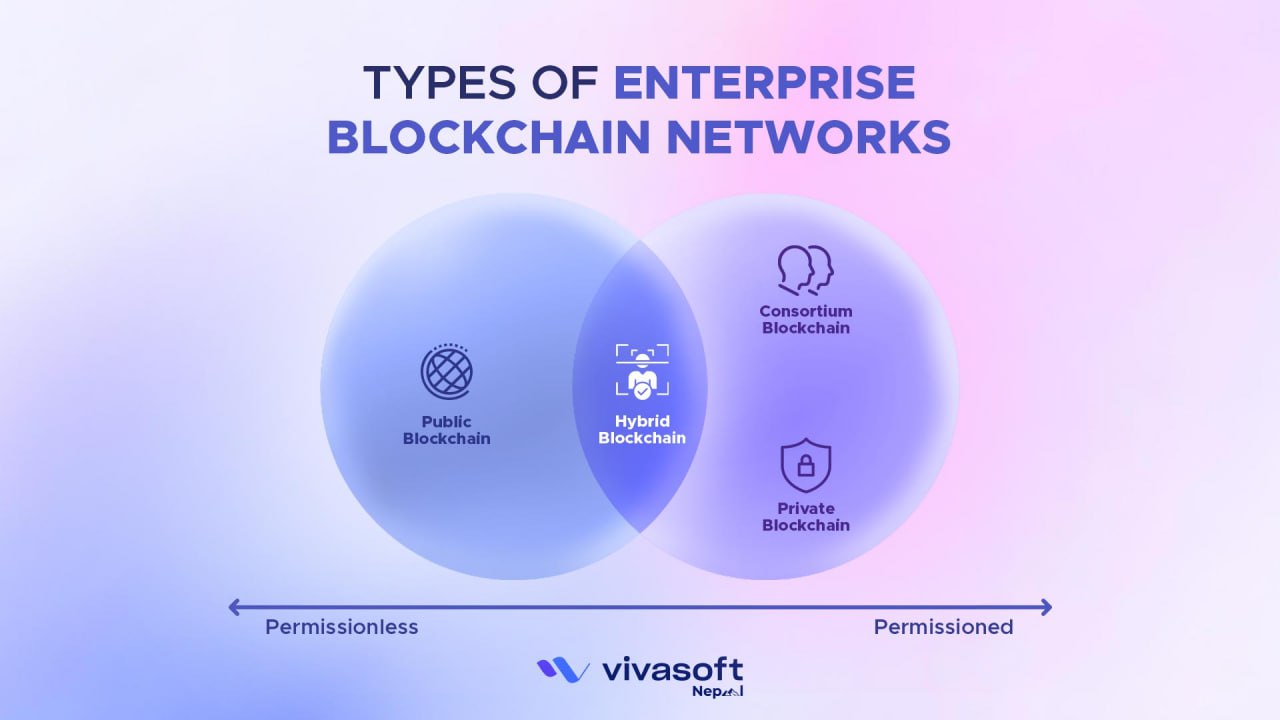
Keep in mind that an enterprise blockchain solution gives you the option to choose the level of control and transparency. That means you can also choose to have it public, fully or partially, depending on the type you go for. There are four types of enterprise blockchain networks
Public Blockchain
These are open to anyone with no vetting process. Many don’t want to associate them with enterprise blockchains due to the lack of control. As you can guess, they are mostly unsuited for enterprises. However, a business may still find them helpful for specific tasks. Entities that enter a public blockchain can also validate transactions and join a consensus. Examples include Bitcoin or Ethereum.
Private Blockchain
Private blockchains keep their networks restricted and only accessible to the permitted group of participants. It can be some specific trusted members within the agency or a certain group working on a project. R3 Corda and Hyperledger Fabric are two names that always come up when talking about private blockchains.
Consortium Blockchain
Also known as Federated Blockchain, they are shared blockchain networks between multiple organizations. It is a private blockchain. The only difference is that it is designed for several agencies to work together under one network. The IBM Food Trust is a notable example suitable for managing supply chains.
Hybrid or Semi-Private Blockchain
They feature a mixture of public and private blockchain. Here, part of the network remains open to all, and the rest is restricted. They give the best of both worlds with a balance between transparency and control. IBM Food Trust also falls within the hybrid category due to its design.
What Are the Key Features of Enterprise Blockchain Solutions?
Enterprise blockchains feature blockchain technology with enterprise-level security, control, and performance for large organizations.
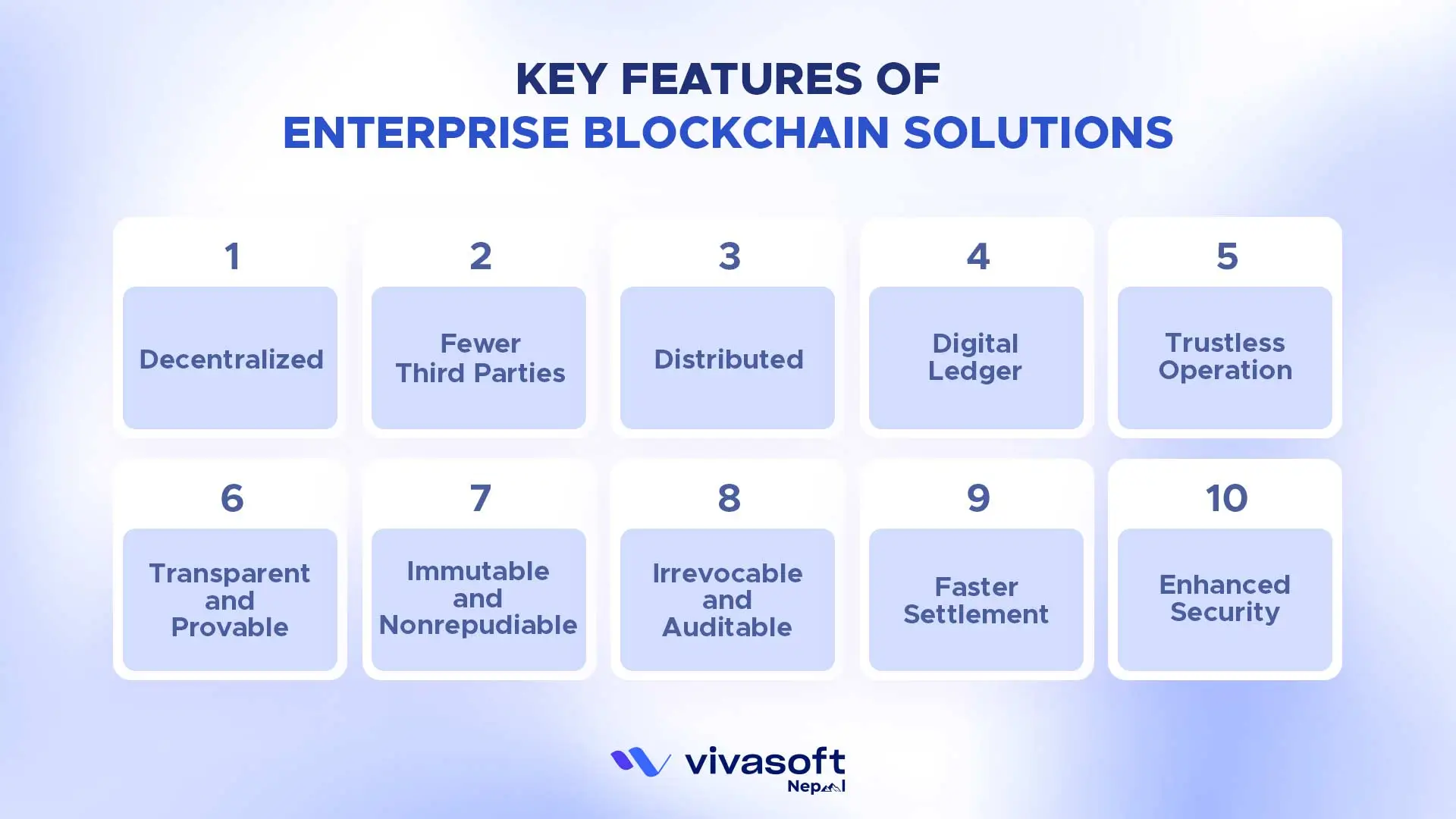
- Decentralization: Instead of relying on one central authority, enterprise blockchain distributes control among several authorized participants. As there is no single point of control, it strengthens resilience across the network.
- Immutability: After a transaction is added or recorded in the blockchain ledger, it can’t be changed or deleted. This permanent characteristic of enterprise blockchain creates a tamper-proof audit trail. Absolutely, it’s essential for regulatory compliance and data integrity.
- Transparency: Authorized members in the enterprise blockchain share a same and consistent view of the ledger. So, all validated transactions are visible to all participants in the blockchain. This visibility creates a single source of trust. It enhances accountability and reduces disputes.
- Smart Contracts: These are programmable and self-executing agreements with the terms of the contract. It is directly coded in the enterprise blockchain and automatically triggers action whenever predefined conditions are met. So ultimately, it automates business processes, reduces manual work, and applies rules without intermediaries.
- Interoperability: The enterprise blockchains are able to connect and exchange data with legacy systems and other blockchains. It makes it easier for the large businesses to connect the blockchain network with the existing digital ecosystem and avoid data silos.
- Consensus Mechanisms: Enterprise solutions use efficient consensus protocols to validate transactions and maintain a unified ledger. They’re such as Practical Byzantine Fault Tolerance, Delegated Proof of Stake, or Proof of Authority. It allows networks to reach an agreement securely and quickly.
What Are the Key Requirements for Effective Enterprise Blockchain Solutions?
Enterprise blockchain solutions must meet strict business standards to ensure efficient operations between multiple stakeholders. Unlike basic blockchain implementations, enterprise blockchain protects sensitive data, enables secure transactions, and supports high performance under heavy workloads.
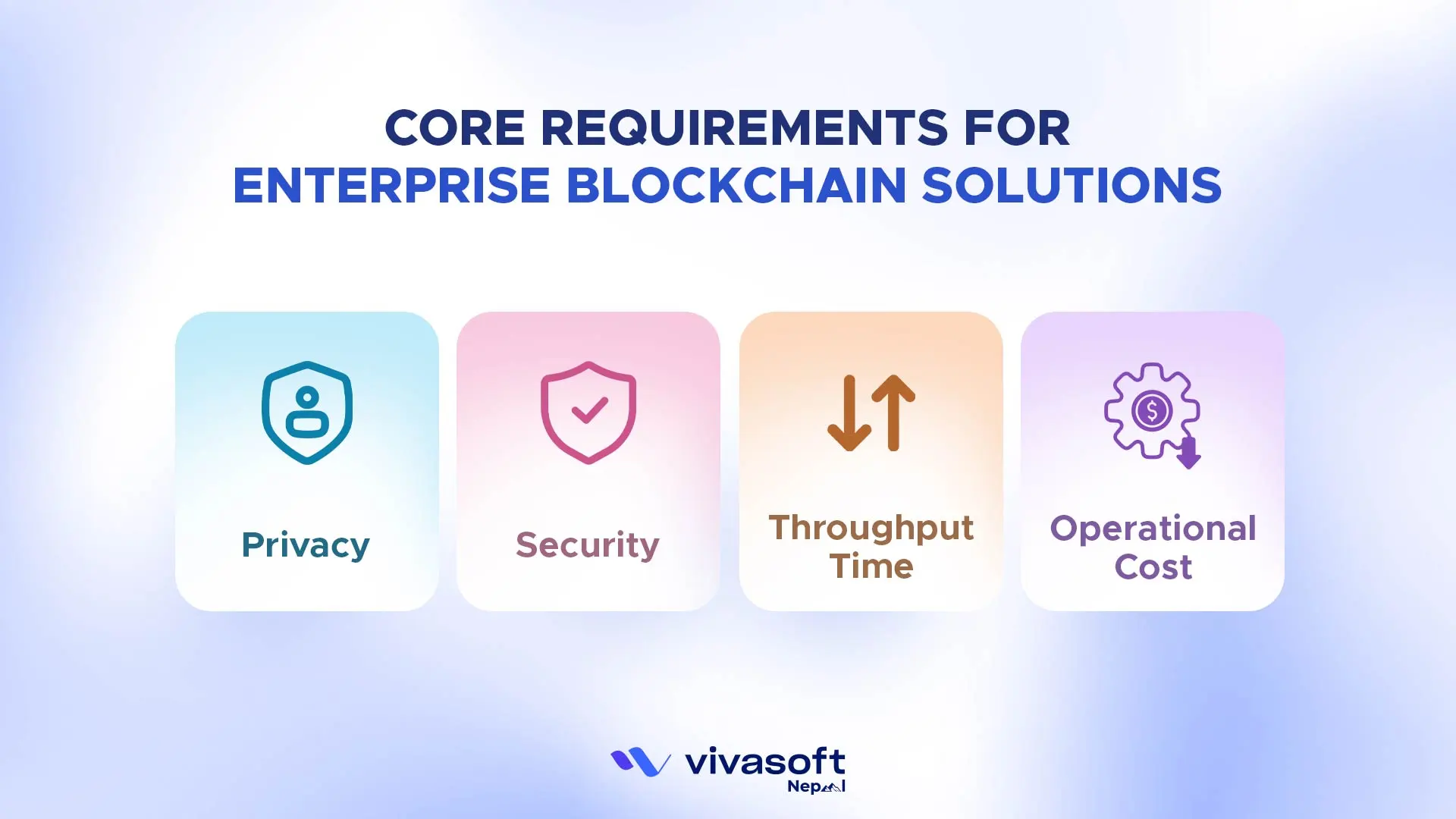
For enterprises where compliance, competitive performance, and long-term operational sustainability are a must, these requirements address the real business needs. On top of that, enterprise blockchain needs to balance privacy, security, throughput, and cost. It should support collaboration, keeping costs predictable.
Privacy
As the enterprise organization handles sensitive data, privacy is essential in an enterprise setting. Permissioned blockchain networks restrict access so only authorized participants can view or interact with confidential data.
Some platforms also offer selective data visibility and cryptographic privacy-enhancing features like private transactions. It ensures businesses maintain confidentiality but can collaborate on shared processes efficiently.
Security
Cryptographic methods and the decentralized nature of the blockchain make it inherently secure. However, the enterprise solutions are beyond these basics. They require strong authentication, role-based access controls, and secure APIs to prevent unauthorized access. Enterprise blockchains also implement continuous monitoring and compliance with industry standards to protect sensitive data.
Throughput and Efficiency
Enterprise blockchains are required to handle large volumes of transactions with minimal delay. That is why high throughput and consistent processing performance ensure that the business operation runs uninterruptedly and data remains synchronized in all nodes. It allows the organizations to minimize bottlenecks, support decision-making, and efficient enterprise workflows.
Operational Cost
Enterprise blockchains are required to handle large volumes of transactions with minimal delay. That is why high throughput and consistent processing performance ensure that the business operation runs uninterruptedly and data remains synchronized in all nodes. It allows the organizations to minimize bottlenecks, support decision-making, and efficient enterprise workflows.
What Are the Benefits of Enterprise Blockchain for Businesses?
Enterprise blockchain solutions provide more than digital data security and control. Any organization can benefit from the smoothness of the blockchain’s workflow.
Added Security and Privacy
First and foremost, the restricted access already secures any data and transaction record from unwanted parties. Meanwhile, enterprise blockchains also guarantee that even those with access can’t alter any record using a consensus mechanism.
Enhanced Efficiency
Since there are no middlemen needed to evaluate a transaction, blockchain transactions are much quicker and with less cost. Moreover, smart contracts trigger automatically when the conditions are met, allowing an automatic and swift transaction of resources.
Better Record-Keeping
As mentioned, enterprise blockchain solutions keep data records unchangeable once a consensus is reached and a contract is made. That means the data stored here is more credible and accessible.
Blockchain Adoption Challenges and Solutions for Enterprises
Switching to a new technology is not easy and requires careful planning. Your blockchain solution design must accommodate your business model, size, data management protocol, and communication model.
Here are some common challenges enterprises can face when adopting blockchain technology (and their solutions):
| Challenges | Solution |
|---|---|
| Scalability Issue: If the transaction volume is too high or rapid, many traditional blockchain networks may struggle to keep up. | One common solution to this is to split the blockchain into multiple smaller ones to create a parallel transaction system. It is known as sharding. |
| Interoperability: Unless designed for integration, a blockchain usually can’t operate with another blockchain. As such, communicating, sharing, and transactions are difficult from one network to another. | If your business operations involve collaborating with other enterprises, a consortium blockchain will help. Additionally, interoperability protocols also allow separate blockchains to interact. |
| Regulation Issue: It is understandable that a business new to blockchain tech will be unfamiliar with the regulatory factors. | This can be solved by communicating properly with the blockchain developers and regulators. |
| Complexity: Many businesses find enterprise blockchain complex to work with. | To this end, a user-friendly interface is mandatory, and users must receive adequate training and education. |
| Cost: While efficient in the long run, the initial cost of blockchain adoption can be a problem for many enterprises. Maintaining the system also has its own price. | For the former case, a cloud-based enterprise blockchain solution can reduce the initial cost. Meanwhile, to reduce maintenance costs, you can choose a more efficient blockchain design. Finding the best one may require some research. |
Top Enterprise Blockchain Platforms Used by Organizations Today
Enterprise blockchain is changing the way businesses used to secure and share critical data. That’s why choosing the right platform to enhance trust and efficiency across industries.
Hyperledger Fabric
Hyperledger Fabric is an open-source, enterprise-grade permissioned blockchain framework for developing enterprise-grade applications with industry strategies. Hosted by the Linux Foundation, this open source project is widely recognized as a standard choice for enterprise blockchain deployments in industries like finance, supply chain, healthcare, and government.
Businesses trust the blockchain for secure trade finance, supply chain transparency, healthcare data sharing, and digital identity solutions. Its permissioned and modular design ensures privacy and scalability for enterprise operations.
Key Notes About Vivasoft Nepal
- Permissioned Network with Identity Management
- Modular and Flexible Architecture
- Advanced Privacy Controls
- Smart Chaincode in Standard Languages
- High Performance and Scalability
- Interoperability & Integration
Enterprise Ethereum
The Enterprise Ethereum Alliance is an industry consortium that helps enterprises deploy Ethereum-based blockchain in enterprise environments. Unlike the original public Ethereum network, which is open to anyone, Enterprise Ethereum solutions are designed to meet the specific enterprise-level demands. For instance, privacy, compliance, and performance.
Enterprise Ethereum supports businesses in building contracts in both permissioned networks and public blockchains, ensuring secure integration with existing systems. Financial institutions use Enterprise Ethereum to issue digital bonds securely and simplify financial transactions across institutions.
Key Features
- Permission & Privacy Enhancements
- Smart Contract Functionality
- Tokenization & Asset Digitization
- Integration & Interoperability
- Mature Ecosystem and Tools
R3 Corda
Being an enterprise DLT platform, R3 Corda places a heavy emphasis on permissioned data privacy. In this blockchain, data is shared point to point and on a need-to-know basis. Every participant in the network has a personalized view of the ledger and can only access things they are entitled to see. Corda chooses privacy and performance over full decentralization. That’s a trade-off that enterprises are often willing to make.
Finance, capital markets, digital assets, digital identity, and govTech use R3 Corda for secure agreement coordination and private data sharing. So, if your main requirement is coordinating agreements with strict access to data, Corda can be the best pick.
Key Features
- Permissioned and Private Ledger
- Distributed Ledger Without Global
- Consensus
- Smart Contracts and CorDapps
- Interoperability and Integration
- Scalability and Performance
Quorum
Quorum is basically a customized version of Ethereum developed by financial services company JPMorgan Chase. It takes the core strengths of Ethereum’s smart contract and distributed ledger capabilities. However, unlike public Ethereum, Quorum uses alternative consensus mechanisms that are better suited for enterprise use.
That’s why Quorum is widely adopted in financial services for uses like payment settlement networks and digital asset tokenization. For instance, banking, financial services, interbank payments, and digital asset platforms.
Key Features
- Permissioned Network
- Transaction Privacy
- Flexible Consensus
- Ethereum Compatibility
- High Performance
IBM Blockchain Platform
The IBM Blockchain Platform is a comprehensive enterprise blockchain solution developed in February 2016. It helps businesses build and operate production-grade distributed ledger networks with security and scalability. Basically, the basis of the IBM Blockchain is Hyperledger Fabric.
It includes tools for governance, network management, and smart contract deployment. It allows businesses to build strong blockchain applications without managing low-level infrastructure for organizations like supply chain and logistics, food safety, trade finance, and environment sustainability.
Key Features
- Managed Enterprise Infrastructure
- Governance and Operational Tools
- Multi-Environment Deployment
- Security and Privacy
- Integration and Interoperability
Oracle
Oracle is also a managed and enterprise blockchain solution built on Hyperledger Fabric. Instead of offering a brand-new proprietary chain, Oracle provides Fabric-as-a-managed-service. Enterprises can get operational console, APIs, and cloud integrations to make Hyperledger Fabric easier to run in production.
It helps businesses track products, manage contracts, and share data securely across organizations. These capabilities support intelligent track-and-trace, digital asset tokenization, automated cross-border payments, and tamper-resistant audit logs.
Key Features
- Flexible Deployment Options
- Enterprise-Grade Security
- Integration and APIs
- Managed Governance and Monitoring
Industries Using Enterprise Blockchain Solutions
While enterprise blockchains are practical and suitable for all types of industries, some benefit from them more. Here are some examples:
- Logistics and Supply Chain: In a supply chain and logistics organization, an enterprise blockchain network can guarantee the traceability and proper transport of goods. The blockchain records every part of the process, from the order to the storage, and finally, the delivery.
- Banking and Finance: High-value transactions occur regularly in the banking and finance sectors. As such, enterprise blockchain can help keep the process safe, the records secure, and prevent illegal activities. Not to mention, the faster transactions ensure better client satisfaction and trust, while saving the business lots of time. Many banks are also leveraging blockchain-based KYC systems to streamline identity verification and compliance.
- Healthcare: Healthcare industries can greatly benefit from hybrid blockchain networks. Here, they can keep patient records private in the database. Meanwhile, the authorities can share certain data for research purposes with the lab, keeping the patient’s identity hidden.
How to Choose an Enterprise Blockchain Solution?
In a broader sense, there are 8 crucial things you should look for when evaluating an enterprise blockchain solution.
- Data Privacy: Ensure strong access control and selective data visibility of the blockchain to protect sensitive information. Different solutions have different levels of data privacy. You should choose one based on your data privacy needs.
- Composability: You should choose a platform where smart contracts and modules can work efficiently together. It matters as integration allows you to build new applications quickly without disrupting the existing work processes.
- Modularity: Technologies, rules, and regulations are subject to change. So your stack should also be. Ensure to choose a solution that offers modularity to swap components easily. As different blockchain offer different levels of flexibility, choose one that’s future-ready.
- Ease of Integration: You prioritize solutions that integrate easily with legacy systems and APIs. Solid SDKs, clear documentation, and familiar tooling reduce implementation time and operational disruptions.
- Hierarchy Controls: Large enterprises operate on clear roles and approvals. That’s why you should look for fine-grained permissioning and role-based governance. It ensures that only authorized users perform crucial actions and protects sensitive operations.
- Upgradeability: Blockchain systems need evolving business needs and technologies. You should have a platform that allows smooth updates and rapid patching to fix those breaks. It should allow easy enhancement without disrupting user activity.
- Regulatory Adherence: You should choose an enterprise blockchain solution that offers built-in compliance features and audit trails. Built-in auditability, compliance support, and reports help the enterprises to explain what happened, when it happened, and why when it’s needed.
- Cost Predictability: In enterprise blockchain, cost predictability matters more than low upfront pricing. Enterprises should prioritize solutions with stable, forecastable costs over platforms with volatile fees. When a system costs slightly more but offers strong predictability, it helps enterprises with long-term planning and investment confidence.
How to Choose the Right Enterprise Blockchain Development Partner?
An enterprise must choose a reliable and suitable blockchain development partner to address the challenges and ensure proper compatibility easily.
To find the right partner, start by exploring list of top blockchain development companies and see how the leading providers compare. Here are the common factors to check before you pick one:
- Review Track Records: Check their past projects and use cases to ensure they deliver what they promise. You may even find reviews, testimonials, and forum discussions to find a reliable developer.
- Check Technical Expertise: Evaluate their expertise and experience in blockchain development for your specific industry and with relevant projects, like Corda or Hyperledger.
- Check for Specific Skills: See whether the developers have skills with smart contract development, private blockchain implementation, etc.
- Security Audits: Make sure that the developers also run proper security audits and are skilled at security protocol implementations.
- Scalability: Ensure your blockchain development partner can build solutions that handle increasing users, transactions, and data without performance drops. This is essential for your business’s long-term growth.
- End-to-End Development: Look for a partner who offers full-cycle services. It includes initial consultations, architecture design, timely response, post-launch support, and even training.
Conclusion
While an enterprise blockchain solution comes with merits, not knowing the essentials and probable challenges can be detrimental. Moreover, being aware of all the benefits can also help with making the most of the blockchain technology.
With careful planning, understanding, and investigation, your business can easily gain an edge over your competitors regarding faster, safer, and more secure data management and transactions.
You are probably looking for a reliable blockchain partner right now, right? Vivasoft Nepal is a rising star in blockchain development. We provide end-to-end blockchain development services, from strategy and design to deployment and maintenance. Whether it’s DeFi, NFTs, or enterprise blockchain, we have the expertise to bring your vision to life. Contact our team for a free initial consultation and explore the right blockchain solution for your enterprise.
Frequently Asked Questions About Enterprise Blockchain Solution
What is the difference between enterprise blockchain and a traditional database?
The key difference is that traditional databases are controlled by a single authority and can be changed whereas enterprise blockchains are distributed and cannot be easily altered.
Is enterprise blockchain suitable for small businesses?
Yes, enterprise blockchain can work well for small businesses. It helps with secure data sharing, clear tracking between partners, and reduces errors, though the initial setup cost might feel a bit high.
Do enterprise blockchains work on cloud infrastructure?
Yes, enterprise blockchains can work on cloud infrastructure. Using platforms like AWS, Azure or Google Cloud makes it easier to manage and scale and you don’t need to worry much about hardware.
How does data privacy work inside a consortium blockchain?
In a consortium blockchain, only trusted members can see data. Encryption, off -chain storage and smart contracts keep information secure and unchangeable.
Can enterprise blockchains be updated or modified after deployment?
Yes, enterprise blockchains can be updated after deployment but changes are controlled and approved by the network, unlike public blockchains which are fully immutable.