


Private blockchain holds the largest share of the blockchain market; 42.47% as of 2026. Yet despite this, most enterprises that pilot blockchain projects never fully scale them. The biggest reason isn’t budget or tech. It’s trust.
And trust is hard to maintain on an open network. Companies handling patient records, supplier contracts or sensitive financial data simply can’t afford to operate where anyone can see, join or interfere.
That’s exactly where private blockchains come in. They keep everything that makes blockchain powerful; immutability, transparency, tamper-proof records while locking access to verified participants only. Frameworks like Hyperledger Fabric, Quorum and Corda have already made this a reality for banks, hospitals and global supply chains.
In this guide, we’ll cover all you need to know about building a private blockchain. You’ll discover its main components and how to launch a fully functional network for your business.
Key Takeaways
- Private blockchains are permissioned by design which makes them easier to align with compliance and internal policies.
- Performance is usually better than public networks because the network is smaller and consensus is tuned for trusted participants.
- Governance is clearer because membership rules, upgrade processes and node responsibilities are defined up front.
- They still need strong security, because “private” does not automatically mean “safe.”
What is Private Blockchain?
A private blockchain is the type of blockchain where only approved participants can join and access the network. It’s controlled by an organization or group, making it faster, more secure and suitable for business use. This makes them ideal for businesses that need confidentiality and compliance such as financial institutions, healthcare providers and supply chain networks.
Private blockchains offer key features like controlled governance, faster transaction speeds, customizable smart contracts and strong security. They are essential for businesses that handle sensitive data yet want to use the advantages of immutability and transparency of blockchain.
What Are the Components of Private Blockchain?
Private blockchains are like a team with each part playing a role. They keep the network secure and efficient. Here are the main components:
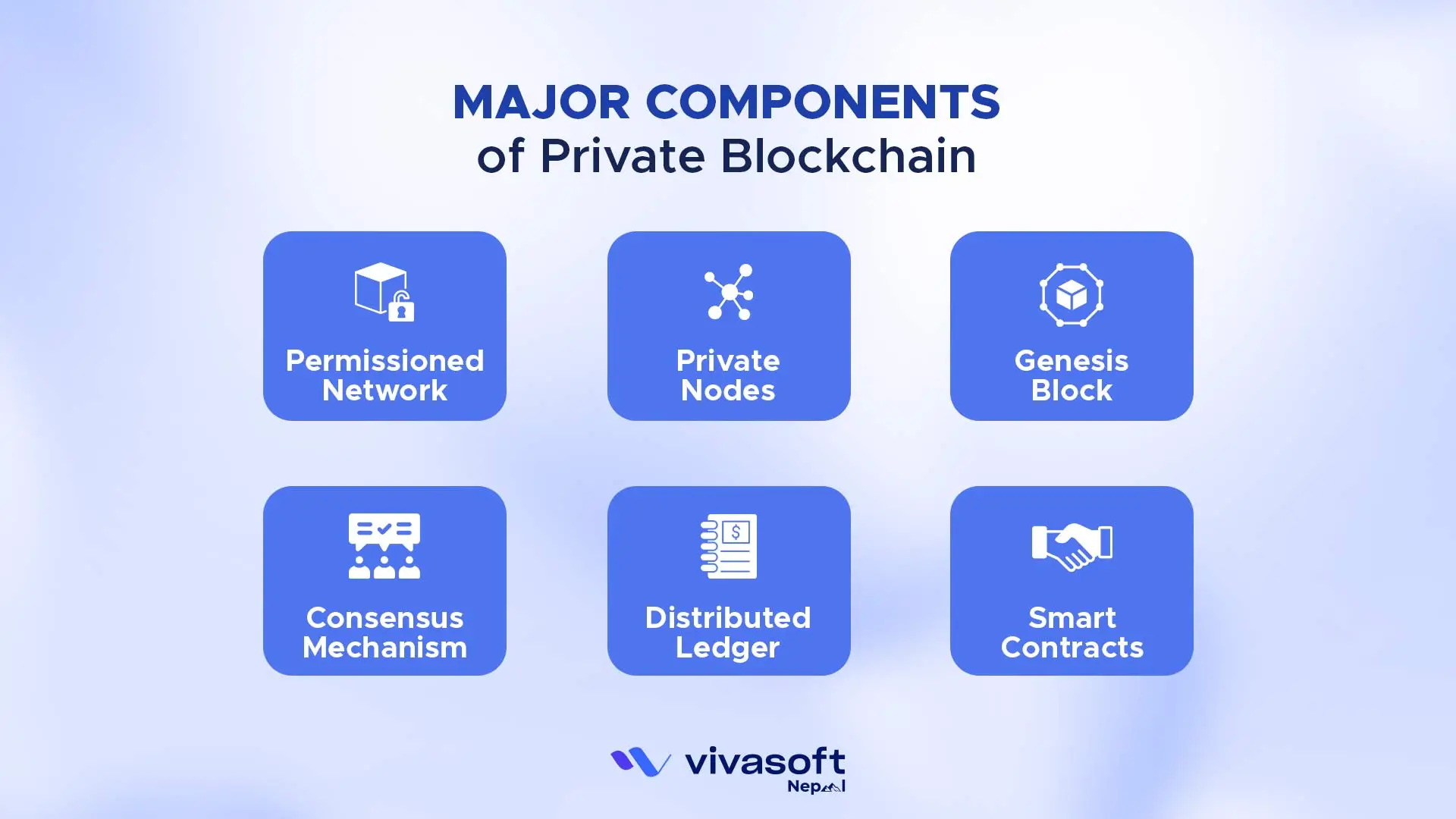
- Permissioned Network: Only authorized participants can access the blockchain ensuring security and controlled participation.
- Private Nodes: A select group of nodes maintains ledger copies and validates transactions. This helps keep the network both safe and efficient.
- Genesis Block: The first block. It starts the network and lays the foundation.
- Consensus Mechanism: Rules like RAFT, PBFT or PoA. They make sure all nodes agree on valid transactions.
- Distributed Ledger: Common record that keeps track of all transactions. Once written it cannot be changed. Only approved participants can access it.
- Smart Contracts: Code that runs itself. It enforces rules and handles tasks automatically on the blockchain.
These core components work together across different blockchain layers to ensure security, scalability, and modularity.
Private Blockchain for Business: A Features Checklist
Private blockchains are built specifically for business environments where privacy matters, transactions need to be quick, and access can’t just be open to anyone on the internet. Here are some of the key features:
Control Over Access: Only authorized participants can join and interact with the network.
Centralized Governance: Policies and network rules are enforced by the organization or consortium governance.
High Efficiency and Faster Transactions: Permissioned nodes and simple consensus like RAFT or PoA make transactions fast.
Privacy and Confidentiality: Sensitive data is protected and shared only with approved parties.
Smart Contract Automation: Chaincode or smart contracts handle business rules automatically.
Integration and Customization: Connect blockchain easily to ERP, CRM or other systems using APIs or SDKs.
Compliance and Data Governance: Follows regulations like GDPR and financial laws while keeping internal policies in check.
Scalability: The network can easily add nodes or adjust consensus to handle growing transaction volumes.
Cross-chain Interoperability: Use bridges or cross-chain connectors to interact with other blockchains.
Security: TLS encryption, HSM/KMS key management and controlled access control lists (ACLs) protect data and transactions.
Step by Step Guide to Create Private Blockchain Platform
Private blockchains give businesses full control over their data, security and operations deciding who can participate and what actions they can take. Here’s a step by step guide to create a private blockchain:
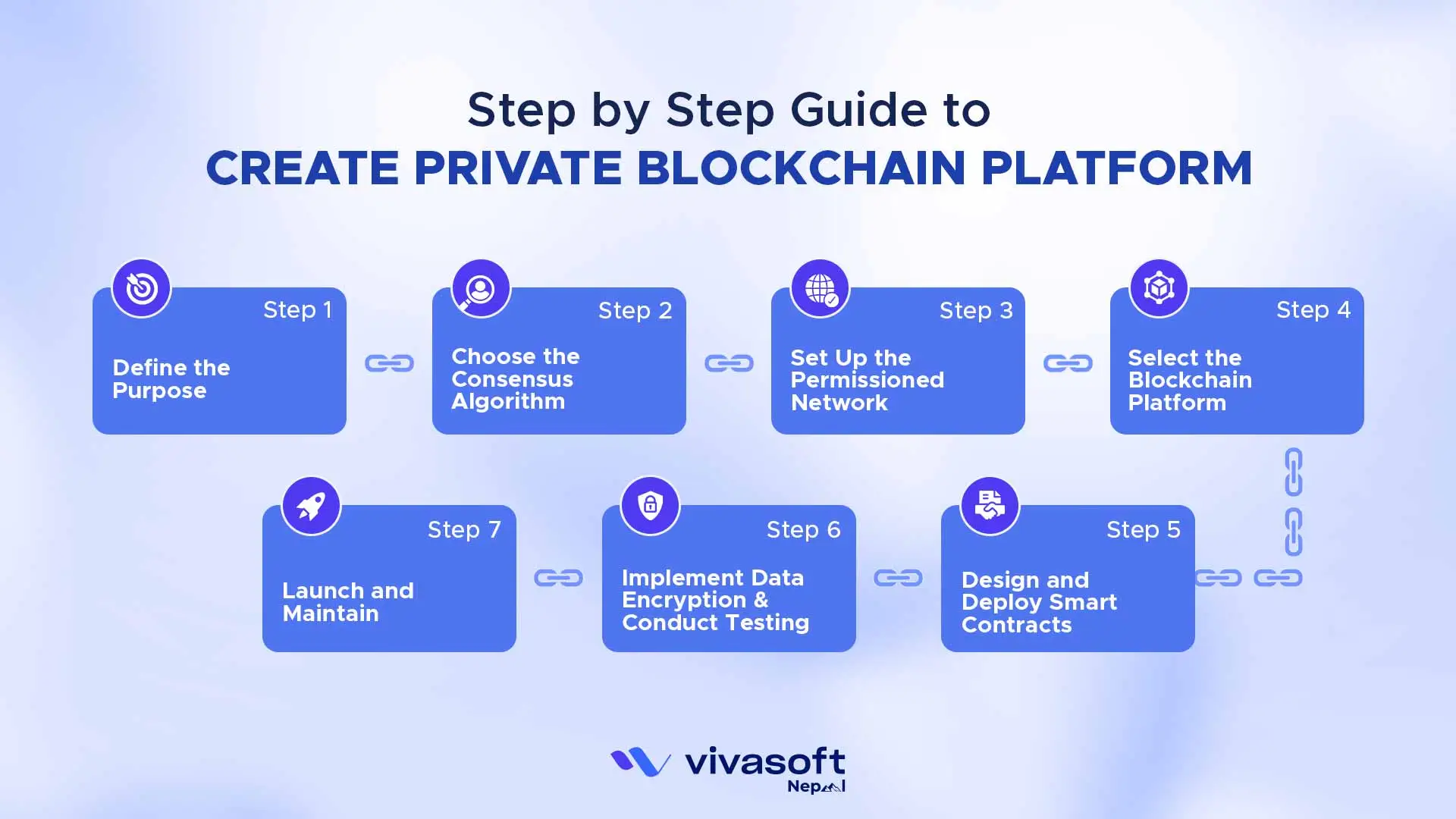
Step 1: Define the Purpose
The first step is to understand why your organization needs a blockchain? A clear purpose guides all your technical decisions later. Determine what issue it will help solve and what objective it should achieve. This understandability assists you to plan the network; choose the right smart contracts and the right consensus algorithm to fit your needs.
Step 2: Choose the Consensus Algorithm
The consensus algorithm is what keeps all member of your blockchain network on the same track. It ensures all participants agree on which transactions are valid. There are several popular options to consider:
- RAFT: Fast and reliable for smaller networks.
- PBFT (Practical Byzantine Fault Tolerance): Ensures safety even if some nodes misbehave.
- IBFT / IBFT2: Ethereum based option designed for permissioned networks.
- Proof of Authority (PoA): Uses trusted validators to sign blocks making it perfect for enterprise environments.
The algorithm you pick affects how fast and secure your transactions are.
Step 3: Set Up the Permissioned Network
Now it’s time to develop your network. Set up nodes, peers, orderers and certificate authorities (CAs). Assign role using role-based access control (RBAC) and secure communication with TLS encryption. Key storage can be handled by HSMs or cloud KMS solutions. A well-structured setup ensures your network is both secure and efficient right from the start.
Step 4: Select the Blockchain Platform
Choose a platform based on your requirements :
- Hyperledger Fabric: Offers modular design, private channels and chaincode for enterprise workflows.
- Quorum: Ethereum-based and privacy-focused which is perfect for finance.
- R3 Corda: Optimized for regulated industries.
- MultiChain: Lightweight and simple to deploy.
Consider developer support and programming languages such as Go, Java, Solidity or JavaScript for building applications.
Step 5: Design and Deploy Smart Contracts
Smart contracts do the work for you like sharing data, approving payments or handling deals. Write and test contracts, deploy them with CLI devices or SDKs. Make sure they follow your network’s access control policies and only allow authorized actions.
Step 6: Implement Data Encryption & Conduct Testing
Encrypt what matters most. Use AES or RSA to keep data safe. Store large files off-chain in places like IPFS. Test everything first in a sandbox network. Watch how it performs, how fast it moves and how it handles pressure. Check for security gaps, ensure smart contracts respect access rules and run multiple tests to catch errors early. Fix issues before going live.
Step 7: Launch and Maintain
Once testing is completed go live! Monitor nodes, block production and overall network health. Update chaincode and policies as needed. Keep backups, plan upgrades and monitor the system using tools such as Prometheus or Grafana. A blockchain is a living system, it will remain strong as long as you continue taking care of it.
How Does a Private Blockchain Work?
Private blockchains work in a step-by-step process in order to ensure the security of the data and the reliability of the network. All operations are well controlled to ensure that only the authorized parties are allowed to communicate with each other and ensure that the transactions are done properly.
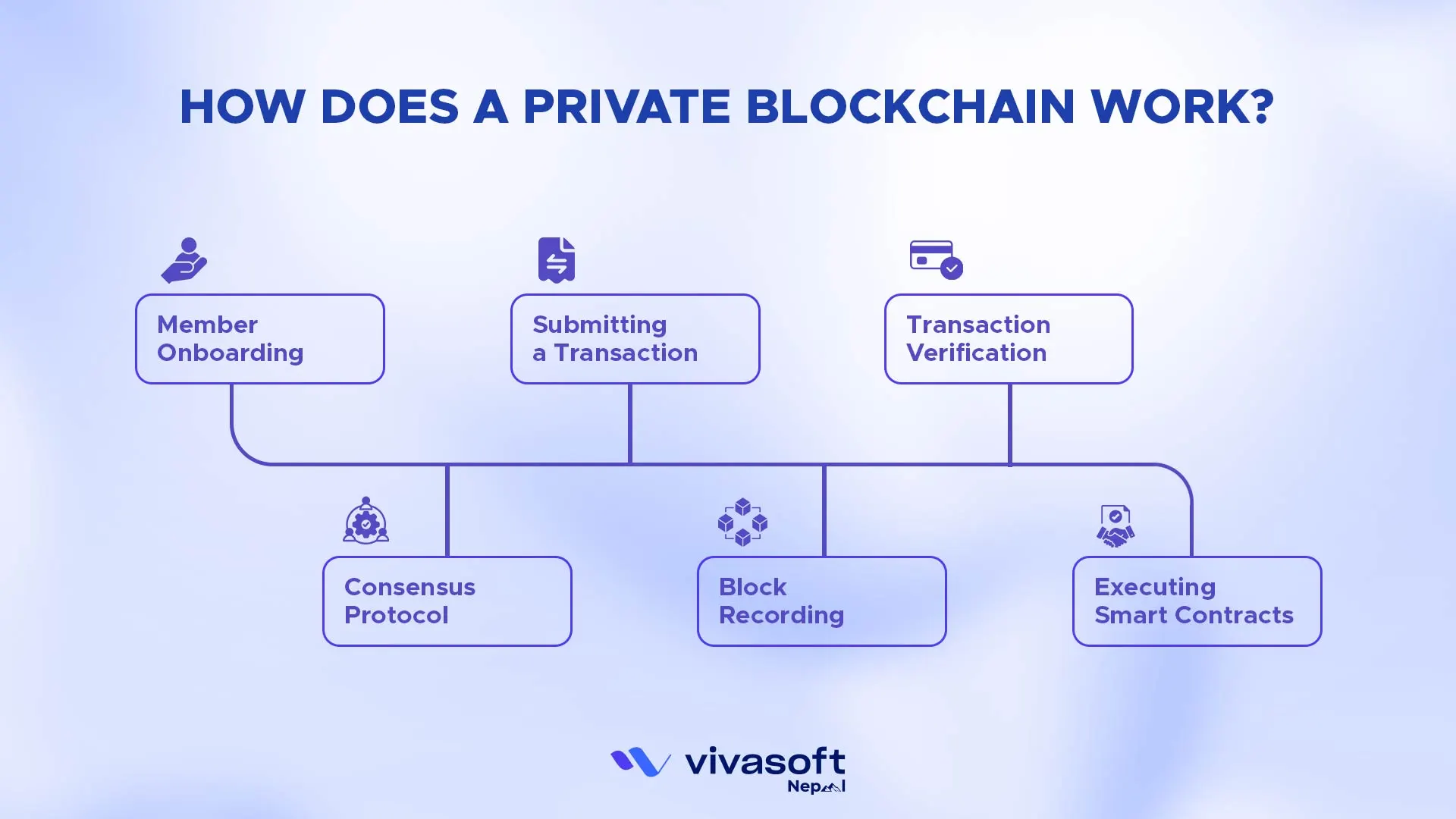
- Member Onboarding: New members are authenticated using X.509 certificates and the members are registered to the network.
- Submitting a Transaction: Transactions request is sent by authorized clients via SDKs or API gateways.
- Transaction Verification: The peers confirm every transaction according to ACLs and network policies.
- Consensus Protocol: Nodes agree on transaction order using RAFT, PBFT, IBFT or PoA.
- Block Recording: Verified transactions are combined into blocks and they are connected to Merkle roots and appended to the ledger.
- Executing Smart Contracts: There are pre-established contracts that automatically apply business rules to the network.
What Are the Advantages of Private Blockchains?
Private blockchains come with a number of advantages for businesses. Let’s take a look at some of the key advantages they provide.
- Enhanced Data Security: Only authorized participants can access sensitive data.
- Faster Transactions: The network will be permissioned which means that transactions will be approved fast and will not take as much time.
- Cost Savings: Automation of processes reduces workload and errors.
- Traceability: All the transactions are documented and may be reviewed by the authorized parties which simplifies accountability.
- Custom Governance: The companies have the ability to establish their rules, roles and policies. They can adjust the blockchain to their requirements.
- Scalability and Compliance: The networks can grow with business needs and regulatory demands.
What Are the Challenges of Private Blockchains?
Private blockchains come with tradeoffs. The permissioned model improves control but can introduce centralization risks, governance overhead and integration complexity.
| Challenge | Mitigation |
|---|---|
| Centralization/trust issues | Use multi-party governance, independent validators, clear audit policies. |
| Limited transparency | Provide auditor roles, logs, and reporting: design "need-to-know visibility carefully. |
| Security & collusion | Harden nodes, separate duties, monitor behavior, and use BFT consensus when needed. |
| Interoperability | Use standard APIs, message queues, and consider bridges or interoperability frameworks. |
| Cost & complexity | Start with a PoC, reuse cloud tooling, and keep architecture simple early on. |
| Governance | Define onboarding, upgrades, dispute handling and exit policies from a day one. |
How Much Does It Cost to Build a Private Blockchain?
The cost of building a private blockchain varies a lot depending on what you’re trying to achieve. A small proof-of-concept can be fairly cheap but a full enterprise grade system with integrations, security layers and with multiple nodes can become a serious investment. Most of the expense comes from development time, infrastructure setup and ongoing maintenance rather than just the initial build.
In simple terms the more complex your business logic, compliance needs and number of participants; the higher the cost tends to be.
Typical price ranges
| Project Scale | Estimated Cost |
|---|---|
| Small-scale pilot / PoC | $30,000 – $150,000 |
| Mid-scale enterprise | $150,000 – $500,000 |
| Large-scale ecosystem | $500,000 – $5,000,000+ |
What Drives the Cost
- Planning & design (consulting, architecture, compliance, legal review):
This is where the project gets shaped before actual development starts. A lot of cost can go here because bad planning early usually creates bigger problems later. - Node setup & infrastructure: Private blockchain needs servers, node configuration, cloud setup and a monitoring tools. Even if the build is simple; infra cost can still add up slowly over time.
- Development team & timelines: The size and skills of your team directly affects the total budget. If the project take longer than expected; cost also stretches more than people usually think.
- Small-team builds (freelancers or small dev shop): This option is cheaper in the beginning and works for MVPs or testing ideas. But sometimes delivery can feel slower or less structured if the project gets bigger.
- Full-scale enterprise teams: Bigger teams cost more but they usually bring stronger processes and better long-term support. For serious business use, this can actually save trouble later.
- Ongoing costs: After launch, the spending does not really stop fully. You still need updates, bug fixes, security checks and system monitoring to keep things running well.
Which Platforms and Tools Are Used for Private Blockchain Development?
Choosing the right platform is one of the most important decisions in private blockchain development. It affects performance, scalability, integration options and even long-term maintenance costs. Most enterprise systems rely on a framework that are designed specifically for permissioned networks rather than public crypto environments.
A strong platform choice usually depends on industry need, compliance requirements and how much customization is needed.
- Hyperledger Fabric: It is widely used for modular enterprise blockchain systems with strong privacy controls
- Corda: It is popular in finance and regulated industries due to its point-to-point data sharing model
- Quorum: Ethereum-based solution optimized for private transactions and enterprise use
- Hyperledger Besu: Supports both public and private network configurations
- IBM Food Trust: It used in supply chain and food industry tracking
- Polygon Supernets: Designed for scalable, customizable enterprise blockchain deployments
Enterprise Use Cases of Private Blockchain
Private blockchain is not just theory anymore; it is actively used in real industries where data control and trust matter more than public visibility. The main idea is to reduce friction between organizations while keeping sensitive information protected.
| Industry | Use Case | Benefits | Example Platforms |
|---|---|---|---|
| Supply Chain | Track provenance and handoffs | Traceability, fewer disputes, audit-ready records | Hyperledger Fabric, IBM Food Trust |
| Finance | Internal settlement and reconciliation | Faster settlement, shared truth, automation | Quorum, Corda |
| Healthcare | Secure sharing of medical record references | Privacy, controlled access, compliance support | Hyperledger Fabric, Corda |
| Manufacturing | Parts tracking and quality audits | Better recall handling, less fraud, visibility | Fabric, Besu |
| Insurance | Claims processing automation | Reduced processing time, fewer manual checks | Corda, Quorum |
What Are the Best Practices for Using Private Blockchain Development?
Building a private blockchain is not just about setting up nodes and writing smart contracts. Long term success depend on governance, security design and how well the system adapt over the time.
- Use permissioned networks for controlled access rather than open participation
- Strong encryption & security design, including key management and secure identity systems
- Compliance by design so regulatory requirements are considered from the start
- Smart contract auditing & testing to avoid logic bugs and financial or operational risks
- Network resilience & scalability planning so performance does not degrade with growth
- AI-enhanced automation where smart contracts can trigger smarter decision-making over time
Build a Private Blockchain for Your Business with Vivasoft Nepal
Enterprises often need more than a blockchain framework; they need the whole system around it. Vivasoft Nepal supports private blockchain initiatives through consulting, platform selection, network design, smart contract development, deployment, integration and monitoring. The goal is not just to launch a network but to keep it reliable and secure after launch as well.
Want a secure, scalable blockchain for your business? Let’s talk. If you already have an idea or an early prototype; a short architecture audit can helps to identify risk early and set a realistic roadmap for production rollout.
FAQs
Can private blockchains interact with public blockchains?
Yes. Private networks can interact with public chains using bridges, oracles or gateway services. This is useful when you want to anchor proofs publicly while keeping sensitive data private.
How scalable is a private blockchain for growing enterprises?
Scalability depends on platform choice, network size, consensus settings and infrastructure. Private chains can scale well, but only if you plan for monitoring, node capacity and partitioning data access (channels or subnets) early.
Is Ethereum a public or private blockchain?
Ethereum mainnet is public. However Ethereum compatible clients like Besu or Quorum can be configured to run private, permissioned networks.
Is private blockchain decentralized?
It can be partially decentralized but it is usually less decentralized than public networks because membership and governance are controlled. Some private networks distribute governance across multiple organizations to reduce central control.
Is private blockchain faster than public?
Often yes. Private networks have fewer nodes and more efficient consensus, so transaction finality can be faster and more predictable. But “faster” also depends on configuration and infrastructure.
Is Ripple a public or private blockchain?
Ripple (XRP Ledger) is generally considered a public blockchain; though it uses a unique consensus model and has specific validator dynamics.
What is a private enterprise blockchain?
It is a permissioned blockchain designed for business use, with controlled membership, governance rules, identity management and compliance friendly data handling.
How to import private key blockchain?
If you mean importing a private key into a wallet or node clieny; the exact steps depend on the platform (Ethereum wallets, Fabric identities, etc). In enterprise settings; keys should be managed through secure vaults or HSM/KMS rather than manual imports.
What is the point of a private blockchain?
The point is controlled collaboration: a shared ledger across known parties with auditability, automation via smart contracts, and reduced disputes without exposing sensitive data publicly.
Are private blockchains decentralized?
They can be distributed across several entities, but governance is permissioned. Some networks are basically centralized with multiple nodes while others share governance among partners which is more decentralized.
Is consortium blockchain faster than private blockchain?
It can be similar. A consortium chain usually has multiple governing organizations, which can add coordination overhead. Performance depends more on consensus design and node infrastructure than the label.
Why are private blockchains faster?
Because they avoid expensive open consensus methods, have fewer validators, and can tune network parameters for known participants. They also usually have better controlled infrastructure.