


When you look at how the global tech landscape is shifting right now; software outsourcing Nepal is rapidly moving from a fallback option to a mainstream strategy. While traditional outsourcing powerhouses like an India, the United States or Ukraine have dominated the conversation for years; places like Kathmandu are quietly building incredibly capable developer communities. It’s cementing the country as an emerging tech hub for 2026, perfect for companies looking to innovate without burning through their financial runway.
But recognizing the talent is really only half of the battle. Simply hiring external help isn’t enough, if you don’t choose the right engagement framework even the most skilled teams can suffer from the misaligned priorities and budget overruns. You need to implement the right models to match your specific project goals. This guide breaks down the essential outsourcing models 2026 has to offer; helping you figure out exactly how to structure your partnerships for maximum success.
What Are Software Development Outsourcing Models?
Software development outsourcing models are essentially the different ways companies organize and manage work with an external development teams. It’s not just about handing over a project to another company; it’s about defining how responsibilities are shared; how communication flows and how progress is tracked. Without a clear model in place even simple projects can start to feel unstructured pretty quickly.
In the context of Nepal, this becomes even more relevant. As more international clients begin working with Nepali teams, having a defined approach helps avoid confusion on both sides. Some companies prefer long term collaboration with dedicated teams while other only outsource specific tasks or short-term projects. Each model comes with its own trade-offs so choosing one isn’t just a formality; it directly affects timelines, cost control and overall quality.
Why Businesses Outsource Software Development?
Outsourcing software development lets companies reach skilled talent worldwide, lower their operational costs a lot and get products out faster, often without losing much on quality.
1. Access to Global Talent
Outsourcing lets companies work with skilled developers outside their own country. Nepal for instance, is producing more engineers who can handle international projects and have strong technical skills. This help companies to tap into expertise that might not be available locally.
2. Cost Efficiency
Building an in-house team can be very expensive; especially in high cost regions. Outsourcing help reduce these expenses while still keeping quality reasonable. Companies can invest the saved budget into marketing, research or other growth areas.
3. Faster Time to Market
Working with external teams allow development to move faster since multiple parts of a project can be handled in parallel. This is especially useful for the startups or companies aiming to beat competitors to launch.
4. Focus on Core Competencies
Instead of stretching their own teams too thin; companies can concentrate on strategy, growth or customer engagement while outsourced teams take care of the technical work. It helps businesses maintain focus without compromising project progress.
What Are Types of Software Development Outsourcing Models?
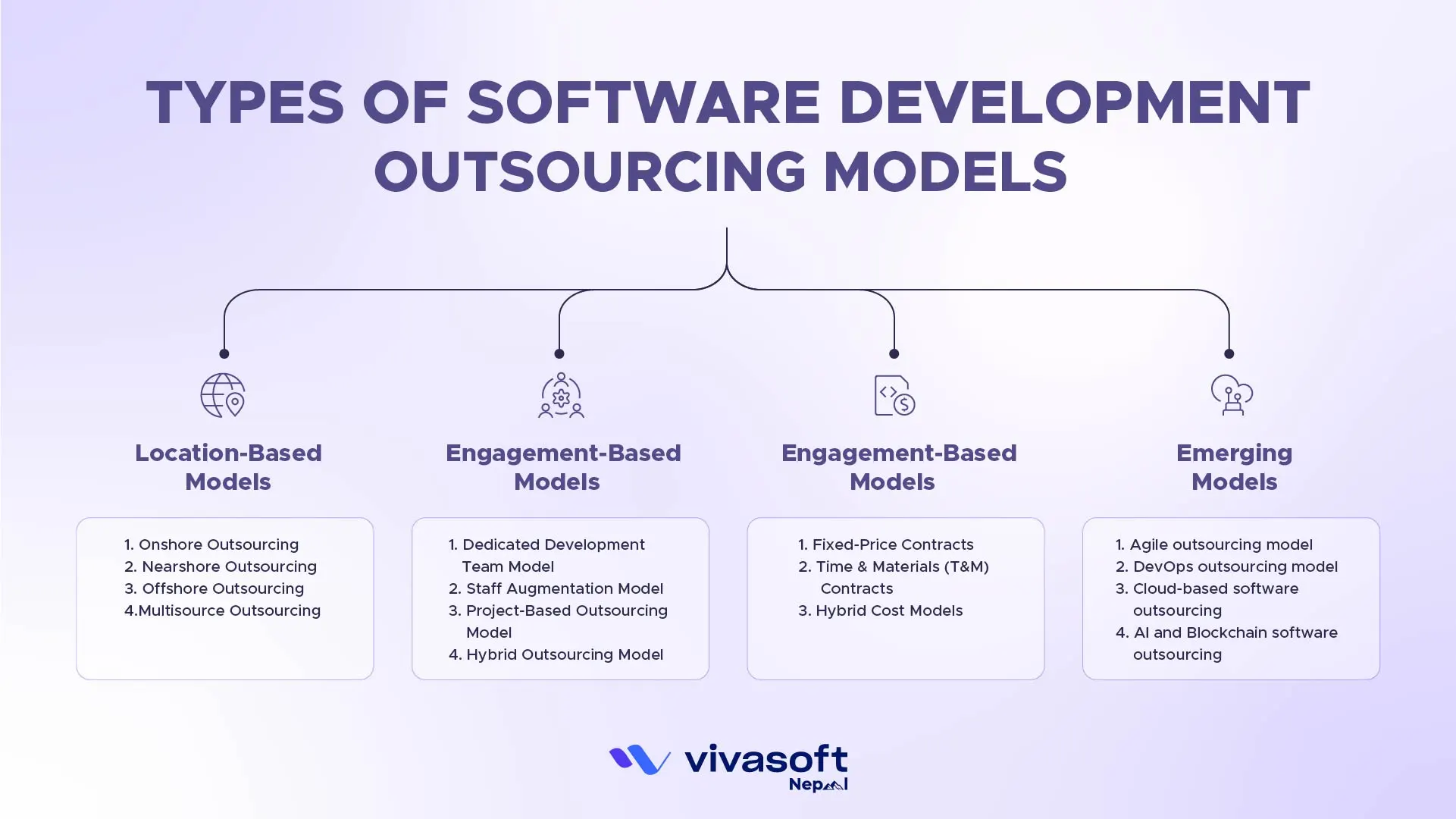
Outsourcing isn’t the same for every company. The way you work with outside team depends on things like location, how involved the team is and how you want to handle costs. Picking the right model is key to getting good results without running into unnecessary problem.
1. Location-Based Outsourcing Models
Geography plays a huge role when you decide where to send your work, directly impacting communication overlap and overall cost.
- Onshore Outsourcing: This involves hiring a development partner within your own country. It’s the most expensive option but offers the smoothest communication since time zones and expectations are identical.
- Nearshore Outsourcing: Partnering with a team in a neighboring country or similar time zone. It offers a nice middle ground better cost savings than onshore without the extreme time differences.
- Offshore Outsourcing: Offshoring is hiring teams in distant countries. Opting for offshore development Nepal, for example, offers massive cost benefits and lets you keep development running around the clock.
- Multisource Outsourcing: Here, a company works with multiple vendors from different geographic locations simultaneously. Great for risk mitigation and finding the absolute best talent for distinct project parts.
Quick Comparison:
| Aspect | Onshore | Nearshore | Offshore | Multisource |
|---|---|---|---|---|
| Characteristic | Same country as client | Neighboring country | Distant country | Multiple vendors globally |
| Pros | Easiest communication | Good cost balance | Highest cost savings | Best-of-breed skills |
| Cons | Highest rates | Slightly higher costs | Big time differences | Complex to coordinate |
| Use Case | High-security projects | Agile projects needing syncs | Budget-focused builds | Massive enterprise apps |
2. Engagement-Based Models
Engagement models determine just how involved you and the vendor are in the daily grind of building the software.
- Dedicated Development Team Model: You hire a complete, self-sustaining team such as developers, QA, project managers; that works exclusively on your project. They act practically as an extension of your own in-house staff.
- Staff Augmentation Model: Instead of a whole team, you “rent” specific individual developers to fill gaps in your existing in-house team. You still manage the project and hold onto the leadership reins directly.
- Project-Based Outsourcing Model: You hand off the entire project from start to finish. You agree on the scope, and the vendor’s team handles everything from design to deployment.
- Hybrid Outsourcing Model: This approach blends the models based on project phase. You might use project-based for the MVP, then switch to staff augmentation for long-term support.
Quick Comparison:
| Aspect | Dedicated Development Team | Staff Augmentation | Project-Based Outsourcing | Hybrid Outsourcing |
|---|---|---|---|---|
| Characteristic | Complete external team | Devs added to internal team | Entire project outsourced | Mix of engagement models |
| Pros | Deep project knowledge | Quick skill gap filling | Minimal management overhead | Highly flexible |
| Cons | Can be pricey short-term | Internal management is high | Less client control daily | Can cause scope confusion |
| Use Case | Long-term roadmap items | Temporary bursts of work | Core, well-defined projects | Complex, evolving builds |
3. Contract/Cost-Based Models
How you pay the bills has a big influence on the flexibility and final delivery outcome.
- Fixed-Price Contracts: You agree on a single budget for a clearly defined set of features before coding starts. The vendor assumes the risk, but it leaves almost zero room for changing your mind later.
- Time & Materials (T&M) Contracts: You simply pay for the developer hours actually worked. It’s incredibly flexible for shifting requirements and is the standard for the Agile methodology.
- Hybrid Cost Models: A mix of both. Maybe you agree on a fixed price for the discovery phase, then move to a Time & Materials approach once the iterative coding phases begin.
Quick Comparison:
| Aspect | Fixed-Price | Time & Materials | Hybrid |
|---|---|---|---|
| Characteristic | Set price for a scope | Pay by the hour/resources | Combines fixed and variable |
| Pros | Predictable budgeting | Extremely flexible | Balances predictability |
| Cons | Rigid scope | Cost can exceed estimates | Requires careful contract |
| Use Case | Small, defined projects | Long-term software services | Projects varying predictability |
4. Emerging Models & Methodologies
The way outsourcing gets done is quickly evolving to keep up with modern tech demands.
- Agile outsourcing model: Instead of writing a giant spec document Agile outsourcing integrates the vendor into iterative sprints; focusing on continuous delivery and fast feedback loops.
- DevOps outsourcing model: This goes beyond just writing code to handling the entire infrastructure, deployment and operation; ensuring apps are scalable and reliable.
- Cloud-based software outsourcing: Vendors are specializing heavily in building cloud-native apps or migrating legacy systems to modern Cloud computing environments efficiently.
- AI and Blockchain software outsourcing: Companies are increasingly outsourcing Artificial Intelligence integrations or blockchain architectures to niche agencies that already have the rare expertise.
What Are Advantages and Disadvantages of Outsourcing?
Outsourcing can significantly accelerate product development, but like any strategic decision, it comes with both benefits and trade-offs that businesses need to evaluate carefully.
Key Advantages
Outsourcing gives access to skilled global talent quickly, helps stretch your budget, and adds flexibility so projects can move faster.
- Cost savings & budget efficiency: It lowers operational costs, letting companies get more work done without having to hire a full time team which also saves money for other things.
- Flexibility & scalability: You can quickly make your team bigger or smaller based on what the project needs without dealing with the hassle of long term hires.
- Access to niche skills: Outsourcing makes it simpler to get expert for rare or specific technologies when needed without having to hire them full time.
- Improved software quality: Working with external team often bring better processes and testing practices which can make the final product more reliable and less buggy than if only handled in-house.
Key Disadvantages
Even though outsourcing has a lot of benefits working with external teams also comes with real risks. Things like communication problems, cultural differences or IP security issues can cause headaches if not handled properly.
- Language & cultural barriers: Different languages or work cultures can sometimes leads to misunderstandings or slow down project progress if not noticed.
- Communication challenges: Remote teams can create delays in feedback or decision making; specially if there aren’t clear ways to communicate.
- Knowledge transfer & IP risks: Sharing your ideas with outside teams always has some risk. Legal agreements and security measures are really important here.
- Dependence on external teams: Relying too much on an outsourced vendor can be a problem if they change priorities or have any internal issues, that might affect your project timeline.
How to Select Vendors and Manage Contracts & Legal Considerations in Outsourcing?
A successful partnership relies just as much on the paperwork and vetting processes as it does on actual coding abilities.
1. Vendor Evaluation Criteria
Don’t just look at their hourly rate. Dig into their portfolio, read past case studies and check if they have actual experience in your industry. It’s carefully evaluating communication during interviews to confirm tech stack alignment.
2. Key Performance Indicators in Outsourcing
You need ways to measure if things are actually working. Track metrics like sprint velocity, bug density, and cycle time to keep the vendor accountable with objective data.
3. Contract Management Tips
- Fixed-price vs T&M vs Hybrid contracts: Pick the contract type that matches your project. Fixed-price works best for clear, predictable scopes. T&M is better when experimenting or requirements might change. Hybrid can mix both approaches but needs careful tracking.
- SLA performance tracking: Actively track server uptime, response times to bugs and support availability.
- Negotiation clauses: Ensure contracts cover exit strategies, transition periods and outlines for scope creep.
4. Intellectual property & legal compliance
GDPR compliance: If your app touches European user data, strict GDPR privacy rules must be written into the contract.
IP protection & risk mitigation: Sign NDAs early. The contract must state that all code belongs 100% to you upon payment.
Cybersecurity compliance: Vendors must follow modern security standards and be transparent about preventing accidental leaks.
5. Managing Multiple Vendors & Distributed Teams
When working with several vendors or remote teams; it is easy for tasks to overlap or get missed. Using a central tools like Jira keep everyone on the same page. A strong project manager is crucial to coordinate teams, track progress and make sure communication flows smoothly across all groups.
How to Manage Projects, Communication, and Risks in Software Development Outsourcing?
A great outsourcing relationship requires continuous effort; you can’t just set it and forget it.
1. Time Zone and Remote Collaboration Management
When teams are in different countries, time differences can slow things down. Identify golden hours where everyone can join important meetings while leaving most work asynchronous. This keeps collaboration smooth without forcing everyone to work odd hours.
2. Communication Strategies and Tools
Clear communication is key with remote teams. Over communicate rather than assume understanding. Use Slack for the quick updates, Zoom for blockers or demos and keep everyone aware of who handle what. Regular check-ins helps to avoid delay and confusion across time zones.
3. Cultural Differences and Sensitivity Training
Acknowledging working styles goes a long way. Proactively create an environment where developers feel totally safe pushing back on bad ideas and suggesting technical alternatives.
4. Knowledge Transfer Processes
You don’t want to be locked out of understanding your product. Mandate that teams follow a clear custom software development process for documentation and regular hand-offs so your in-house team understands the core architecture.
5. Outsourcing Risk Assessment & Mitigation Strategies
Mitigate risks by doing a small paid test project before signing a long term deal. It requires frequent, small code deployments to spot errors early on.
What Are Some Specialized Software Services Outsourcing?
Nepal’s outsourcing ecosystem offer a wide range of specialized software services; making it easier for businesses to access expert skills without building large in-house teams. Companies can choose services based on project size, complexity or technology requirements whether it’s a simple app or a complex enterprise solution.
- SaaS, ERP, CRM development
- Cybersecurity services
- Software modernization & maintenance
- AI/ML, and Blockchain outsourcing
- Enterprise software development
- Mobile and web app development
- DevOps/Cloud services
Software Development Outsourcing Cost, ROI & Optimization
Understanding the money side of outsourcing helps you justify the investment to stakeholders.
Cost Benefits of Software Outsourcing
Drastically reduced recruitment and hiring costs.
Zero expenses applied toward developer hardware or office space.
Lower hourly rates compared to hiring senior talent locally.
Payment is often tied directly to delivered milestones.
Cost Comparison: Offshore vs Onshore vs Nearshore
When choosing an outsourcing location, understanding cost differences helps businesses balance budget, quality, and time-to-market. The table below summarizes typical rates and value propositions for key regions.
| Region / Model | Typical Hourly Rate (USD) | Notes (2026) |
|---|---|---|
| United States (Onshore) | $100 – $200+ (mid-level to senior) | Highest cost, zero friction, maximum legal safety |
| Eastern Europe (Nearshore/Offshore) | $35 – $70 (avg. range) | Great quality, good middle ground (e.g., Poland, Romania, Ukraine) |
| India / Philippines (Offshore) | $20 – $50 (avg. range) | Tremendous scale and cost savings; India has the world's largest talent pool |
| Nepal (Offshore) | $20 – $45 (avg. range) | Emerging market with talent; growing IT hub in Kathmandu |
Cost Optimization Strategies
- Start with a stripped-down MVP to test assumptions cheaply.
- Utilize open-source tech to avoid hefty enterprise licensing.
- Continuously monitor cloud server usage to avoid inefficient code jacking up bills.
Measuring ROI in outsourcing projects
ROI isn’t just about the money saved on salaries. Measure it by looking at the accelerated timeline; how much faster did they get your product to market, and what revenue was generated?
Vendor Retention Strategies & Scaling Teams
Treat outsourced developers like genuine team members. Celebrate their specific wins and involve them in the broader company vision to retain top senior devs on your account.
Outsourcing Marketplaces, Platforms, and Directories
For serious software development services Nepal engagements, engaging directly with established local firms that have a proven corporate track record often performs better than relying strictly on freelancer directories.
Trends & Future Outlook
As we look toward the future, the outsourcing landscape is shifting quickly
- Software outsourcing trends: We’re seeing a shift from just hiring to seeking true strategic partnerships. Companies expect vendors to act as consultants on system architecture rather than just blindly writing whatever code is requested.
- Emerging outsourcing markets: While hubs like Bangalore remain huge, the next wave of tech centers is rising up. Nepal and Vietnam are becoming major players by offering excellent English proficiency and strong technical university pipelines.
- Innovation strategies in outsourcing: Vendors are increasingly using their own internal proprietary tools to speed up work. Many use automated scaffolding for the boring backend plumbing, saving billable hours for complex logic.
- Technology stack considerations: Simple websites are out; complex microservices architectures are the norm. You have to ensure your partner isn’t stuck using outdated tech and has an active culture of upskilling.
- The future of software development outsourcing: With remote work normalized, an IT outsourcing Nepal team in 2026 will simply feel like a remote department of your own company. The focus will be entirely on quality and seamless integration.
Conclusion
At the end of the day, there’s no single “best” outsourcing model, it really comes down to how your project is structured and what kind of internal support you already have. If you’re starting from scratch and don’t have much technical direction, a project-based approach can give you a clear path. But if you already have a team in place, then staff augmentation or a dedicated team usually makes more sense to fill gaps and keep things moving without slowing everything down.
Location also plays a role here. Onshore gives you more control and easier collaboration, but it’s expensive. Offshore options like Nepal’s best software companies are much more cost-effective and are getting stronger in terms of talent, though you do need to be a bit more intentional with communication and coordination.
In the end, outsourcing works best when you treat it like an actual partnership, not just a way to save money. Picking the right model, being clear about expectations, and staying involved throughout the process makes a big difference. If those things are handled well, outsourcing can genuinely speed things up and help you build better without stretching your resources too thin.
Frequently Asked Questions (FAQs)
What questions should I ask before hiring an outsourcing partner?
Ask about their specific experience in your niche, how they handle unexpected scope changes, and what their internal QA looks like. Request to speak with the senior developers, not just sales.
Who owns intellectual property (IP) when outsourcing?
Typically the client owns the IP, but this must be explicitly detailed. Ensure your contract has strict clauses stating all source code is transferred to your ownership upon payment.
What are the top outsourcing destinations?
Traditional giants include Philippines, India, Vietnam and Mexico. However, emerging hubs like Nepal are gaining serious traction for 2026 due to growing talent pools and highly cost-efficient delivery.
How do outsourcing firms estimate project costs?
They gather requirements during a discovery phase, then break the project down into sprints. They estimate hours for each task, multiply by the hourly rate, and add a buffer for testing risks.