


Businesses today clearly need mobile apps to stay relevant but building everything in-house is honestly not as simple as it sounds. Hiring developers takes time; good talent is limited in many regions and the overall cost can quickly go out of control. This is exactly why mobile app development outsourcing is no longer just an option; it is becoming a practical strategy for any growing company.
In fact, the global application outsourcing market is projected to reach around $118.1 billion by 2025 (Statista). That number alone shows outsourcing is not some shortcut or temporary fix but a serious business decision companies are making at scale.
At the same time, markets like Nepal are growing steadily. Studies suggest Nepal’s application development market revenue may reach about $33.1 million by 2025. With increasing government support and international collaboration, the country is gradually positioning itself in the offshore app development space.
This guide will walk you through everything that actually matters like outsourcing models, mobile app outsourcing cost, risks, how to evaluate vendors and where Nepal fits in the global outsourcing map.
By the end of this guide, you will have a clear idea whether you should outsource mobile app development or not and more importantly, how to do it without messing things up.
What Is Mobile App Development Outsourcing?
Mobile app development outsourcing basically means hiring an external vendor to design, build, test and deliver your app instead of doing everything internally. The vendor company handles the full app development lifecycle; depending on the engagement model and project scope you agree on.
It’s important to understand what this is not. It is not randomly hiring developers without structure. It is not about avoiding responsibility. And it is definitely not limited to big enterprises; startups and mid-sized businesses rely on it just as much.
Compared to other ways in-house development gives control but costs a lot and scales slowly. Freelancers are cheaper and flexible but not always reliable long term. IT outsourcing covers many things while mobile app outsourcing focuses on delivering a full app. It also changes by location such as onshore, nearshore, offshore and by setup like a dedicated team or staff augmentation.
There are three outsourcing models for different needs:
- Project-based: You contract a vendor for a complete app development cycle. You set the deliverables and timelines far upfront and are best suited for projects with fixed requirements.
- Dedicated team: In this model, you partner with a remote team as an extension of your workforce who are dedicated solely to your app. You can get access to the daily operations and product direction.
- Staff augmentation: This mode helps you hire highly skilled developers to your existing team temporarily. It is especially a must if your in-house team has specific technical gaps and you want an entire team for your project without hiring process individually.
How Outsourcing Differs from Freelancing and In-House Development
Freelancers are usually the most flexible and budget friendly option. You can hire quickly and get small tasks done fast. But coordination becomes tricky especially if you need multiple developers and there’s often no strong accountability system if things go wrong.
In-house development gives you full control. Your team understands your product deeply and communication is easier. But the trade-off is high fixed cost, long hiring cycles and difficulty scaling when project need change.
Outsourcing sits somewhere in the middle. You get structured execution, access to broader technical skills and a defined delivery process while still keeping flexibility compared to building everything internally. It’s not perfect but for many teams; it’s the most balanced option.
In-House vs. Outsourced Mobile App Development
Before choosing any vendor; this is usually the first decision businesses need to make.
| Dimension | In-House | Outsourced |
|---|---|---|
| Upfront cost | High (hiring, setup, tools) | Lower, no hiring overhead |
| Time to start | Slow (weeks to months) | Fast (days to weeks) |
| Tech expertise | Limited to hired team | Access to global specialists |
| Control | Full control | Shared control |
| Scalability | Hard to scale quickly | Easy to scale up/down |
| Risk | Hiring risk, retention issues | Vendor dependency risk |
| Best for | Long-term core products | Faster builds, MVPs, scaling |
For most businesses building their first app or even expanding an existing one; outsourcing tends to be the faster and lower risk path. In-house only really makes sense when the app is central to your entire business model and you plan to maintain a long term engineering team.
Once outsourcing starts to make sense; the next question becomes: freelancer or agency?
Freelancer vs. Mobile App Development Agency: Which Is Right for You?
Freelancers are cheaper and flexible. They work well for small features or quick fixes. But there is usually no team structure, no formal QA process and accountability can become an issue if timelines slip.
Agencies, on the other hand, cost more but bring a full system such as project managers, developers, QA engineers and defined workflows. They also typically include things like IP ownership clauses, structured delivery and better long term support.
If your app involves multiple features, API integrations or anything beyond a simple build, going with an agency is usually the safer call.
There is also a middle ground staff augmentation where agencies provide individual developers who work within your team setup. This works well when you already have a team but need extra expertise.
When Should You NOT Outsource Mobile App Development?
Even though outsourcing sounds efficient; it is not always the right move. There are situations where it can actually create more problems than it solves.
If your app involve highly sensitive algorithms or a confidential data, outsourcing may introduce IP or compliance risk. In such cases keeping development in-house or using a hybrid approach with strict NDA controls is safer.
Another situation is budget. If your total budget is under $5,000, outsourcing won’t magically deliver a full product. At that level, it’s better to define an MVP (minimum viable product) first and then expand later.
Outsourcing also struggles when there is no clear scope. If your project requires constant daily changes with no structured plan; it can lead to scope creep, delays and rising costs. Remote teams work best with defined direction.
Lastly, if you don’t have a product manager or technical lead on your side, outsourcing becomes risky. Vendors can build what you ask but if no one is validating decisions, the final product might not meet expectations.
Why Outsourcing Mobile Application Development to Nepal?
Through outsourcing mobile app development, you get access to a global-standard service. They offer local pricing advantages and a strong professional commitment that is rare. Here is what you can expect:
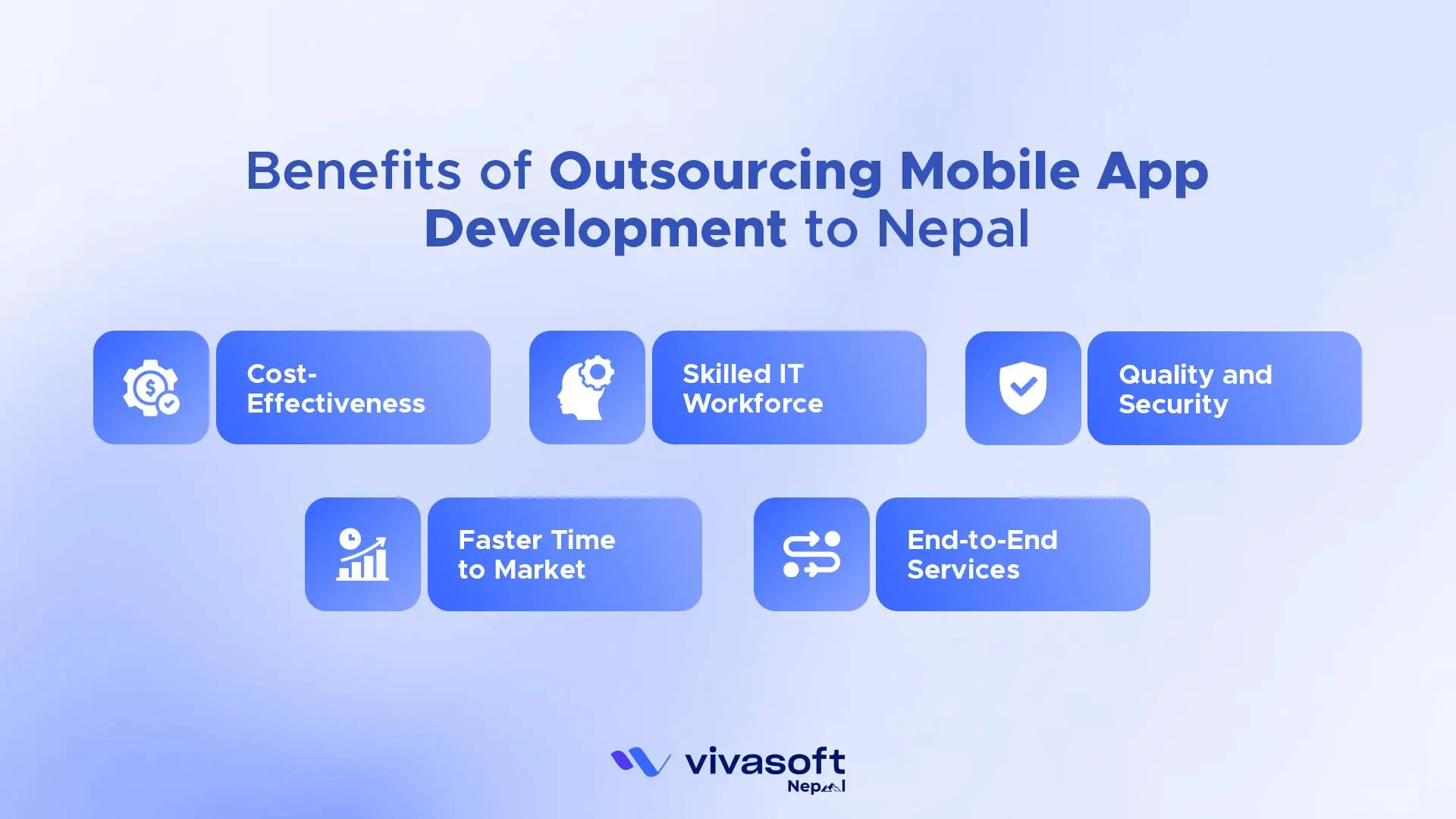
- Cost-Effectiveness: Nepal provides notably lower development costs compared to Western countries, and it is not far that you can save 60–80% with optimal quality. You can set a budget to have more innovation or marketing strategies. Moreover, favorable exchange rates of Nepal and reduced overhead, such as office setup costs or fixed payroll, offer long-term savings.
- Skilled IT Workforce: Nepal developers are highly proficient in both native and cross-platform technologies. Many even have advanced degrees, success rates in open-source projects, and expertise in international projects. With such a young and technically enhanced IT workforce, you can guarantee meeting global standards in your next app development project.
- Quality and Security: Leading Nepali IT firms such as Vivasoft follow Agile methodologies and maintain efficient communication throughout projects. Besides, they follow industry best security measures. Such as handling encrypted protocols and managing secure API development. Moreover, most companies here are ISO-certified, so you can ensure that your app meets international privacy regulations.
- Faster Time to Market: Nepal’s UTC+5:45 time zone offers “follow-the-sun” development cycles with clients in Europe and North America. Experienced offshore teams and agile processes ensure to completion of the project with efficient sprint cycles and timely delivery. You can reduce the overall time to market compared to local hiring.
- End-to-End Services: Nepali IT companies offer a complete package of services ranging from initial concept design and UI/UX to coding, backend integration, testing, and deployment. They even cover a wide range of industries, including finance, e-commerce, telecom, and health. You are likely getting a one-stop solution that offers consistent project execution.
| Factor | Nepal | India | Vietnam | Eastern Europe |
|---|---|---|---|---|
| Avg. hourly rate | $15–$35 | $20–$50 | $20–$45 | $40–$80 |
| English proficiency | High | High | Medium | Medium |
| Time zone | UTC+5:45 | UTC+5:30 | UTC+7 | UTC+1–3 |
| EU overlap | 2–4 hrs | 2–4 hrs | 3–5 hrs | 6–8 hrs |
| US overlap | Narrow evening | Narrow evening | Narrow evening | Morning overlap |
| ISO certification | Yes | Yes | Limited | Yes |
| Talent pool size | Medium | Large | Medium | Large |
| Cultural alignment | High | High | Medium | Medium |
Nepal’s smaller pool means senior developers can dedicate more attention per project, improving communication and project quality. For businesses seeking reliable offshore partners, these factors often outweigh sheer scale.
Onshore vs. Nearshore vs. Offshore: Where Nepal Sits
Onshore Outsourcing
This involves hiring a development partner within your own country. It’s the most expensive option but offers the smoothest communication since time zones and an expectations are identical.
Nearshore Outsourcing
Partnering with a team in a neighboring country or similar time zone. It offers a nice middle ground better cost savings than onshore without the extreme time differences.
Offshore Outsourcing
Offshoring is hiring teams in distant countries. Opting for offshore development Nepal, for example, offers massive cost benefits and lets you keep development running around the clock.
For US, UK and EU clients, Nepal is offshore. Practically, this means communication is often async-first, with sprint demos over video calls and milestone based oversight. Offshore doesn’t mean uncontrolled ; it just means structured, documented collaboration that aligns with your internal processes.
What Are the Outsourcing Models for Mobile App Development?
There are now four main models to consider when outsourcing:
Fixed-Price Model
The fixed-price model works best when your app’s scope is fully defined from the start. In this model, the cost, timeline and deliverables are agreed upfront and payments are usually tied to milestones. It’s simple to plan for but if your requirements change during development, it can lead to disputes or delays. This model is typically used for MVPs, redesigns or building specific features where everything can be clearly specified before starting.
Dedicated Development Team
The dedicated development team model is ideal for long term projects or apps that will keep evolving. Here, you lease a full team like project manager, developers, QA and UX designers who work exclusively on your project. You direct the product goals while the team handles execution. This model fits SaaS platforms, marketplaces or enterprise apps that needs ongoing development and close collaboration.
Staff Augmentation
Staff augmentation is used when your internal team need extra skills temporarily. The vendor provides individual developers who integrate into your existing workflows, tools and processes. This is helpful for filling technical gaps like adding a Flutter developer, a backend engineer for a sprint or scaling quickly during a product launch without hiring a full time staff.
Time-and-Material (T&M) Model
The time-and-material (T&M) model is for projects with evolving or unclear requirements. You pay for the actual hours worked and the scope can expand or contract as needed. It’s very flexible but requires active oversight to prevent budget overruns. Typical use cases include discovery phases, R&D builds or apps still in early product market fit stages.
How to Outsource Mobile App Development: Step-by-Step Process
Outsourcing mobile app project work best when you follow a structured approach. This helps to reduce risks, manage costs and ensures that your app is delivered on time with high quality. Here is a practical step by step guide :
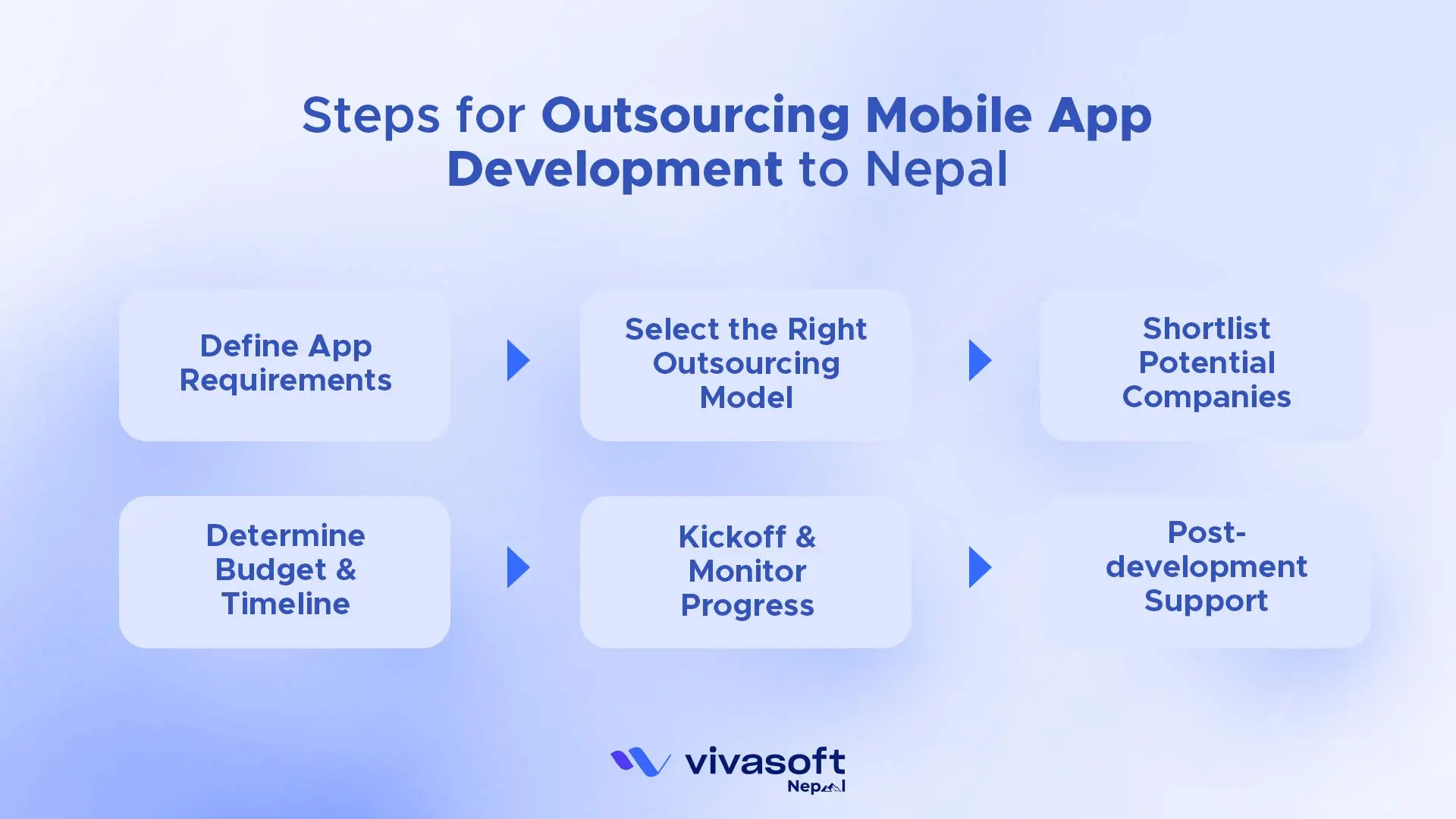
Step 1: Define Your App Blueprint
Start by documenting your core functionality, target platforms (iOS, Android or both), target users and key user flows. Make a short product brief or functional specification (FSD), even 1–2 pages, so developers know what’s essential versus nice-to-have. Creating wireframes at this stage can save 30–50% of revision time later.
Step 2: Set Your Budget and Complexity Tier
Decide your realistic budget range before talking to vendors. Classify your app:
- Simple: 3–5 screens, no backend, no real-time features
- Medium: backend, APIs, user accounts, 10–20 screens
- Complex: real-time features, AI/ML, payments, analytics
Add a 20% contingency for QA, revision cycles and App Store submission costs.
Step 3: Choose Your Outsourcing Model
Refer back to the four models covered earlier: Fixed-Price, Dedicated Team, Staff Augmentation, T&M. Match your project needs:
- Fixed scope: Fixed-Price
- Evolving scope: T&M or Dedicated Team
- Skills gap: Staff Augmentation
Step 4 :Research and Shortlist Partners
Search platforms like Clutch.co, G2, GoodFirms, LinkedIn or get direct referrals. Look for:
- Relevant industry experience
- Portfolio depth
- Tech stack match
- Client review volume
Shortlist 3 to 5 candidates before outreach.
Step 5: Vet Candidates: 9 Questions to Ask
Ask each vendor these critical questions:
- Can you show case studies in my industry or app type?
- Who will be my dedicated point of contact?
- How do you handle scope changes after sign-off?
- What security certifications do you hold?
- How is IP ownership transferred at project completion?
- What does your QA process look like, who defines “done”?
- Which project management tools will be used and will I have access?
- What is included in post-launch support? Any SLA?
- Have you worked with clients in my time zone before and how did you manage it?
Each question matters: they reveal experience, transparency and your control over the project.
Step 6: Protect Your IP: NDA and Contract Essentials
Always sign an NDA before sharing business logic or product ideas. Ensure your contract includes:
- Scope of work
- Milestone-based payments
- IP transfer clause (ownership to you)
- Termination conditions
- Bug-fix SLA for post-launch support
Think of this as practical legal guidance; protecting your app idea without slowing down the workflow.
Step 7: Set Up Communication and Project Management
Agree on tools upfront:
- Tasks: Jira or Linear
- Async communication: Slack or Teams
- Documentation: Notion
- Video updates: Loom
Define cadence: weekly sprints, bi-weekly demos, monthly retrospectives. Set response SLAs for async queries (e.g., 24 hours for non-urgent).
Step 8: QA, Testing, and Acceptance Criteria
Define “done” for each feature before development starts. Ask about:
- Unit testing
- Integration testing
- User Acceptance Testing (UAT)
- Device compatibility
Client sign-off should happen per feature not just at the end. Avoid vendors that test only after full development.
Step 9: Plan Launch and Post-Launch Support
Include App Store submission timelines (Apple: 1–3 business days, Google Play: similar). Arrange post-launch support (usually 30–90 days for bug fixes). Plan ongoing maintenance and user feedback cycles. Ask about retainer options if you expect continuous updates.
How Much Does Mobile App Development Outsourcing Cost?
Understanding mobile app outsourcing cost is critical to planning your project. Costs vary by region, app complexity and engagement model. Below is a clear breakdown.
Cost by Region
| Region | Avg. Hourly Rate | Simple App | Medium App | Complex App |
|---|---|---|---|---|
| United States | $120–200/hr | $40K–80K | $100K–200K | $200K+ |
| Western Europe | $80–150/hr | $30K–60K | $80K–150K | $150K+ |
| Eastern Europe | $40–80/hr | $15K–35K | $40K–100K | $100K+ |
| India | $20–50/hr | $8K–20K | $20K–60K | $60K+ |
| Vietnam | $20–45/hr | $8K–18K | $18K–55K | $55K+ |
| Nepal | $15–35/hr | $6K–15K | $15K–45K | $45K+ |
Nepal sits at the value-optimized end of offshore pricing while maintaining ISO-standard delivery quality, making it particularly attractive for startups and mid-market businesses.
Cost by App Complexity
Here’s the cost by app complexity:
| App Complexity | Features | Estimated Development Time |
|---|---|---|
| Simple | 3–8 screens, no backend login, no real-time features | 6–12 weeks |
| Medium | Backend APIs, user authentication, payment gateways, 10–20 screens | 3–5 months |
| Complex | Real-time features, AI/ML, third-party integrations, admin panel | 6–12+ months |
Hidden Costs to Budget For
Even with outsourcing, plan for these additional expenses:
- App Store developer accounts: Apple ($99/yr), Google ($25 one-time)
- Third-party API licenses: payments, maps, push notifications
- Post-launch bug-fix window: if not included in contract
- Ongoing maintenance: budget 15–20% of build cost annually
- Marketing and ASO (App Store Optimization): separate from development
Careful budgeting and contingency planning help avoid surprises and maximize ROI.
What Are the Challenges of Outsourcing Mobile App Development (and How to Avoid Them)
Outsourcing mobile app development brings many benefits, but it also comes with risks. Being aware of these challenges and actively managing them ensures smoother delivery and protects your investment. Below is a structured overview of common risks and ways to avoid them:
| Risk | How to Avoid It |
|---|---|
| Communication breakdown | Set weekly sprint demos, use async-first tools (Slack, Loom, Notion), define response SLAs in the contract |
| Data security breach | Require ISO 27001 or SOC 2 certification, sign NDA, audit third-party API access |
| Scope creep and budget overrun | Lock scope in a signed functional specification; use T&M model only when scope is genuinely uncertain |
| Quality inconsistency | Define acceptance criteria per feature; conduct QA throughout development, not just at the end |
| IP ownership dispute | Include clear IP transfer clauses in the contract; vendor retains no code rights after final payment |
| Delayed delivery | Tie milestone payments to delivery; include delay penalty clauses |
| Long-term vendor dependency | Ensure code is transferred to your repository at each milestone; avoid vendor-only hosting |
Mobile App Outsourcing Trends in 2026-2027
Mobile app development is moving quickly and if your outsourcing strategy hasn’t kept up; you’re probably already behind. Here’s what actually matters heading into 2026-2027:
AI and On-Device Machine Learning
A year or two ago, AI felt like a bonus feature. Now it’s basically expected. Users want apps that feel smart personalized feeds, intelligent search, interfaces that adapt to how they behave. What’s changed recently is where that AI runs. More apps are processing things directly on the device rather than sending data to the cloud which means better privacy, faster responses and apps that still work without a strong connection. If you’re outsourcing; it’s worth asking your partner about their experience with CoreML on iOS and TensorFlow Lite on Android.
5G-Native App Design
5G isn’t just about speed; it changes what’s actually possible. Real time collaboration tools, AR features and live streaming with almost no lag were genuinely hard to pull off on 4G. The shift now is designing with low latency as a priority not just assuming users have fast internet. Testing on real networks not just office Wi-Fi, makes a big difference here.
Cross-Platform Development (Flutter and React Native)
Flutter has become the go to for teams that want one codebase across iOS and Android. React Native still makes a lot of sense if you’re moving an existing web product to mobile. Either way, the quality of the engineers matters more than the framework; look for senior developers not just someone who’s “worked with it before.”
Security and Compliance by Default
Regulations like GDPR and CCPA aren’t going away and app stores are getting stricter too. Security can’t be an afterthought anymore. Before kicking off a project; make sure your vendor can explain how they handle data, what SDKs they use and how they stay compliant throughout development.
Best Practices for Successful Mobile App Outsourcing
Outsourcing mobile app development can be smooth if you follow some simple best practices. Missing these can lead to delays, confusion and extra cost. Here are the main things to focus on:
Document Before You Develop
Before starting any coding, write down your requirements clearly. Include user stories, acceptance criteria, platform targets, design system preferences and any third-party tools you already use. Even a short functional spec or product brief saves way more time than trying to fix miscommunications later.
Set a Communication Cadence from Day One
Agree with your outsourcing team on a regular communication schedule. Weekly sprint reviews, bi-weekly demo sessions and formal monthly retrospectives help keep everyone on the same page. Don’t rely only on Slack messages, sprint demos force accountability that chats can’t.
Define “Done” for Every Feature
Make sure everyone knows what “done” means before starting work on a feature. Typically, done means coded, tested, reviewed by client, deployed to staging and approved in writing. Without this, features often stay “almost ready” and slow down the whole project.
Plan for Maintenance from the Start
Post-launch support isn’t optional. Negotiate your SLA or maintenance plan before signing the contract. Apps need updates every 6–8 weeks minimum to stay compatible with OS updates and app store requirements. Planning this from day one avoid the surprise costs and downtime.
Why Choose Vivasoft Nepal for Mobile App Development Outsourcing
When you outsource mobile app development, picking the right team is really important. Vivasoft Nepal, a leading mobile app development company in Nepal; has a team of 300+ experts covering frontend, backend, QA and UX. They follow ISO certified processes and agile delivery; so projects move faster without losing quality. Their engineers know Flutter and React Native which make cross-platform development smoother and quicker.
They’ve worked in industries like fintech, e-commerce, telecom and health; so they know how to handle security, compliance and complex features. By focusing on execution, communication and post-launch support; they help apps grow even after launch. If you want to plan your project and pick the right model, Vivasoft Nepal offers a free consultation to help figure out the best approach.
FAQs
Which platform is best for mobile app development?
The choice depend on your target market. Flutter and React Native are popular cross-platform frameworks; letting you build apps for both iOS and Android using a single codebase. Native development gives full access to device features and better performance but may increase cost.
How can I evaluate a Nepali team’s Flutter versus React Native expertise?
Ask for sample projects or code repositories. Review their proficiency in Dart and JavaScript, check live apps or case studies and assess infrastructure choices, API integration and UI quality. A short paid test project is often the most reliable way to evaluate skill.
What realistic timeline should I expect for a mid-complexity app from Nepal?
Three to five months is a fair expectation when you factor in design, development, testing and submission. Some teams move faster but anything that feels rushed usually shows up in the QA phase and fixing bugs post-launch is never fun.
What is the difference between a fixed-price and a T&M model?
Fixed-price means the scope and cost are set upfront with milestone payments, works best when requirements are clear and stable. T&M (Time-and-Material) is more flexible you pay per hour or sprint, good for projects where things can change but needs careful oversight.
How long does it take to outsource and build a mobile app?
A simple app usually takes 6-12 weeks, medium apps 3-5 months and complex apps 6-12+ months. You also needs to add 2-4 weeks for the QA and App Store submission plus 2-3 weeks for discovery and scoping.
How do I manage time zone differences with a Nepal-based team?
Nepal is UTC+5:45. European clients get 2–4 hours of morning overlap; US East Coast clients overlap in the early evening. Use async-first tools like Loom, Notion, Jira and schedule weekly demos during overlapping hours. Most Nepal based companies are experienced with EU and US workflows.
What should I look for when evaluating a mobile app outsourcing company?
When evaluating for the company check for : portfolio relevance, ISO or security certifications, transparent pricing, clear IP ownership, preferred tech stack expertise and a dedicated project manager. Use the 9 vetting questions covered earlier to finalize your choice.
Can I switch outsourcing models mid-project?
Yes and it happens more than you’d think. If your scope grow beyond what a fixed-price contract covers; most vendors will work with you to shift to T&M or a dedicated team arrangement. Just make sure that option is written into your contract from the start.
Which platform should I build first: iOS or Android?
It depend on who you’re trying to reach. Android usually performs better in regions like South and Southeast Asia because of its larger user base. On the other hand , iOS is often the better starting point for markets like North America and Western Europe. You can also go with both at once using cross-platform tools like Flutter or React Native.