


DeFi token development is like a core part of building modern blockchain ecosystems. From governance systems to liquidity-driven platforms, tokens have an important role in how decentralized applications function and grow.
In DeFi, token development isn’t just about launching an asset. Instead, utility-driven DeFi tokens are built around usage, liquidity, and system design that need to work even after the hype fades. That is what separates functional DeFi tokens from short-lived token models like Meme coins, which often rely on hype and timing in the broader crypto space. In this article, we’ll cover every aspect of token development for Defi. Just read on.
What Is a DeFi Token?
A DeFi token is basically a digital asset you use inside decentralized finance platforms. These platforms run on blockchain networks. So you don’t deal with banks or other middlemen. Here, everything works through smart contracts that handle transactions on their own.
You can use DeFi tokens for different things depending on the platform. Sometimes you use them to trade or earn rewards. In other cases, they give you a say in how the project works. For instance, voting on updates or changes. That combination of utility and control makes them important in the DeFi platform developments.
DeFi Token vs. Standard Crypto
| Feature | DeFi Token | Standard Crypto |
|---|---|---|
| Layer | Built on top of existing blockchains (you’ll usually see them on Ethereum-based apps) | Runs as the base layer of its own blockchain |
| Blockchain Role | Tied to apps and smart contracts, not the core network itself | Powers the network and keeps transactions running |
| Primary Purpose | Used for lending, staking, or voting | It’s mostly used to send money, store value, or pay fees |
| Regulation | Still a bit unclear in many regions, rules keep changing | Slightly more defined, but still varies country by country |
| Value Driver | Grows when people actually use the protocol or need the token | Moves based on demand, adoption, and overall market trends |
| Examples | UNI, AAVE, MKR | BTC, ETH, LTC |
DeFi Token vs. Security Token
| Feature | DeFi Token | Security Token |
|---|---|---|
| Layer | Usually sits on top of blockchains and connects to DeFi apps | Issued on blockchain too, but connected to real-world financial assets |
| Blockchain Role | Works inside smart contracts | Represents ownership or rights |
| Primary Purpose | Helps you use a platform | Gives you a financial stake |
| Regulation | Not always clearly defined yet | Strict rules apply |
| Value Driver | Depends on how much people actually use the protocol | Depends on the value of the asset or business behind it |
| Examples | UNI, AAVE, COMP | Tokenized real estate, equity tokens, STO assets |
Common Misconceptions: Is Bitcoin or Solana a DeFi Token?
A common mistake you’ll see in crypto is people calling Bitcoin or Solana DeFi tokens. But they’re not. Bitcoin works as digital money and a store of value. It runs on its own blockchain. In contrast, Solana is basically a base-layer network. It handles fast transactions and supports decentralized apps.
Now, DeFi tokens sit totally in a different category. You use them inside platforms for things like trading, earning yield, or voting. And in Bitcoin’s case, it only enters DeFi indirectly through wrapped versions existing on other networks.
Why DeFi Tokens Are the Future of Finance?
DeFi tokens already handle billions of dollars in value, daily trading, and global stablecoin transfers, shaping the future of finance. Here is how.
- Growing adoption: DeFi is no longer experimental. The DeFi crypto market cap is already valued at nearly $59B. This concentration shows where real capital and user activity continue to build.
- Innovative use cases: The space has moved far beyond simple token swapping. You now see lending, borrowing, trading, and yield systems running without banks. Platforms handle billions of dollars daily, proving their real demand.
- Regulatory clarity: Now, governments are starting to define clearer rules for digital assets. It’s giving the users a safe reason to know more about the DeFi system and get involved.
- Improved security: Due to smart contracts, every transaction stays transparent and verifiable. It ultimately reduces your reliance on centralized control.
- Integration with traditional finance: Traditional banks and financial institutions are now integrating blockchain technology. They’re doing so to meet the increased consumer demand and cross-border payment solutions. Crypto payment gateway development is a clear example, connecting on-chain assets to real-world commerce.
- Transparency and accessibility: In defi platforms, anyone can verify transactions. Stablecoin transfer volumes now regularly pass $72 billion. So, its global and borderless usage is already clear.
- Community-driven governance: Most DeFi protocols use governance tokens. It allows users to vote on the DeFi rule, encouraging broader adoption.
What Are the Core Features of DeFi Tokens?
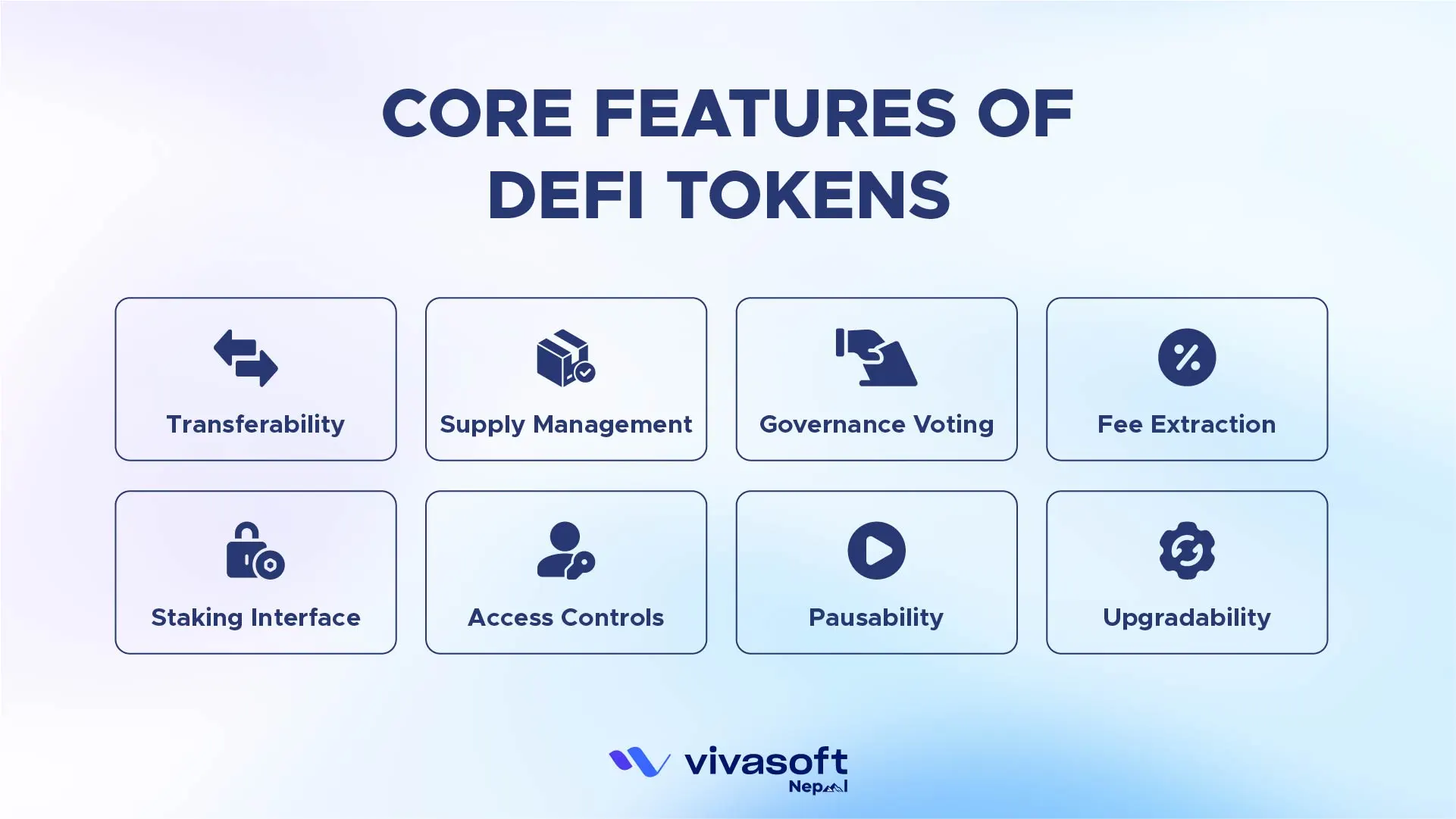
- Transferability: DeFi tokens can move directly between users using a self-custody wallet. The transfer process follows rules defined in a token standard like ERC-20, validated by the network’s consensus mechanism.
- Supply Management: Token supply is controlled through minting logic, burning mechanism, and issuance rules defined in the Smart contract. Many protocols design a deflationary model or fixed supply schedule to influence scarcity and value.
- Governance Voting: Governance tokens let you vote through DAO systems. Your votes run through smart contracts on EVM-compatible networks.
- Fee Extraction: DeFi protocols generate fees through automated market maker (AMM) activity inside liquidity pool systems. These fees are distributed to liquidity providers and token holders via staking or defi yield mechanisms.
- Staking Interface: Staking means you lock your tokens in a smart contract to support a blockchain or liquidity system. Then you earn rewards from protocol incentives or token emissions as a return.
- Access Controls: Access control defines who can perform actions in a protocol. These rules are enforced through Smart contract permissions, sometimes supported by security audit checks to prevent vulnerabilities.
- Pausability: Pausability allows developers or governance to temporarily stop contract functions in case of issues. This is often used when a smart contract exploit risk is detected or during an emergency response.
- Upgradability: Upgradable DeFi systems use proxy-based Smart contract architecture. This allows improvements after testnet deployment and mainnet launch, without breaking existing token standard compatibility.
What Are the Key Components DeFi Token?
A DeFi token is built on multiple connected layers. They decide how it works, grows, and maintains value inside a protocol.
- Smart Contract Base: It is the core code that defines how the token behaves on-chain. It controls transfers, supply, and basic token functions.
- Tokenomic Engine: It decides how tokens are distributed and how incentives are structured. It shapes supply, rewards, and long-term economic balance.
- Governance Mechanism: It allows the token holders to vote on protocol decisions that help in decentralized control.
- Liquidity Architecture: It defines how users can trade or access tokens in DeFi markets. It includes liquidity pools or DEX integration.
- Value Accrual Layer: It determines how value flows back to the token. It connects usage, fees, or protocol activity to token demand.
What Are the Key Benefits of DeFi Token Development?
DeFi tokens don’t create value just because they live on-chain. Their real impact comes from how they shift financial coordination at scale without needing traditional intermediaries in every step.
- Enhanced Liquidity: Liquidity in DeFi doesn’t rely on fixed market makers or trading hours. Instead, capital is continuously supplied through liquidity pools and automated market systems. This structure improves price discovery and keeps markets active.
- Cross-Protocol Composability: DeFi tokens aren’t locked into a single application. They move across lending markets, trading platforms, and derivatives protocols, forming layered financial strategies without permission barriers. That’s what allows DeFi to scale faster than traditional financial stacks.
- Decentralized Governance: In DeFi, Token holders typically influence fees, emissions, and risk settings. In practice, participation is uneven. But the mechanism still shifts control away from centralized operators toward on-chain decision systems.
- Cost Efficiency: The cost advantage in DeFi doesn’t come from removing institutions entirely. It comes from removing operational layers that normally sit between users and settlement through smart contracts.
- Global Accessibility: Defi tokens democratize access to the global financial system. You can participate in the global financial market without traditional bank account requirements.
- Programmable Money: Dei tokens have built-in logic that executes automatically, including staking rules, reward schedules, or liquidation conditions. It makes them flexible, but also highly dependent on correct design.
- Transparency: All DeFi activity is recorded on-chain and can be independently verified. This replaces institutional reporting with open and real-time data access.
What Are the Challenges in DeFi Token Development?
When you build a DeFi token, you step into a space where things can break fast. You deal with code, markets, and user funds all at once. That mix creates challenges you cannot ignore.
- Smart Contract Vulnerabilities: Your smart contract controls funds. That’s why even small mistakes can cause serious exploits. On top of that, it’s difficult to fix once it’s deployed.
- Scalability Limits: As your token grows, the network starts to slow things down. High demand in chains often means higher fees and slower transactions.
- Regulatory Uncertainty: DeFi platforms’ rules keep changing. Authorities still define how DeFi tokens should be treated. Ultimately, it creates long-term uncertainty.
- Oracle Risks: Your protocol depends on external data to function properly. If price feeds from providers like Chainlink fail or get manipulated, the system can react in the wrong way.
- Interoperability: DeFi works best when platforms connect, but that connection is still fragile. Cross-chain movement introduces new risks and often lacks consistent standards.
- Complexity: DeFi systems involve multiple layers working together. That complexity makes it easier to miss edge cases or create unexpected behavior.
- Tokenomics Flaws: A weak economic model can break your project over time. The collapse of Terra shows how fast things can fall apart when incentives don’t hold.
Use Cases of DeFi Tokens
DeFi tokens give a way to actually use blockchain apps, not just hold assets. In most cases, it is connected to every action inside a DeFi platform in some way.
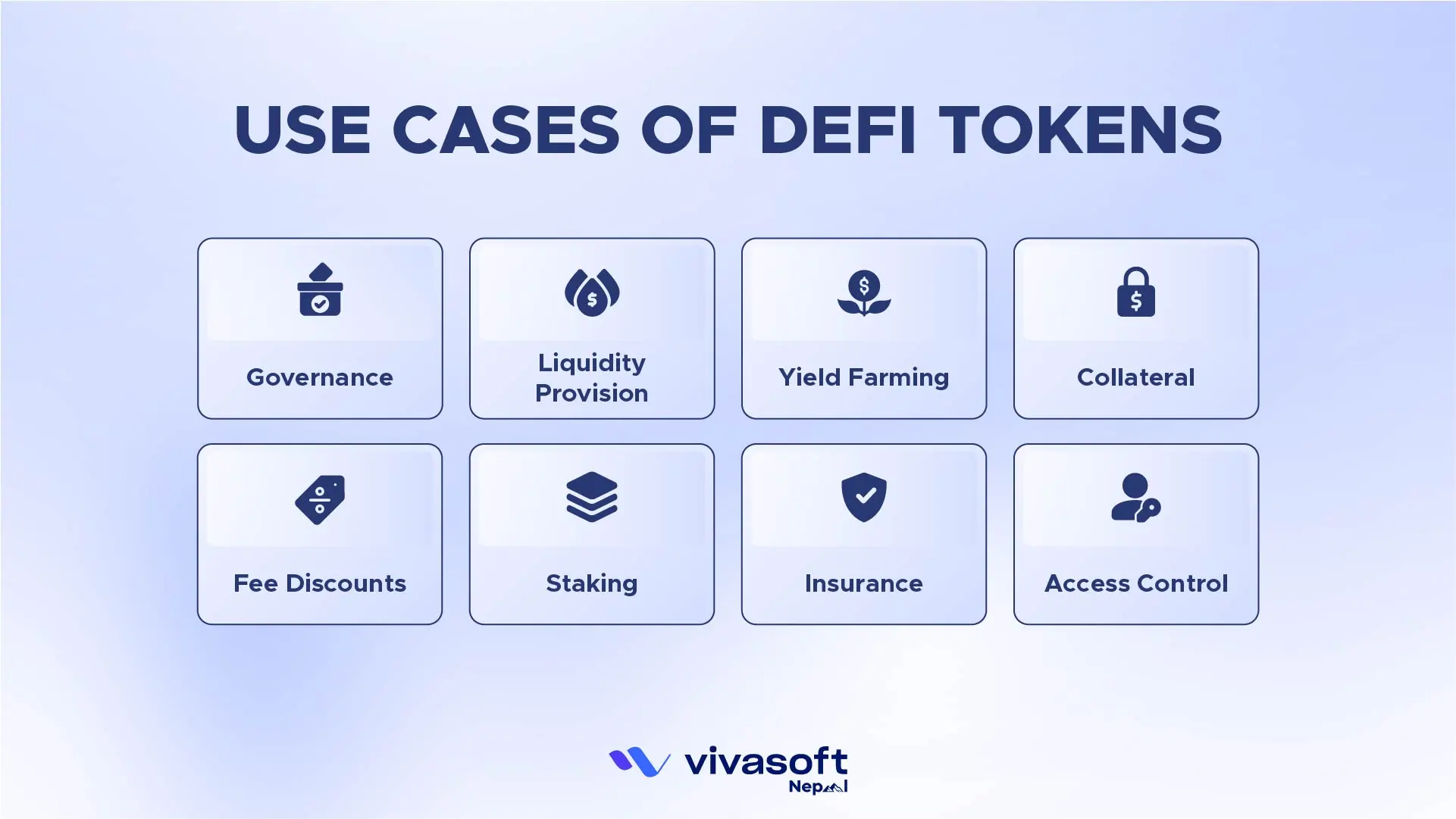
- Governance: Token holders use DeFi tokens to participate in protocol governance. Most platforms operate through DAOs, where token holders vote on upgrades, fee models, and treasury allocation.
- Liquidity Provision: When users add tokens to a liquidity pool, it helps others to trade without waiting for a buyer or seller. The system uses an AMM model to price assets automatically.
In return, the user get a cut from the trading fees. The more trading happens in that pool, the more you earn. - Yield Farming: Yield farming is about putting tokens to work, like moving assets between pools or platforms to earn better returns. Here, users earn rewards from trading fees, lending interest, or extra tokens given by the project.
- Collateral: Users can lock their tokens as collateral and borrow against them. This helps when they need liquidity but don’t want to sell their assets.
- Fee Discounts: Some platforms reduce fees if users hold or use their native token. It’s often seen on DEXs and lending protocols.
- Staking: Staking means locking tokens for a time to earn rewards. It supports transaction validation and network security on Proof-of-Stake networks. Returns depend on how long users stake and how the protocol distributes rewards.
- Insurance: Some DeFi platforms offer coverage against things going wrong. They add funds to a shared pool, and that pool pays out if a covered event happens.
- Access Control: Some platforms use tokens as access keys. Users need them to unlock features, participate in early launches, or join exclusive pools.
Designing DeFi Token Strategy & Tokenomics
When you design a DeFi token, you’re not just picking a number for supply and launching it. You need to think about where the demand will come from and why anyone will keep it, not sell it.
Types of DeFi Tokens
There are different types of tokens you should know about before you design anything. Check it out below.
| Types | Description |
|---|---|
| Utility Tokens | It is used inside the platform for fees, access, or specific actions. How often people are actually using the product decides their value. |
| Governance Tokens | Governance token gives holders voting power in DAO decisions. In many projects, early users receive these tokens to decentralize control. |
| Stablecoins | It’s designed to stay close to a fixed value, usually pegged to USD. Widely used in lending, borrowing, and as a base trading pair. |
| Liquidity Provider (LP) Tokens | It is issued when you add funds to a liquidity pool. They represent your share and let you withdraw your portion with earned fees. |
Mapping Token Utility vs. Ecosystem Mechanics
A utility token is only as valuable as the ecosystem it powers. You need to connect token utility → protocol activity → value flow. For example, if your token is used in a liquidity pool, it should tie into trading volume, fees, or rewards.
Projects often fail here. They launch a token first and try to figure out utility later. It basically leads to short-term hype without the demand for the long term.
Designing Tokenomics: Supply, Allocation, and Vesting
This is where most projects either get it right or quietly set themselves up for problems later. You’re deciding how tokens enter the market, who gets them first, and how fast they can sell. Those three things shape price behavior more than anything else.
- Token Supply: You start with the total supply. A smaller supply can feel scarce, but that alone doesn’t create value. If demand isn’t there, the price still drops.
- Token Allocation: Next is distribution. You split tokens into team, investors, community rewards, and ecosystem incentives. This part needs balance. If insiders hold too much, people notice and they don’t stick around long.
- Vesting Schedule: You don’t release everything at once. Tokens unlock over time, often with a cliff at the start. This slows down early selling. It also shows whether the team is thinking long-term or just rushing to market.
Deflationary vs Inflationary Models: Controlling Token Velocity
Now comes the part that affects how your token behaves after launch. It has two main approaches impacting token velocity.
Inflationary Model, where new tokens keep entering the system. You’ll see this in staking rewards or yield farming incentives. It helps attract users early. But if rewards stay high for too long, people farm and sell instead of holding.
In the Deflationary Model, tokens get removed from circulation. This usually happens through fee burns or buyback mechanisms. So, it reduces supply, but only works if the protocol actually generates enough activity.
How to Create Your Own DeFi Token?
The following steps will give you the basic idea about the DeFi token development. So, check it out.
Step 1: Choosing the Right Blockchain Network (Ethereum, L2s, Solana)
It’s the first real decision in DeFi token development as it can directly affect transaction speed, user experience, and others. So, here, you’re simply choosing between Ethereum for security and liquidity, Layer 2s for scalability, or Solana for raw performance.
| Factor | Ethereum (L1) | Base (L2) | Solana |
|---|---|---|---|
| Transaction Cost | $0.0648 | $0.0122 | $0.00155 |
| Speed | 15-30 transactions per second | 250-500+ TPS | 65,000+ transactions per second |
| Liquidity Depth | Deepest DeFi liquidity in the market | Ethereum liquidity plus growing ecosystem | Growing |
| Architecture | Monolithic L1 and settlement layer | Rollup built on Ethereum | High-performance L1 with parallel processing |
| Best For | High-value DeFi | Scalable DeFi apps with low fees | High-frequency trading, gaming, fast DeFi apps |
So, Ethereum remains the strongest liquidity hub in DeFi, but Solana is for high-speed transactions. So, planning to launch on Solana for high-speed transactions? Then trust the Solana development company to construct your high-throughput architecture.
Step 2: Selecting Token Standards (ERC-20, SPL, etc.)
Token standards basically decide how your token behaves after the launch. On Ethereum, most tokens use ERC-20. It’s because everything in DeFi already supports it. As for Solana, it follows the SPL standard. It’s built around faster execution and lower transaction costs. In practice, this choice matters more than people think.
If you pick a standard that doesn’t fit your ecosystem or tools, it can create integration issues. That’s especially when connecting to liquidity pools or decentralized exchange platforms. That means your token acts as the fuel, but the dApp is the engine. But do you know how to build a dApp that perfectly integrates your tokens?
Step 3: DeFi Token Launch Smart Contract Components
A DeFi token is defined by its smart contract development. On Ethereum and EVM chains, most tokens follow the ERC-20 standard, where a small set of core functions controls the token utility.
- Minting: Minting is used when new tokens need to enter circulation. In many projects, this is either locked after deployment or restricted to specific roles, like a multisig or governance contract.
- Burning: Burning is used to permanently remove tokens from the supply. It is usually applied in fee mechanisms or deflation-focused models where part of the token flow is destroyed instead of being redistributed.
- Transfer Logic: Transfers in ERC-20 tokens simply update balances inside the contract ledger between sender and receiver. Some projects extend this basic flow with extra rules depending on how the token is meant to function in the ecosystem.
Step 4: DeFi Token Staking Development
Staking is basically how you lock tokens in a smart contract to earn rewards over time. Most DeFi projects use it to keep liquidity stable and reduce constant selling pressure. A typical staking setup runs on three parts:
- a contract that holds locked tokens
- a reward system that releases emissions over time
- an exit mechanism with optional lock periods
In practice, rewards depend on how long and how much you stake. Some protocols use fixed emission rates, others adjust rewards based on total participation.
DeFi Token Security & Legal Compliance
Security and legal compliance help protect your DeFi token after launch
Smart Contract Auditing: Automated vs. Manual Verification
Audits use automated scans and manual review before deployment. Automated tools detect known issues like reentrancy, unsafe calls, and missing access controls. But only at a pattern level. Manual review goes deeper, tracing logic, edge cases, and real execution flow.
Top Contract Vulnerabilities to Watch For
There are two things to watch for:
- Reentrancy
- Flash Loan Attacks
Reentrancy usually happens when a contract sends funds out before updating its balance, which lets an attacker repeatedly call the function and drain funds. As for Flash loan attacks, they use instantly borrowed large liquidity to manipulate prices.
Legal Wrappers, SAFTs, and Navigating Compliance Early
A legal wrapper helps the project operate within real-world rules and regulations. A SAFT is a way for early investors to fund a project. Here, they receive tokens when the token officially launches. Most serious projects set up their legal structure early. This helps them avoid legal issues when the token goes live or starts trading.
How to Launch a DeFi Token Successfully?
You need to follow strategic approaches to launch a DeFi token successfully.
- Finalize Tokenomics: First off, lock supply, allocation, and incentives. It sets a token utility after it enters the market.
- Audit and Test: Before launch, test and audit smart contracts to detect risks early. It’ll help you avoid issues after deployment.
- Seed Liquidity: Next, add initial liquidity to DEX pools so trading can begin. Without this step, the token cannot function in the market.
- IDO/ICO Platforms: Then distribute tokens through launchpads or fundraising platforms. It creates early access and initial market activity.
- Community Building: A user base is built before and around launch. This is what drives early demand and token movement.
- Post-Launch: After launch, focus on stability, updates, and growth to keep the token active. So that it doesn’t just have initial hype.
What DeFi Token Development Really Costs in 2026?
Actually, it’s not a fixed price. However, it can cost you around $5,000 for basic tokens and $300,000 for advanced ones.
| Component | Basic Token | Advanced DeFi Token | Drivers |
|---|---|---|---|
| Smart Contracts | $3,000 – $10,000 | $25,000 – $120,000+ | Feature complexity and integrations |
| Audits | $5,000 – $15,000 | $20,000 – $200,000+ | Security depth and risk level |
| Deployment | $200 – $2,000 | $2,000 – $10,000 | Blockchain choice and gas fees |
| Liquidity/Marketing | $5,000 – $20,000 | $30,000 – $180,000+ | Promotion scale and exchange listings |
| Legal/Compliance | $0 – $10,000 | $30,000 – $150,000+ | Jurisdiction rules and compliance needs |
| Total | $5,000 – $40,000 | $80,000 – $500,000+ | Overall scope and project scale |
Why Hire a DeFi Token Development Company?
A DeFi token development company can help you avoid costly mistakes from the start. As this team already understands every nuance of the defi token, they know what can go wrong and how to prevent it before launch.
That experience also saves you a lot of time during execution. Instead of figuring everything out on your own, you get support across development, audits, deployment, and compliance.
What to Look for in a DeFi Token Development Partner?
Here’s what you should look for in a defi token development partner.
- Smart contract audit history: It shows how often their contracts pass security checks without issues.
- Code quality metrics: You can know if the code is stable and easy to maintain.
- GitHub activity: It lets you see real and ongoing development work.
- EVM/multi-chain expertise: It shows they can build across Ethereum and other chains.
- CI/CD pipelines: Helps ensure faster updates.
- Security-first processes: Shows they ensure safety all the time.
- Scalability proof: It confirms their systems can handle more users and transactions.
- Tech debt management: It keeps the project from becoming messy and hard to upgrade later.
- Post-launch monitoring: Makes sure they track performance after launch.
- Team credentials: Gives you confidence based on their past work.
Summing Up
All in all, building a DeFi token isn’t just about avoiding mistakes and launching code. Here, tokenomics, smart contracts, and compliance all shape long-term stability. That’s why partnering with experienced DeFi development companies like Vivasoft Nepal helps reduce risks early instead of fixing costly issues later. Ready to build it right? Start with a team that knows how to get it done from day one.
DeFi Token Development: FAQs
How long can it take to create DeFi tokens?
You can create basic tokens in a few days. But if you’re doing it properly with testing, audits, and deployment. It usually takes a few weeks.
Can I make my own DeFi token without coding experiencee?
Yes. Basic tokens can be created using no-code tools. But if you want it used in real DeFi apps, you’ll still need proper smart contract development support.
Does deploying a smart contract automatically list it on an exchange?
No. Deployment just puts the token on-chain. Listing requires liquidity setup on a DEX or an approval process for centralized exchanges.
What makes a DeFi token successful long-term?
Actually, it depends on the usage. If your token has a strong design, security, and ongoing demand, it can go long in the defi platforms.