


DeFi is not slowing down for anyone; it is already reshaping how value moves across the internet. While traditional financial institutions are still debating how blockchain fits into the future of finance, decentralised protocols are already moving billions of dollars through liquidity pools and reward systems every month. For founders, crypto startups and enterprise teams exploring DeFi yield farming development, the opportunity is clearly there but so is the competition. Teams that enter the market late usually end up struggling to attract liquidity, users, or long-term trust.
At the same time, this is not a space where rushed development survives for long. Without the right technical foundation, yield farming platforms can run into smart contract exploits, liquidity drain, broken reward mechanics, or failed launches before they ever gain traction. Our end-to-end DeFi yield farming development service covers the full build process from smart contract architecture and tokenomics design to dApp development and post-launch governance support, helping teams launch platforms that are actually built to last, not just launch quickly.
What Is DeFi Yield Farming Development?
DeFi yield farming development refers to the design and construction of decentralised platforms that allow users to earn rewards by depositing and staking crypto assets. It is the technical process of building the protocol itself not participating in one as a user. This distinction matters, and it is one that most resources on this subject fail to address.
The market opportunity here is substantial. In 2025, DeFi’s TVL exceeded $90 billion at times (peaking near $172B), though yield farming is no longer among its most active sub-sectors, lending and staking now dominate. Founders building well-audited platforms today can capture growth projected through 2032.
Building a Yield Farming Platform vs Using One
Yield farming, from a user’s perspective, means depositing crypto assets into a liquidity pool and earning rewards, typically in the form of trading fees, governance tokens or both. It’s a participation activity. Users bring capital; the platform puts that capital to work.
Building a yield farming platform is the engineering work that makes that experience possible. It means writing and auditing the smart contracts that hold user funds, designing the tokenomics that determine how rewards are calculated and distributed, constructing the frontend that lets users actually connect a wallet and interact with pools and setting up the governance mechanisms that will eventually let the community steer the protocol. That’s what development means here, infrastructure not participation.
How DeFi Yield Farming Differs from Staking and Traditional Savings?
The clearest way to understand why someone would build a yield farming platform rather than a simpler staking product is to look at the revenue streams side by side. Yield farming stacks multiple income sources like trading fees from swap activity, governance token emissions, and LP reward distributions whereas staking typically offers a single, predictable reward stream. Traditional savings accounts are fixed-rate and bank-controlled. The comparison below makes the differences concrete:
| Feature | DeFi Yield Farming | DeFi Staking | Traditional Savings |
|---|---|---|---|
| Returns | Variable, multi-stream | Fixed or variable, single-stream | Fixed, low |
| Risk level | High (IL, smart contract risk) | Medium | Low |
| Liquidity | Varies by pool lock | Often locked for a period | Usually accessible |
| Control | User-controlled, non-custodial | Protocol-controlled | Bank-controlled |
| Entry requirement | Crypto wallet + assets | Specific token | Bank account |
| Passive vs. active | Active management needed | Mostly passive | Fully passive |
For builders choosing between product types, yield farming offers more monetisation levers but also more engineering complexity. If staking alone fits your use case, dedicated defi staking platform development is worth exploring as a simpler starting point.
Market Size and Growth Opportunity (2025–2031)
The numbers behind this market are hard to ignore. Total Value Locked (TVL) across DeFi protocols has consistently recovered and grown following every major market cycle, with DeFiLlama tracking tens of billions in active liquidity across protocols at any given time.
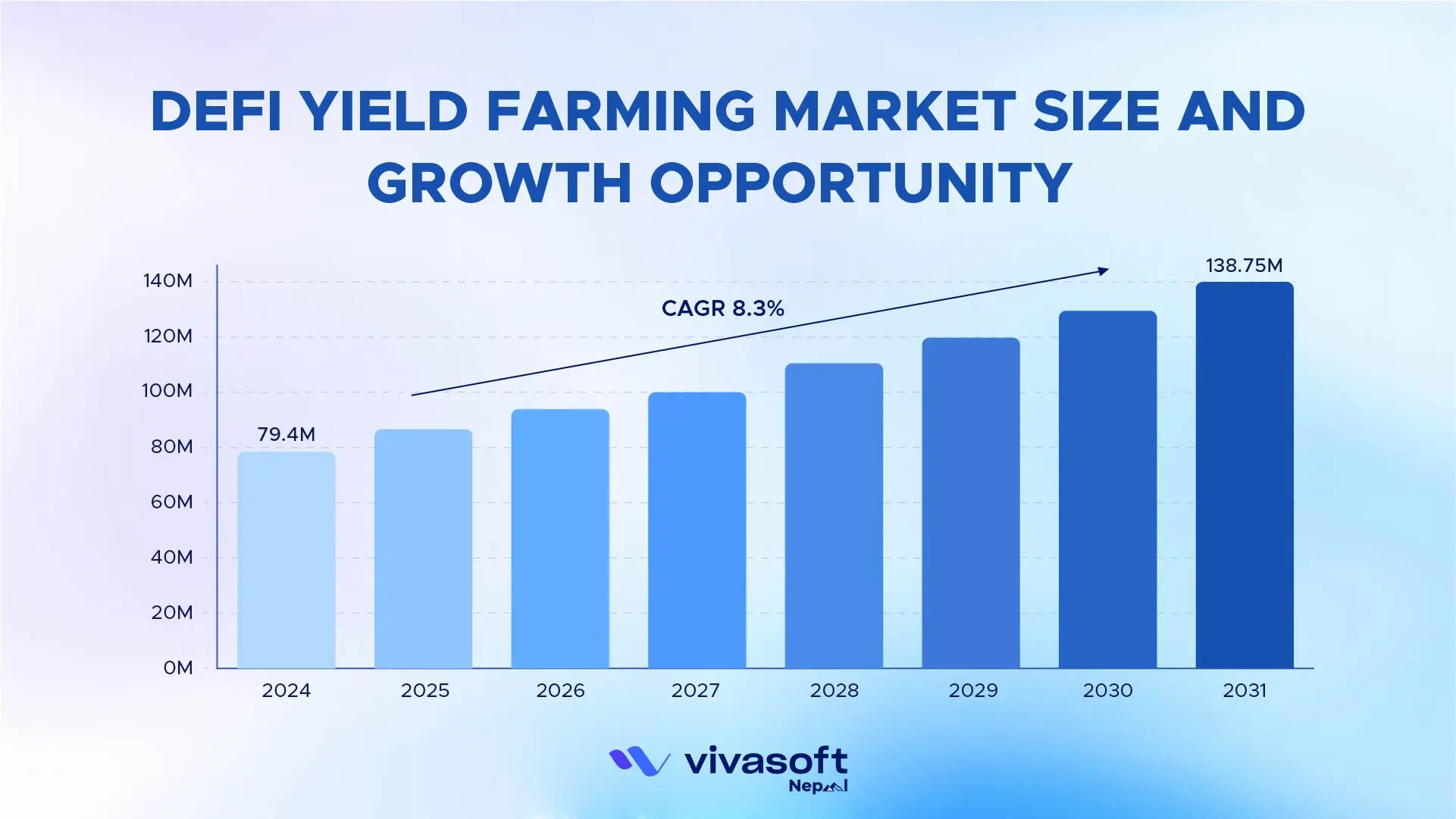
The broader DeFi yield farming segment is projected to grow at a compound annual growth rate of roughly 25–30% through 2032, with the market potentially reaching well over $100 billion in activity by the end of that window. Protocols like Aave, Uniswap and Curve among the top DeFi protocols driving total value locked, continue to demonstrate that well-built platforms can sustain liquidity even during volatile market conditions.
| Metric | Estimate |
|---|---|
| Current DeFi TVL | ~$85–100 billion |
| Projected Market Size (2032) | ~$220+ billion |
| Estimated CAGR (2025–2032) | ~27% |
The window for building competitive platforms is open but it won’t stay that way indefinitely.
How Do DeFi Yield Farming Platforms Work?
Understanding how these platforms function mechanically is important for two reasons : it tells non technical founders what they’re commissioning and it shows technical leads exactly where the development effort concentrates. Each step below describes the user journey and what needs to be built to make it happen.
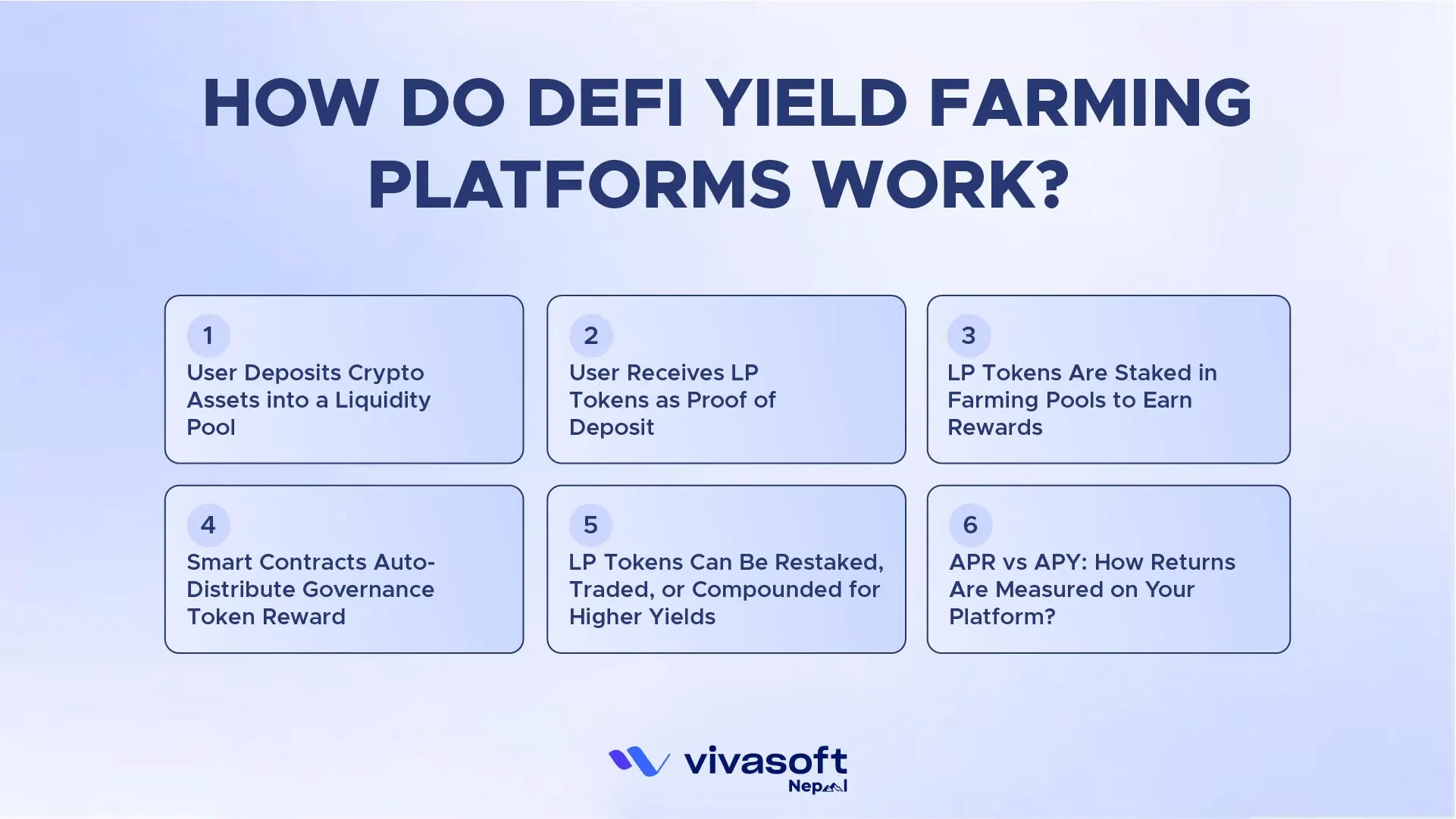
Step 1: User Deposits Crypto Assets into a Liquidity Pool
A liquidity pool is a smart contract that holds paired assets like ETH/USDC to support decentralised trading. When users deposit assets into a pool, they become liquidity providers (LPs), and their funds are used by other traders on the platform. Pools with higher liquidity usually experience lower slippage, attract more trading activity, and generate more fees for LPs. This is why understanding the benefits of deep liquidity in DeFi protocols is important when designing fee structures, incentives and asset pairing strategies for yield farming platforms.
Step 2: User Receives LP Tokens as Proof of Deposit
When a user deposits, the smart contract mints LP tokens, receipts representing their proportional share of the pool. These aren’t cosmetic. LP tokens are fully programmable assets; their transfer rules, burn logic, and eligibility for staking downstream are all defined in the smart contracts your team writes. Getting LP token mechanics right is essential because everything that follows depends on them.
Step 3: LP Tokens Are Staked in Farming Pools to Earn Rewards
LP tokens can then be deposited into separate farming contracts that distribute rewards over time. Those rewards typically come in three forms: governance tokens (which give holders voting rights over the protocol), native protocol tokens, and additional LP rewards. The rate of distribution, the weight assigned to different pools, and the schedule for emission are all configurable and all defined in your smart contracts.
Step 4: Smart Contracts Auto-Distribute Governance Token Rewards
This is where your platform’s economic design becomes visible to users. The reward distribution contract calculates each user’s share, handles token emissions on schedule, and releases governance tokens without manual intervention. The logic in this contract determines the entire economics of the platform such as emission rates, vesting schedules, anti-whale mechanics, and more. Errors here don’t just create bugs; they create exploitable vulnerabilities with real financial consequences.
Building these contracts securely and efficiently is the most critical part of yield farming platform development. How DeFi smart contracts are built and deployed is a topic worth understanding in depth before any development begins.
Step 5: LP Tokens Can Be Restaked, Traded, or Compounded for Higher Yields
Modern yield farming doesn’t stop at simple reward collection. Sophisticated platforms allow LP tokens to be restaked into secondary pools (boosting yield), auto-compounded through vault contracts that automatically reinvest rewards, or repositioned using concentrated liquidity strategies (pioneered by Uniswap v3) that focus capital within specific price ranges to maximise fee earnings. These features sit at the advanced end of the development scope but are increasingly expected by serious users.
What Are the Key Benefits of DeFi Yield Farming Development?
Yield farming platforms create value at three different levels : for the protocol itself, for the users who participate and for the broader DeFi ecosystem. Understanding all three helps you design a platform that works well for everyone which is ultimately what sustains liquidity long term.
1. For DeFi Protocols and Founders
1.1 Liquidity and TVL Growth
Yield incentives give users a concrete financial reason to deposit assets into your platform. More deposits mean deeper liquidity, which means tighter spreads, more trading activity, and a better experience for everyone. TVL growth also signals credibility to the market, it’s one of the primary metrics new users check before trusting a new protocol with their funds.
1.2 Token Distribution and Decentralisation
Distributing governance tokens through farming rewards is one of the most defensible ways to decentralise a protocol over time. Rather than concentrating tokens in the hands of insiders, farming distributes them to active participants, users who have real skin in the game. This creates a more resilient governance structure and improves long term sustainability.
1.3 User Acquisition and Ecosystem Expansion
High yields attract traders and liquidity providers, but a well-designed platform attracts developers and protocol partners too. Integrations, co-incentivised pools, and ecosystem grants all follow from a protocol with real liquidity and an active user base.
2. For Users and Investors
2.1 High-Yield Passive Income
Users can stack multiple income streams such as trading fees from pool activity, governance token rewards, and in some cases additional incentives from partner protocols. This multi-layered return structure is something no traditional savings account or single-asset staking product can replicate.
2.2 Open and Permissionless Access
Anyone with a crypto wallet can participate. No credit checks, no KYC requirements in many cases, no geographic restrictions. This is particularly meaningful for users in regions with limited access to traditional financial infrastructure.
2.3 Portfolio Diversification and Optimisation
Sophisticated users spread positions across multiple pools and chains, using aggregators and auto-compounders to optimise returns automatically. The infrastructure you build determines how much flexibility those users have.
3. For the Broader DeFi Ecosystem
3.1 Enhanced Token Utility and Innovation
Well-designed yield farming mechanics turn governance tokens into functional economic assets not just speculative vehicles. Tokens that confer staking rights, fee-sharing entitlements and governance power have real utility and that utility drives demand beyond pure speculation. The ecosystem has also seen creative extensions : NFT-gated farming pools, cross-chain yield vaults and protocol-owned liquidity models have all emerged from builders experimenting with farming mechanics.
3.2 Democratised Finance and Trust-Minimised Systems
DeFi removes intermediaries. There’s no bank deciding whether your deposit qualifies, no opaque fee structure hidden in the fine print. Smart contracts executes exactly what they’re programmed to do and because most DeFi protocols are open source anyone can verify that the code does what the team claims. That transparency is foundational to why DeFi has attracted the capital it has.
Key Risks of DeFi Yield Farming and How to Build Around Them
Every yield farming platform has been built in the shadow of real failures. The Poly Network hack, the Cream Finance flash loan exploit, the string of rug pulls in DeFi’s earlier years, these aren’t cautionary tales from a distant industry. They happened to teams that were underprepared, and they happened with real user funds. Understanding these risks isn’t just informational, it’s the foundation of how you build.
1. Smart Contract Vulnerabilities: Why Auditing Is Non-Negotiable
Smart contracts are immutable once deployed to mainnet. A bug in your reward distribution logic or your LP token mechanics can’t be quietly patched with a server-side update, it can be exploited, drained, and broadcast across crypto Twitter within hours. The Poly Network breach in 2021 resulted in over $600 million being moved by an attacker who found a vulnerability in cross-chain contract calls. Cream Finance suffered multiple exploits totalling hundreds of millions due to flash loan vulnerabilities in their lending contracts.
The mitigation isn’t complicated but it is non-negotiable: every contract that touches user funds needs both internal code review and an independent third-party audit from a recognised security firm before mainnet deployment. Firms like Certik, Hacken and Trail of Bits have become something close to standard requirements for any platform that expects serious liquidity.
2. Impermanent Loss: What It Is and How Platform Design Reduces It?
When the relative prices of assets in a pool diverge, liquidity providers end up holding a different ratio of assets than they deposited and that ratio is worth less than if they had simply held the original assets. That’s impermanent loss (IL), and it’s one of the most common reasons users withdraw from pools during volatile periods.
Platform design can mitigate IL in several ways. Concentrated liquidity ranges (letting LPs define price bands for their capital) reduce exposure to extreme price divergence. Dynamic fee structures that increase during high-volatility periods compensate providers for the IL risk they’re absorbing. Some protocols have also introduced IL insurance mechanisms as a feature differentiator. How deep liquidity reduces impermanent loss exposure is worth understanding at the architectural level before you finalise your pool mechanics.
3. Rug Pulls and Bad Actors: Platform-Level Safeguards
Not every DeFi platform failure is a hack. Some are straightforward fraud. A team deploys a platform, accumulates liquidity, and drains the treasury. The technical safeguards that prevent this are well-understood: timelock contracts that delay admin actions by 24–72 hours (giving users time to exit if something looks wrong), multisig admin keys that require multiple parties to sign off on critical functions, transparent token distribution with locked vesting schedules, and public audit disclosures. None of these are optional for a platform that wants to be taken seriously.
4. Market Volatility and Liquidity Pool Drying Up
During sharp market downturns, users withdraw liquidity from farming pools to reduce exposure which reduces depth, increases slippage, and can trigger a feedback loop of further withdrawals. Circuit-breaker mechanisms that pause withdrawals during extreme volatility, and dynamic fee models that adjust rewards based on current pool depth, are the primary development-side responses to this pattern.
Platform Security Checklist
| Security measure | What it protects against | Implementation complexity |
|---|---|---|
| Smart contract audit (third-party) | Logic errors, exploits, flash loan attacks | Medium |
| Multising admin keys | Unilateral admin abuse, insider threats | Low |
| Timelock on admin functions | Rug pulls, sudden parameter changes | Low |
| Oracle manipulation protection | Price feed attacks, flash loan exploits | Medium–High |
| Emergency pause mechanism | Active exploits, rapid damage control | Medium |
| Token distribution lock / vesting | Insider dumping, early exit fraud | Low |
| Front-running protection | MEV extraction, sandwich attacks | High |
| Bug bounty program | Undiscovered vulnerabilities | Low (ongoing) |
Every platform we build goes through mandatory third-party smart contract auditing, the full process is covered in our smart contract development and audit methodology.
Types of DeFi Yield Farming Platforms We Build
DeFi yield farming development solutions aren’t one-size-fits-all. The platform type you choose shapes your architecture, your audit scope, and your go-to-market strategy. Here’s what we build, and who each product type is actually suited for.
1. Single-Asset Staking Platform
Users deposit a single token and earn rewards, simpler architecture, lower audit risk, faster time to market. This is often the right entry-point product for new protocols launching a governance token and wanting to incentivise early adoption without the complexity of AMM mechanics.
2. Liquidity Pool Farming Platform
This is the core yield farming product; AMM integration, LP token mechanics, multi-pool reward distribution, and the full farming loop described earlier. Uniswap and Curve are the canonical examples of this category; your platform won’t be those at launch, but they set the UX and mechanic standard users expect.
3. DeFi Lending and Borrowing Platform
Users deposit assets to earn interest, and borrowers take collateralised loans against their holdings. Yield farming rewards are commonly integrated as an additional incentive layer, lending platforms like Aave distribute governance tokens to both depositors and borrowers. This dual-incentive model is powerful for bootstrapping a lending market.
4. Cross-Chain Yield Farming Platform
Users bridge assets across blockchains and farm across ecosystems simultaneously, capturing arbitrage yield opportunities that single-chain platforms can’t offer. The technical complexity here is substantially higher, cross-chain messaging protocols, bridge security, and a unified dashboard that aggregates positions across chains all need to be purpose-built. This is a space where almost no development company competitors have published meaningful content, which reflects how rarely it’s done well.
5. Auto-Compounding / Yield Optimizer Platform
Smart contracts automatically reinvest farming rewards back into the position, compounding returns without any user action. Yearn.finance pioneered this model. Building it right requires sophisticated contract logic that handles frequent rebalancing, gas cost optimisation (compounding too often eats returns in fees), and careful security review. The user-facing appeal is significant “set it and forget it” yield attracts users who want returns without active management.
6. Synthetic Asset Farming Platform
Synthetic tokens represent the value of external assets, other cryptocurrencies, commodities, or real-world indices within a DeFi ecosystem. Farming mechanics on top of synthetics allow users to gain exposure to diverse assets while still earning yield. This is the most architecturally complex product type and requires robust oracle infrastructure to maintain accurate price feeds.
DeFi Yield Farming Platform Comparison
| Security measure | What it protects against | Implementation complexity |
|---|---|---|
| Smart contract audit (third-party) | Logic errors, exploits, flash loan attacks | Medium |
| Multising admin keys | Unilateral admin abuse, insider threats | Low |
| Timelock on admin functions | Rug pulls, sudden parameter changes | Low |
| Oracle manipulation protection | Price feed attacks, flash loan exploits | Medium–High |
| Emergency pause mechanism | Active exploits, rapid damage control | Medium |
| Token distribution lock / vesting | Insider dumping, early exit fraud | Low |
| Front-running protection | MEV extraction, sandwich attacks | High |
| Bug bounty program | Undiscovered vulnerabilities | Low (ongoing) |
Our DeFi Yield Farming Development Services
Our DeFi yield farming development services cover every layer of your platform from smart contract architecture to user-facing dApp design and post-launch governance. Here’s what that looks like in practice.
1. Smart Contract Development and Security Audit
This is where every platform starts, and it’s the service that carries the most responsibility. We provide smart contract development services for yield farming using Solidity (for EVM chains) and Rust (for Solana), covering liquidity pool contracts, staking mechanics, reward distribution, governance token logic, and emergency pause controls. Every contract goes through internal review followed by external audit with our security partners before any mainnet deployment.
2. Custom Yield Farming Platform Development
Full-stack platform builds frontend, backend, and blockchain integration designed around your specific tokenomics and target user base. We don’t use templates. The architecture is built from scratch to match your product requirements, with white-label options available for teams that want to move faster.
3. DeFi dApp Development
The user-facing layer: wallet connection (MetaMask, WalletConnect, Phantom), transaction UI, real-time pool dashboards, and a rewards tracking interface. This is what your users actually see and interact with, and it determines whether sophisticated smart contracts translate into a platform people trust and return to.
4. Decentralised Exchange (DEX) Development
Most yield farming platforms need an integrated swap mechanism. We build AMM-based DEXes with liquidity pool integration, fee tier configuration, and the price impact and slippage controls users expect from a professional trading interface.
5. Liquidity Pool and Staking Mechanism Setup
Pool architecture design, fee tier selection, reward distribution logic, and the emission schedule that governs how tokens flow to liquidity providers. This is the core mechanics layer, get it wrong and no amount of good UI will save the platform.
6. Tokenomics and Reward Mechanism Design
This is a service most development companies skip entirely, and it’s arguably as important as the smart contracts themselves. We help clients design governance token supply curves, emission schedules that incentivise early liquidity without causing long-term inflation problems, vesting periods for team and investor allocations, and fee-sharing ratios that balance user rewards against protocol revenue. Token design determines whether your platform is economically sustainable at 12 months, not just at launch.
7. Wallet Integration and Payment Gateway
Multi-wallet support MetaMask, WalletConnect, Phantom improves accessibility and reduces the friction that causes user drop-off at the connection step. Broader wallet compatibility directly translates to higher user acquisition. Platforms that also need to accept crypto payments from external users can extend this further with a dedicated crypto payment gateway, enabling direct payment acceptance without routing through an exchange.
8. Analytics and Reporting Dashboard
Real-time TVL, pool health metrics, APY history, and user position tracking. Transparency in these numbers builds user trust, and institutional liquidity providers won’t touch a platform that doesn’t surface this data clearly.
9. UI/UX Design
Yield farming is genuinely intimidating for new users. A well-designed interface that guides users through the deposit, stake and claim flow with clear risk disclosures and real time feedback is a meaningful competitive advantage. We design mobile first with accessibility built in from the start.
10. Ongoing Support, Maintenance, and DAO Governance Tools
Post-launch is where most vendors disappear. We stay involved. That means smart contract upgrades as the protocol evolves, security monitoring, feature additions, and DAO governance tooling. On-chain proposal systems, community voting contracts, and treasury management interfaces are what let your protocol eventually run itself.
No competitor offers this as a packaged post-launch service, and in our experience, it’s what separates platforms that survive their first year from those that stagnate. As a DeFi development company, our engagement doesn’t end at deployment.
How to Choose the Right Blockchain for Your Yield Farming Platform?
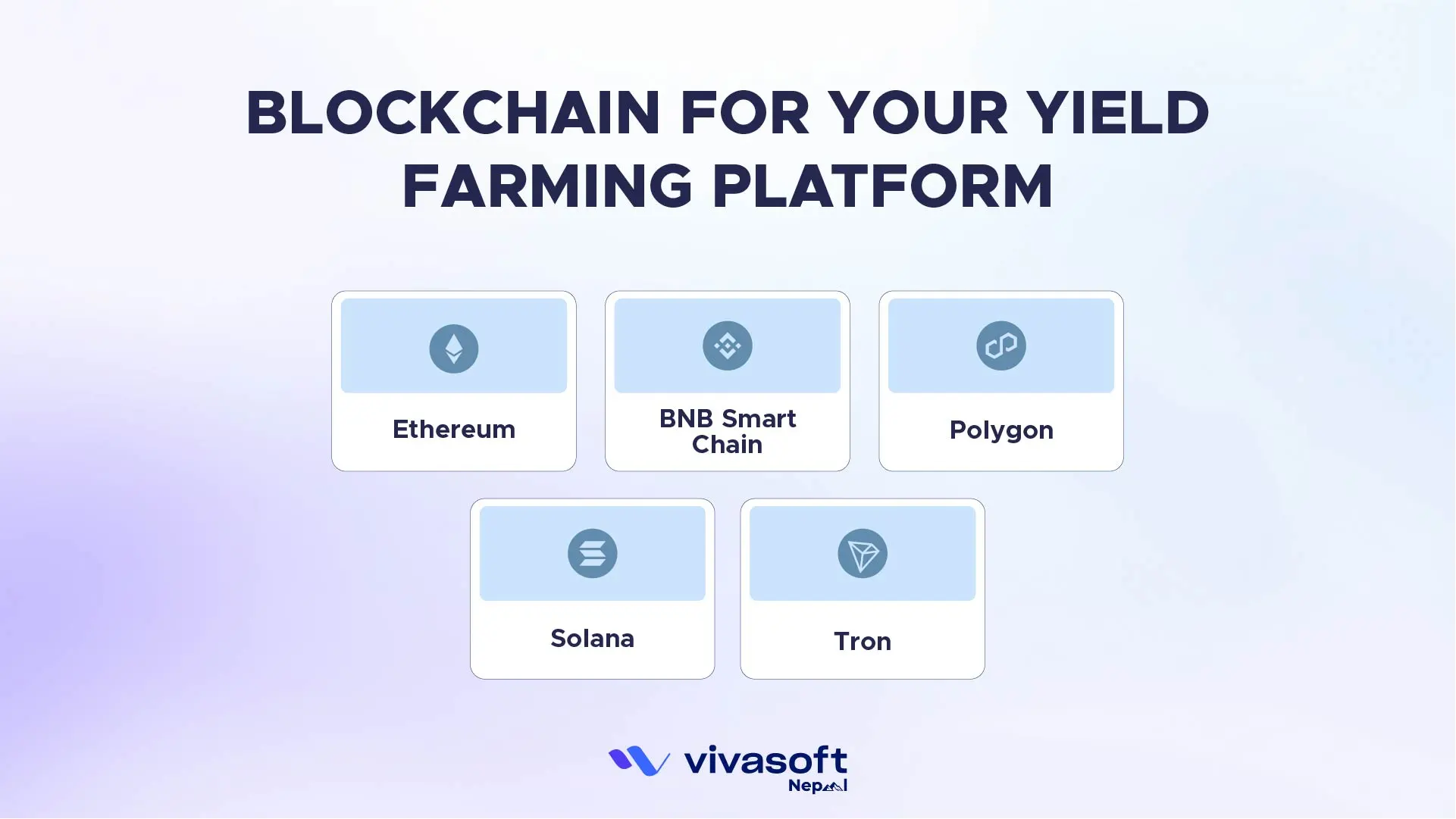
Blockchain choice is one of the most consequential decisions in your DeFi yield farming platform development process, it affects your development cost, your potential user base, your gas fee structure, and your access to existing DeFi infrastructure.
| Blockchain | TPS | Avg. fee | Smart contract language | Ecosystem size | Best for yield farming |
|---|---|---|---|---|---|
| Ethereum | ~15–30 | High ($5–50+) | Solidity | Very large | Institutional, high-value platforms |
| BNB Smart Chain | ~300 | Low (<$0.20) | Solidity | Large | Consumer-facing, retail platforms |
| Polygon | ~7,000 | Very low (<$0.01) | Solidity | Medium–large | Mainstream DeFi, bridged assets |
| Solana | 65,000+ | Very low (<$0.001) | Rust | Growing | High-throughput, performance-focused |
| Tron | ~2,000 | Low | Solidity (modified) | Medium | Stablecoin farming, Asian markets |
1. Ethereum
The largest DeFi ecosystem by TVL, the most established developer tooling, and the deepest pool of experienced Solidity developers. Gas costs are real friction for small transactions, which makes Ethereum best suited for high-value platforms where transaction amounts justify the fees, institutional-grade or premium user targets.
2. BNB Smart Chain
EVM-compatible, which means Ethereum Solidity code can be migrated with relatively minor modifications. Transaction fees are low, and the retail user base is large. For consumer facing yield farming platforms targeting a cost-sensitive audience; BNB Chain remains one of the strongest options.
3. Polygon
A Layer 2 network with Ethereum-level security and a fraction of the gas cost. The PoS bridge makes asset migration between Ethereum and Polygon relatively seamless and the ecosystem has grown substantially. For platforms targeting mainstream DeFi users who want low fees without sacrificing security, Polygon is often the right choice.
4. Solana
High throughput over 65,000 transactions per second sub-second finality and a DeFi ecosystem that’s grown considerably in recent years. The trade-off is the development toolchain: Solana uses Rust not Solidity. That’s a genuinely different skillset and not every DeFi development team can execute it well. Solana DeFi app development has its own considerations worth understanding before committing to the chain.
5. Tron
Tron has an outsized stablecoin user base, USDT on Tron is extremely widely used, particularly across Asian markets. The developer ecosystem is smaller than EVM chains, but for stablecoin-focused yield farming platforms targeting that geographic market, Tron is a legitimate and sometimes underrated choice.
Our DeFi Yield Farming Platform Development Process
A clear process matters because it’s what separates a vendor who delivers from one who perpetually revises. Here’s exactly how we build with timelines.
Step 1: Requirement Analysis
We map your business goals to technical requirements such as platform type, target blockchain, desired features, regulatory considerations and existing infrastructure. You receive a technical requirements document, project scope definition, and preliminary risk assessment.
Step 2: Architecture and Smart Contract Design
We design the system architecture and write detailed smart contract specifications before a single line of production code is written. This includes the tokenomics framework, reward emission schedule, and contract interaction diagrams. You receive a full architecture document and a tokenomics framework.
Step 3: Smart Contract Development
The core development phase like writing, testing, and preparing smart contracts for liquidity pools, staking mechanisms, reward distribution, and governance. We use Hardhat and Foundry for testing frameworks, with extensive unit and integration testing before the audit phase. You receive audited, deployment-ready smart contracts.
Step 4: UI/UX Design
Figma prototypes covering the full user journey like wallet connection, pool discovery, deposit flow, rewards claiming and governance participation. We test against real user feedback before handing off to development. You receive a responsive design system and user journey maps.
Step 5: Platform Development and Integrations
Full-stack dApp development, connecting the frontend to the smart contracts, integrating wallets, building the pool UI, and wiring up the analytics dashboard. You receive a functional, testnet-deployed platform.
Step 6: Testing, QA, and Third-Party Security Audit
Comprehensive QA across devices and browsers, followed by external security audit by an independent firm. All identified issues are resolved before mainnet approval. You receive test reports, the third party audit certificate and full bug fix documentation.
Step 7: Deployment, Launch, and Ongoing Support
Mainnet deployment, monitoring setup and transition to the support agreement. You receive a live platform, a monitoring dashboard and a defined support SLA.
How Much Does It Cost to Develop a DeFi Yield Farming Platform?
One of the most common questions is: how much does DeFi yield farming platform development actually cost? The honest answer depends on four variables like platform type, blockchain, feature complexity and audit depth.
| Platform tier | What's included | Estimated cost range | Timeline |
|---|---|---|---|
| Basic staking platform | Single-chain staking, standard UI, basic audit | $25,000–$60,000 | 8–12 weeks |
| Standard yield farming platform with DEX | AMM farming, DEX integration, analytics dashboard, full audit | $60,000–$120,000 | 14–18 weeks |
| Advanced multi-chain platform with governance | Cross-chain farming, auto-compounding, DAO governance, institutional features, comprehensive audit | $120,000–$250,000+ | 20–28 weeks |
| Smart contract audit (standalone) | Third-party security audit only | $8,000–$30,000 | 2–4 weeks |
Technology Stack We Use for DeFi Yield Farming Platform Development
Our DeFi yield farming development stack is chosen for security, scalability, and compatibility across all major blockchain ecosystems.
| Category | Technologies |
|---|---|
| Blockchain layer | Ethereum, BNB Smart Chain, Polygon, Solana, Tron |
| Smart contracts | Solidity, Rust, Vyper |
| Backend | Node.js, Python, Go |
| Frontend | React, Next.js, Web3.js, ethers.js |
| Wallet support | MetaMask, WalletConnect, Phantom |
| Security tools | Slither, MythX, Hardhat, Foundry |
| Analytics and indexing | The Graph, Dune Analytics, custom subgraphs |
Why Choose Us as Your DeFi Yield Farming Development Company?
Building a DeFi yield farming platform requires security, scalability and real protocol experience not just smart contract development alone. Here’s what sets our team apart and why projects choose us for long-term protocol development.
- Expert blockchain team with Verifiable DeFi experience: Our team has worked on production-level DeFi platforms across multiple chains and protocol types not just internal demos or experimental prototypes. That experience matters because real platforms behave very differently once users, liquidity, and market volatility enter the picture. It also means we have dealt with the kinds of edge cases that rarely show up in documentation, and learned how to make practical architectural decisions when requirements inevitably shift during development.
- Mandatory third party smart contract auditing: Every production contract we deploy goes through internal review first, then external audit with independent security firms before mainnet. This isn’t optional for clients who want it, it’s the default. There’s no version of a production yield farming platform we’d launch without it.
- Multi chain support across 5+ blockchains: We build on Ethereum, BNB Chain, Polygon, Solana, and Tron, with the capacity to extend to other EVM-compatible chains on request. Multi-chain isn’t an afterthought in our architecture, it’s considered from the design phase.
- Fully customisable and scalable architecture: No template builds. Every platform is designed around your tokenomics, your user base and your specific product requirements. Customisability also means the platform can evolve, scaling to new chains, adding governance features or expanding the product suite as the protocol grows.
- Transparent milestone based delivery: We deliver against defined milestones with client sign-off at each stage. Smart contract code is delivered with full documentation; there are no black boxes. If you want to bring an external developer in to review our work, we actively support that.
- Post launch DAO governance and community tools: On-chain governance contracts, proposal systems, community treasury management, and voting dashboards, we build the infrastructure that lets your community take meaningful control of the protocol over time. This is the service that distinguishes a long-term platform partner from a vendor who disappears at mainnet.
Start Your DeFi Yield Farming Project Today
Whether you are building your first liquidity pool platform or scaling to a multi-chain yield farming ecosystem, our DeFi development team delivers audited, scalable platforms from smart contract design to launch.
We’ve covered DeFi yield farming development solutions across every major platform type, blockchain, and service layer. The next step is straightforward. Talk to a DeFi development domain expert, get technical questions answered before you commit to anything. Our team responds within 24 hours and provides a detailed scope and cost estimate within 48 hours of receiving your requirements.
Frequently Asked Questions
How long does DeFi yield farming platform development take?
A basic staking platform can be ready in 8–12 weeks. A standard yield farming platform with DEX integration typically takes 14–18 weeks. A full multi-chain platform with governance and auto-compounding features runs 20–28 weeks, including audit time.
Why is smart contract auditing essential in yield farming development?
Smart contracts are immutable once deployed and control real user funds. A single vulnerability can be exploited to drain the entire protocol. Third-party auditing from independent security firms catches logic errors and attack vectors that internal teams miss, it’s the difference between a platform that survives and one that doesn’t.
Do you support multi-chain DeFi yield farming development?
Yes. We build on Ethereum, BNB Smart Chain, Polygon, Solana, and Tron, and can extend to other EVM chains. Multi-chain support is designed from the start, not added later.
How are yield farming earnings taxed?
It depends on your country. In most cases, farming rewards are treated as taxable income when received, and selling them later can trigger additional capital gains tax.