


Unregulated and unverified products are responsible for nearly 26% of global greenhouse gas emissions and consume half of the world’s habitable land for agriculture. The data is not a future projection. It is the current state of things. So when a company claims it sources cotton from organic farms or uses fair trade inputs, how do you actually verify that? You cannot, unless there is a neutral, tamper-proof record. That is where blockchain enters the picture. Not as a buzzword, but as an operational infrastructure that makes sustainability claims verifiable instead of decorative.
This article explains exactly how blockchain supports sustainable business practices, where it works well, where it does not, and what a CTO or service taker needs to think through before implementing it.
What Is Blockchain Technology in Sustainability?
Blockchain is a distributed ledger that records transactions across a network of computers in a way that no single entity can alter retroactively. Each block in the chain contains a timestamped record. Once added and validated by the network, that record is permanent.
In sustainability terms, this permanence matters because it removes the possibility of greenwashing through selective reporting. A company that records its carbon offset on a blockchain cannot quietly delete that record if the offset turns out to be invalid. The audit trail exists whether the company wants it to or not. Three specific properties make blockchain relevant to sustainability.
- Immutability: Data written to the chain cannot be changed without rewriting every subsequent block across every node, which is computationally impossible in any practical scenario.
- Decentralization: There is no central authority who can be pressured or bribed to falsify records. Every participant in the network holds a copy of the ledger.
- Programmability: Smart contracts are self-executing code stored on the blockchain. They trigger predefined actions automatically when conditions are met, without requiring human intervention or intermediaries.
Together, these three properties allow businesses to do things that were previously impossible at scale: prove something happened, prove it happened when they say it did, and automatically enforce rules about what happens next.
When Blockchain and Sustainability Come Together?
Blockchain and sustainability can act as joint forces if you want to build a trustworthy and robust system. These are the key areas where blockchain impacts sustainability:
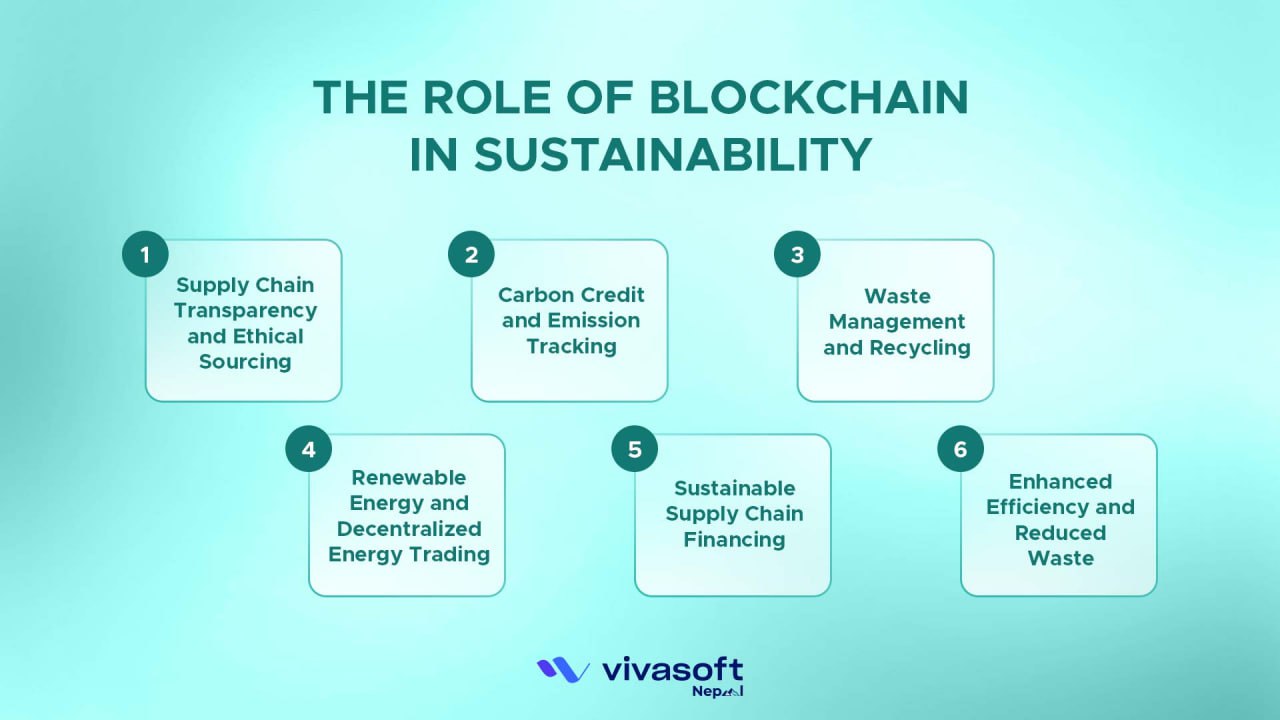
1. Supply Chain Transparency and Ethical Sourcing
This is the strongest and most proven use case. Traditional supply chains suffer from information asymmetry. A retailer buying finished goods from a manufacturer often has little visibility into tier 2 or tier 3 suppliers far upstream. Those upstream relationships are where most ethical and environmental violations occur. Blockchain addresses this by recording every transaction, handoff, and certification along the supply chain on a shared ledger that all participants can read but none can unilaterally edit.
Walmart partnered with IBM to build a food traceability system on the IBM Food Trust blockchain. The result was a reduction in the time to trace a food item from farm to store shelf from seven days to 2.2 seconds. In a contamination event, that speed difference is the difference between a targeted recall and a nationwide pullout. This directly reduces food waste, which is itself a major driver of greenhouse gas emissions.
In the fashion industry, brands like Provenance use blockchain to give consumers QR codes linked to on-chain records showing where materials came from and whether fair labor certifications are legitimate rather than self-reported. This verifiable transparency aligns with the principles of conscious capitalism, allowing brands to prove accountability and build trust with ethical consumers.
The practical question is whether your suppliers can provide data in a format compatible with your blockchain network. Legacy supplier systems often cannot. You will need an integration layer, IoT sensor connections for physical verification, or a manual data entry protocol that is itself auditable.
2. Carbon Credit and Emission Tracking
Carbon credit markets have a well-documented fraud problem. Credits get double-counted. Credits are created for emission reductions that never happened. Credits from one registry are traded in another without cross-verification. The underlying data is often opaque and siloed.
Blockchain solves this at the ledger level. As noted in a joint EY-Nanyang Technological University white paper, blockchain directly addresses the verification of additionality, proving that emission reductions would not have occurred without the offset project. Each carbon credit represented as a token on a blockchain has a unique identifier, a verifiable origin, and a transaction history that shows every time it was bought, sold, or retired. It cannot be retired in one system and sold again in another. This also enables the disintermediation of brokers, reducing transaction friction.
Toucan Protocol tokenizes carbon credits on-chain, creating a public record of every credit from issuance to retirement. Veridium Labs did similar work on the Stellar network, allowing companies to purchase carbon credits as part of purchasing other commodities, embedding the offset directly into business transactions.
For emission tracking specifically, blockchain allows organizations to record Scope 1, 2, and 3 emissions data from multiple sources, verified by multiple parties, into a single auditable trail. Smart contracts can automatically trigger offset purchases or flag compliance issues when emission thresholds are breached.
The limitation here is that blockchain only records what goes into it. If the underlying emission measurement comes from a compromised sensor or a falsified reading, the blockchain faithfully records that false data. The technology is only as trustworthy as its data inputs, which is why combining blockchain with IoT devices for physical measurement is important.
3. Renewable Energy and Decentralized Energy Trading
Traditional energy grids move power in one direction, from large generators to consumers, through a centralized infrastructure controlled by utilities. This model creates inefficiencies and makes it difficult for small renewable energy producers like solar-equipped homes or commercial buildings to monetize their surplus.
Blockchain enables peer-to-peer energy trading. Power Ledger, an Australian company, built a platform where energy producers and consumers transact directly on a blockchain, with smart contracts handling pricing, settlement, and grid balancing automatically. Consumers can sell excess solar energy to neighbors at market-determined prices without a utility as intermediary.
WePower and Grid+ operate similar models in European and North American markets, with the additional function of tokenizing future energy production so that renewable projects can be financed before they generate revenue.
For enterprises, this matters because it provides a mechanism to source renewable energy certificates that are verifiably tied to actual generation events, rather than the existing renewable energy certificate system which has the same double-counting vulnerabilities as carbon credits.
A real consideration for CTOs is that peer-to-peer energy trading operates in a heavily regulated environment. Grid access, tariff structures, and energy trading rules vary significantly across jurisdictions. The blockchain infrastructure can be built, but the regulatory permissions to operate it may take longer to obtain than the technology itself.
4. Waste Management and the Circular Economy
Blockchain supports circular economy models by creating a digital identity for physical products that follows them through their entire lifecycle, from raw material through manufacture, use, and eventual disposal or recycling.
In practice, this means a company can record the materials composition of a product at manufacture, track ownership transfers, and verify at end of life whether the product entered an approved recycling stream or was illegally disposed of. For materials with recoverable value, like lithium-ion batteries, circuit boards, or high-value polymers, this traceable lifecycle record also becomes a financial instrument.
HP and Dell have both explored blockchain-based e-waste tracking. The electronics sector has particular interest because conflict minerals regulations already require sourcing documentation, and blockchain offers a more defensible audit trail than spreadsheets.
Token-based recycling incentives are an emerging application. Some platforms issue tokens to individuals who deposit recyclable materials at verified collection points. These tokens can be exchanged for goods, services, or cash. The blockchain record prevents double-claiming and gives program operators verifiable data on collection volumes.
5. Sustainable Supply Chain Financing
Green finance has a verification problem. ESG-linked loans and sustainability-linked bonds promise better interest rates to borrowers who meet environmental performance targets. But verifying those targets currently relies on self-reported data and periodic audits, neither of which is particularly reliable.
Blockchain-connected ESG performance data changes this. When a company’s water consumption, emissions data, and supply chain certifications are recorded on-chain in real time, lenders can automatically verify compliance with loan covenants without waiting for quarterly reports. Smart contracts can then automatically apply the promised interest rate reduction when verified thresholds are met, or trigger covenant breach notices if they are not.
For companies running operations with genuine ESG compliance, this is a significant financing advantage. It reduces the cost of proving compliance and enables faster access to better terms.
6. Data Integrity and Security for Sustainability Reporting
Sustainability reporting under frameworks like GRI, TCFD, and the EU Corporate Sustainability Reporting Directive requires companies to disclose extensive data about their environmental and social impacts. The credibility of those disclosures depends on whether the underlying data is trustworthy.
Blockchain’s immutability means that data recorded on-chain has a verifiable timestamp and cannot be retroactively altered. Uniform encryption standards protect sensitive proprietary sustainability data from unauthorized access, while allowing third-party assurance providers to verify the on-chain record rather than relying on internal documents that could have been amended. This does not eliminate fraud, but it makes it significantly more difficult and much easier to detect.
MediLedger demonstrates this principle in pharmaceutical supply chains. Pharmaceutical companies use the network to verify the authenticity of drugs and track them through distribution, creating a tamper-evident record that regulatory bodies can audit.
7. Tokenization of Sustainable Assets
This is a more recent and less mature application, but worth understanding for enterprises planning long-term sustainability infrastructure.
Physical sustainable assets, like forest preservation projects, solar installations, or regenerative agriculture land, can be tokenized on a blockchain. This creates fractional ownership rights that can be traded. A company wanting to invest in a forest conservation project to offset its emissions does not need to buy the entire forest. It acquires tokens representing a verifiable stake.
This democratizes access to sustainability investments that previously required large minimum commitments. It also creates liquidity in markets that have been illiquid, which tends to attract more capital and lower the cost of financing genuinely sustainable projects.
What Are the Tangible Benefits Using Blockchain for Sustainability?
The benefits vary based on implementation quality, but the consistent patterns across deployments suggest the following measurable outcomes.
- Supply chain fraud reduction has shown reductions of up to 20% in enterprises that have deployed blockchain-based traceability. The mechanism is simple: when every transaction is recorded and visible, opportunistic fraud becomes much harder to conceal.
- Decentralized energy systems using blockchain have cut energy transaction costs by approximately 15% by eliminating intermediary fees and settlement delays.
- ESG compliance and reporting costs fall when blockchain-connected data systems reduce the labor and time required for manual audit preparation.
- Companies using blockchain for ESG performance tracking have reported improvements in ESG scoring of up to 45% in some assessments, largely because their data quality and verifiability improved rather than because their underlying performance changed dramatically.
- Smart contract automation of payments, compliance checks, and reporting removes human errors and processing delays, which cumulatively reduces overhead costs in supply chain operations.
What Are the Challenges of Using Blockchain in Sustainability?
There is no honest conversation about blockchain for sustainability without this section, because most content skips it or minimizes it.
- Energy consumption: This is the most cited concern and the most important to contextualize correctly. Bitcoin’s Proof of Work mechanism consumes electricity at scale comparable to mid-sized countries. However, Ethereum’s move from Proof of Work to Proof of Stake reduced its energy consumption by approximately 99.95%. Moreover, network-level commitments like the Crypto Climate Accord are pushing the industry toward net-zero emissions by 2030, and protocols like Algorand and Tezos were designed from inception to be highly energy-efficient. The concern is legitimate for public Proof of Work chains. It is largely resolved for purpose-built enterprise deployments.
- Scalability constraints: As transaction volumes grow, some blockchain networks face throughput limitations that result in delays and increased costs per transaction. Layer 2 solutions, sharding, and alternative consensus mechanisms address this, but they require engineering resources to implement and maintain correctly.
- Integration with legacy systems: Most enterprises have ERP systems, supplier portals, and procurement workflows that were not designed to interact with a blockchain. Retrofitting connectivity requires middleware development, API integrations, and in some cases, replacing legacy systems entirely. This is often where blockchain projects fail: not at the blockchain layer but at the integration layer.
- Interoperability between networks: If your sustainability supply chain spans multiple companies using different blockchain platforms, data does not automatically transfer between them. Cross-chain communication protocols exist but add complexity. Industry consortia like the Enterprise Ethereum Alliance have worked on standards, but there is no single interoperability standard that the market has converged on.
- Regulatory uncertainty: Carbon credit trading regulations, data privacy laws like GDPR, and financial regulations around tokenized assets vary significantly by jurisdiction. A blockchain solution built for compliance in one market may create compliance problems in another. Legal review is not optional.
- Data quality at the source: Blockchain suffers from the classic “garbage in, garbage out” problem. If a supplier enters false certification information, or if manual data collection processes are prone to errors, the blockchain will faithfully record and preserve that false information. Verification at the input point, through IoT sensors, third-party auditors, or cryptographic proof systems, is essential.
Use Cases of Blockchain in Sustainable Business
Get the list of some major use cases showing how enterprise blockchain development support sustainable business practices:
- Food Safety and Quality Assurance: Walmart and Nestlé both use IBM Food Trust to trace food products from origin to shelf. The traceability reduces contamination response times and waste caused by over-broad recalls.
- Carbon Credit Markets: Toucan Protocol and Veridium Labs tokenize carbon credits on public blockchains, creating a verifiable and non-duplicative credit registry that is open to inspection.
- Pharmaceutical Supply Chains: MediLedger tracks pharmaceuticals through distribution to verify authenticity and prevent counterfeit drug circulation. This is as much a patient safety initiative as a sustainability one.
- Energy Trading: Power Ledger operates in Australia, Japan, and parts of Southeast Asia, enabling verified peer-to-peer solar energy trading with automatic settlement.
- E-Waste Management: HP, Dell, and other electronics companies are piloting blockchain lifecycle tracking to meet regulatory requirements on conflict minerals and to ensure valuable materials reach appropriate recycling streams.
- Green Bond Verification: Several financial institutions are exploring blockchain-connected ESG data systems to automate covenant verification for sustainability-linked debt instruments.
- Anti-Counterfeiting for Sustainable Products: Chronicled uses blockchain to verify product authenticity, which matters in markets where certified sustainable products command price premiums and where counterfeit versions undercut both the price and the environmental credibility.
Future Adoption of Blockchain Sustainability
The most significant near-term development is the convergence of blockchain with IoT for automated, trusted environmental data collection. A temperature sensor on a refrigerated container, a GPS tracker on a truck, or a smart meter on a solar installation can all feed verified real-time data to a blockchain without human entry. This closes the gap between what people claim and what is measurable.
The integration of AI-powered analytics with blockchain data allows pattern recognition at scale. AI can analyze on-chain supply chain data to identify anomalies, flag potential fraud, or model emissions scenarios across complex supplier networks in ways that manual review cannot. Cross-chain interoperability protocols are maturing. As they do, sustainability data that spans multiple blockchain networks becomes easier to aggregate and verify, making it possible to construct emissions profiles that span an entire value chain even when different segments use different networks.
Decentralized autonomous organizations are beginning to appear in green finance and conservation contexts. These governance structures, managed through smart contracts and token-based voting, allow communities and stakeholders to collectively manage conservation funds or renewable energy cooperatives without centralized administration.
Conclusion
Blockchain doesn’t automatically make a business sustainable. Instead, it makes your sustainability claims verifiable, your commitments enforceable, and your data trustworthy for regulators and partners.
For companies with genuine green initiatives, blockchain turns marketing promises into auditable facts. Conversely, using blockchain to mask unsustainable practices will backfire, as the immutable ledger permanently records the truth.
Before choosing a platform, define the exact verification problem you need to solve. If you need a reliable technical partner to build this architecture, Vivasoft Nepal develops enterprise-grade, energy-efficient blockchain solutions. We integrate seamlessly with your legacy systems to help prove your sustainability impact securely.
FAQs
How do blockchain and AI help track products in sustainable supply chains?
Blockchain builds a secure record of every product’s journey, where you can track everything from origin to delivery. AI analyzes this blockchain data in real time, identifies risks and inefficiencies.
Which benefit can blockchain technology offer to help organizations with their sustainability efforts?
Blockchain offers organizations a tamper-proof way to track sustainable practices. It verifies eco-friendly sourcing and monitors carbon emissions.
Is blockchain able to enhance environmental sustainability?
Yes, blockchain enhances environmental sustainability through a decentralized system. It offers more renewable energy trading and carbon credit verification, enhancing green practices.
Why are energy-efficient consensus mechanisms crucial for sustainable blockchain use?
Energy-efficient consensus mechanisms like Proof of Stake can save their energy use by 99.98%. They lower resource consumption, improve security, and speed up transactions in a cost-effective way.