


The global blockchain app adoption is likely exploding. The report says that around 4% of the global population or over 283 million people, is now using this technology. The growing user base is a clear sign that blockchain is no longer just a random niche technology.
Rather, it has become a core growth factor where tech leaders need to plan carefully to lead in the industry. Even growing companies are already moving towards this shift.
Companies are building systems that are improving the users’ trust and also help reduce fraud. Enterprises are integrating blockchain not just to innovate. But also, the main focus is on reducing costs and accelerating the development time.
However, the rising demand comes with the key question. What does blockchain development actually cost? Also, how can tech leaders budget strategically without overspending?
In this guide, we’ll break down the complete development costs. You will get to know all the key factors that affect your overall investment.
Key Takeaways
- The development cost of a blockchain app is typically around $40K to $300K+ based on complexity and features.
- Businesses often face hidden costs like maintenance, infrastructure, and security audits.
- Start with MVPs, audited libraries, and Layer-2 networks to reduce the overall pricing.
- Outsourcing to experienced blockchain development companies makes your blockchain app development journey cost-effective.
- The overall pricing varies based on the app types and industry you are focusing on.
Understanding the Blockchain Development Hidden Costs
The blockchain app development cost typically ranges from $40,000 to $300,000+. However, it varies based on the app complexity. A simple app development costs start with $40,000 and go up to $60,000.
In contrast, you can expect the costs to be up to $150,000 to build a complex app. Plus, if you are planning to build an enterprise app, it will cost between $150,000 to $300,000.
But here’s the reality tech leaders often miss. Beyond the quoted development price, there are some more hidden factors that will make your overall budget fluctuate.
Here is a clear overview:
Annual Maintenance
After developing and launching the app, you must focus on the proper upkeep of your app. Typically, you need to budget 15–20% of the project cost per year just for maintenance. But some complex enterprise apps even cost more. A blockchain app maintenance typically costs around 30–35% of the overall project cost.
This maintenance budget covers more than simple bug fixes. You will likely pay for community support, ongoing updates, and security monitoring.
- A minor bug fix may cost around $50. But a critical issue that affects the functionality can drive the costs much higher.
- On top of that, security patches are another ongoing cost. It is especially important in an era of cyber threats. If it is compliance maintenance, regular audits, and continuous monitoring, security work adds to your expenses.
- Moreover, many software development firms exclude charges for checks and re-audits from their initial quote. It typically costs anywhere from $500 to several thousand dollars.
The Economics of Gas Fees
Gas fees are another hidden ongoing cost that most leaders miss in blockchain development. Every transaction or smart contract action requires computational power, and gas fees are the payment you make to keep the process running. They directly impact user experience and retention.
High gas fees make apps harder to use and can cause customer churn if transactions fail. To reduce these challenges, companies are adopting Account Abstraction like ERC-4337. This improves onboarding and lowers churn. But it becomes a recurring operational expense as users continue interacting with the app. Even as your user activity grows, gas costs increase with usage.
Infrastructure & Hosting
Running a blockchain app isn’t just about building smart contracts. You also need constant access to the blockchain network and storage for your data. For instance, you have to consider the node providers, like Alchemy or Infura.
The overall cost varies depending on how many requests your app makes per month. Here is a quick overview:
| Provider | Plan Name | Included Usage | Starting Cost | Notes |
|---|---|---|---|---|
| Alchemy | Pay-As-You-Go | 11M Compute Units | $5 | Pricing can go as low as $0.40 per 1M CUs |
| Infura | Developer | 15M requests | $50/month | Suitable for testing and low traffic |
| Infura | Team | 75M daily credits | $225/month | Designed for production-scale apps |
For metadata storage:
- AWS S3 costs $23 per TB per month.
- Arweave charges $3.00 to $12.00 per GB one-time.
What Are the Key Factors That Drive Blockchain App Costs?
The overall blockchain app development cost varies based on some special considerations. Such as smart contract complexity, consensus mechanisms, and integration requirements. Plus, your business model and security needs determine the final investment required for blockchain development.
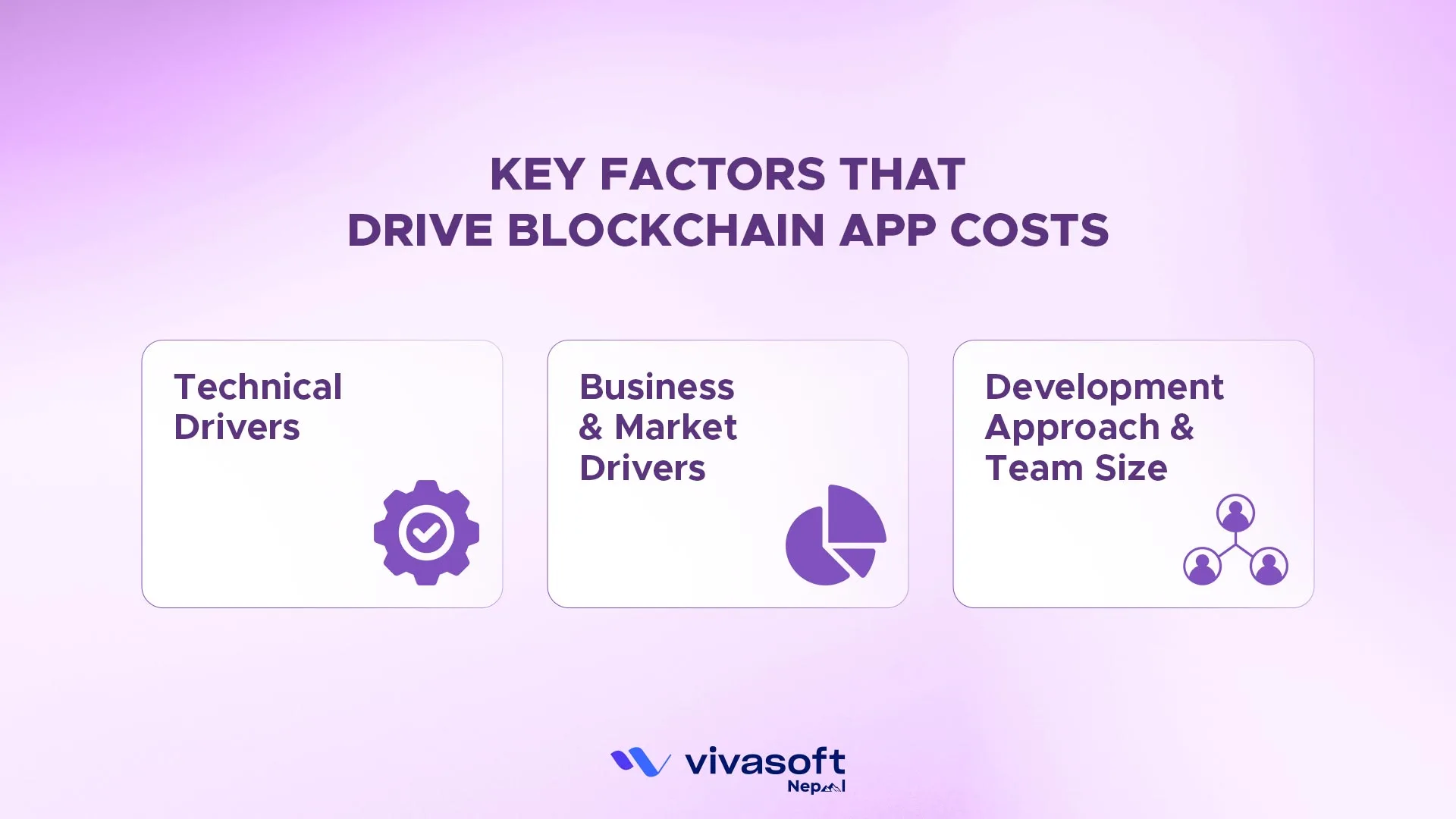
Technical Drivers
The technical requirements for your app development directly determine the overall costing. Here is how:
1. App Complexity
You will need more time and resources to design and develop a complex app. It increases your app budget. For example, DeFi apps need complex smart contracts. The overall development cost usually ranges from $40,000 to $500,000.
In contrast, NFT marketplaces are developed with minting functionality and wallet integration. It typically costs $30,000 to $150,000. However, for developing an enterprise-grade app with high-end private networks and advanced integrations, the budget goes around $75,000 to $400,000.
Consensus mechanism
Another hidden cost in blockchain development you should consider is the consensus mechanism your network uses. It helps determine how transactions are validated and blocks are added to the blockchain. Here’s a clear overview of the available options:
- Proof of Work or PoW: Requires miners to solve complex puzzles, which generally consume high energy and computational resources.
- Proof of Stake or PoS: Does not require expensive hardware and offers faster transactions.
- Delegated Proof of Stake or DPoS: Offers high scalability, meaning it can handle many transactions at once, which helps reduce costs.
- BFT or Byzantine Fault Tolerance: Its main advantage is low-cost scalability, and it operates best when you want fast, cheap transactions.
Number Of Nodes & Decentralization Level
As the number of nodes in a blockchain app increases, the overall cost rises due to higher decentralization and security. Each node affects the cost of hosting, maintenance, and network bandwidth for functional efficiency. However, nodes may cost $100–$500/month each if it is a small network.
Security and Encryption Requirements
Your blockchain app handles sensitive data, so it is important to plan for proper security practices. But it will add to your foundational budget. You have to implement end-to-end encryption, secure key management, and multi-signature wallets. Expect around $5,000–$50,000+ upfront for the overall security setup.
Business & Market Drivers
The blockchain app development cost also fluctuates based on your business goals and the current market trend. Here is what you can expect:
Industry Requirements
The business industry is a key cost driver. Highly regulated industries usually cost more due to following strict standards. These industries must comply with HIPAA, PCI-DSS, and ISO 27001. This adds extra cost to the overall development.
| Industry | Estimated Cost Range |
|---|---|
| Healthcare | $55K – $200K+ |
| Finance / FinTech | $50K – $300K+ |
| Supply Chain & Logistics | $40K – $150K+ |
| E-Commerce & Retail | $35K – $120K+ |
| Real Estate | $45K – $180K+ |
| Gaming & Metaverse | $50K – $250K+ |
| NFT Marketplaces | $30K – $150K |
| DeFi Platforms | $40K – $500K+ |
| Education | $35K – $120K+ |
| Insurance | $45K – $200K+ |
| Energy & Utilities | $50K – $180K+ |
Transaction Volume And Scalability Needs
The number of transactions your app will handle also affects the pricing. Low-volume apps with a small user base run on standard Layer-1 networks, which keeps the cost lower. On the other hand, big platforms with high traffic may require additional layers and advanced consensus mechanisms.
This adds around $15,000–$80,000+ to initial development costs. Even as your user base increases, operational costs also rise, which is often $2,000–$10,000+ per month, especially if you are running public or hybrid blockchains.
Regulatory And Compliance Obligations
The blockchain app must meet strict regulatory requirements. This is even non-negotiable if you are operating in finance, healthcare, or enterprise sectors. Developers perform some special tasks to meet these regulations. Like KYC/AML checks, data privacy, and reporting standards.
| Compliance Feature | Description | Cost Range |
|---|---|---|
| Private Network Setup | Setting up a secure and permissioned blockchain network | $20,000 – $50,000 |
| Integration with Legacy Systems | Connecting blockchain with existing enterprise systems | $30,000 – $100,000 |
| Dedicated Compliance Modules | Features for KYC/AML, reporting, and regulatory checks | $20,000 – $80,000 |
Development Approach & Team Size
The development method and team size also impact the overall costing. It is important to know what costs you can expect while working with a small developer team with hands-on experience. Here is a clear overview:
In-house vs Outsourced Teams
To develop a blockchain app for your business, you either need to build your own in-house team or outsource the complete project to a skilled developer team. If you are building an in-house team, you have to consider high salaries and manage the recruitment and turnover.
This usually drives your overall budget higher. Outsourcing the project is often far more convenient. You will get access to skilled global developers, who usually charge around $20–$60 per hour.
| Criteria | In-House Development (U.S.) | Outsourced Development (Global) |
|---|---|---|
| Team Structure | Internal full-time team | External vendor teams (offshore/nearshore/onshore) |
| Hourly Rate (per dev) | $100–200/hr | $20–60/hr |
| Time to Build Team | 2–4 months (recruiting, onboarding, training) | 1–3 weeks (team setup and kickoff) |
| Cost per MVP | $150,000–$300,000+ | $30,000–$90,000 |
| Infrastructure & Tooling | $10K–25K annually per dev | Included in vendor pricing |
| Scalability | Limited to hiring bandwidth and budget | On-demand; scalable from 2 to 20+ engineers quickly |
| Speed to Start | 3–6 months | 1–3 weeks |
| Best Fit For | Long-term, core product teams with strategic focus | MVPs, rapid launches, cost-sensitive or exploratory builds |
Note: Companies that outsource their work to cost-efficient countries can reduce the overall cost by 30–60% compared to in-house development. Moreover, you will have faster turnaround times and flexibility to scale or upgrade options for your project.
Team Composition & Seniority
The composition and seniority of the development team also impact the overall budget. Senior developers with experience in system design, audits, and optimization charge higher rates. On the other hand, you can expect moderate charges from junior or mid-level developers.
Agency Vs Startup Development Costs
Whether you develop the app by an agency or a startup team directly affects your blockchain app budget. Established agencies typically charge higher rates due to structured processes. They have dedicated project management tools and proven security and compliance practices. In contrast, startup development teams often offer more flexible pricing and faster execution. This approach is best for MVPs and early-stage products.
What Are the Types of Blockchain Apps and Their Costs?
Blockchain applications fall into two categories. Either you are building crypto-native apps or enterprise ledger systems. The native apps run on public blockchains, whereas enterprise systems use private networks for business operations. Here is the clear cost difference between the two categories:
Cryptocurrency-Based Solutions
There are different crypto-based solutions you can develop. Starting with crypto wallets that store and manage digital assets securely. Another category is centralized exchanges. It requires extensive infrastructure and compliance systems. Lastly, NFT marketplaces offer minting, buying, and selling digital assets.
| Application Type | Basic Version | Advanced Version |
|---|---|---|
| Crypto Wallets | $12,000 - $40,000 | $60,000 - $100,000 |
| Centralized Exchange (CEX) | $150,000 - $300,000 | $500,000+ |
| Decentralized Exchange (DEX) | $80,000 - $150,000 | $250,000+ |
| NFT Marketplaces | $40,000 - $80,000 | $150,000 - $300,000 |
Non-Cryptocurrency-Based Solutions
These blockchain apps don’t use cryptocurrencies. Instead, they are built for enterprise or business purposes. For example, supply chain blockchain apps are enterprise solutions that track products from origin to destination. Similarly, healthcare apps manage patient records and medical data.
| Application Type | Basic Version | Advanced Version |
|---|---|---|
| Supply Chain & DLT | $50,000 - $100,000 | $200,000 - $500,000+ |
| Healthcare Ledgers | $80,000 - $150,000 | $400,000 - $1,500,000+ |
Note: The healthcare app development cost varies based on the complexity and integration requirements. A basic healthcare blockchain system costs around $80,000 to $150,000. But if you opt for advanced platforms with smart contracts, the budget can reach $400,000+.
Regional Blockchain Development Costs & Developer Hourly Rates
Blockchain development costs vary drastically depending on where your development team is located. Because of local cost-of-living differences, hiring developers in North America will consume your budget up to 4 times faster than hiring from tech hubs in Asiafor the exact same quality of code.
Here is a breakdown of average hourly rates for blockchain developers globally:
- USA / UK: $100 – $150+ per hour.
- Western Europe (Germany, UK): $80 – $120+ per hour.
- Eastern Europe (Ukraine, Poland): $50 – $90 per hour.
- India / South Asia (Nepal): $25 – $60 per hour.
The Strategic Advantage: You do not need to pay $150/hour to build a world-class DApp. Hiring a dedicated hourly developer from a rapidly growing South Asian tech hub (like Vivasoft Nepal) can reduce your total development cost by up to 60% without compromising on code quality, security, or agile delivery.
Here is a quick table of the regional blockchain development costs:
| Region | Entry-Level | Mid-Level | Senior-Level |
|---|---|---|---|
| USA | $50 - $80/hr | $80 - $150/hr | $150 - $300/hr |
| Australia | $35 - $60/hr | $60 - $100/hr | $100 - $150/hr |
| Europe (Western) | $40 - $70/hr | $70 - $120/hr | $120 - $180/hr |
| Europe (Eastern) | $25 - $45/hr | $40 - $80/hr | $80 - $120/hr |
| Asia | $25 - $60/hr | $40 - $90/hr | $90 - $150/hr |
How to Optimize Blockchain App Development Costs?
Here is the reality check: beyond your base blockchain app development cost, the price can escalate quickly if you are not careful with your process. CTOs and business owners should follow strategic approaches to reduce costs. You can ensure high standards at every stage of development. Here are some expert suggestions you should keep in mind:
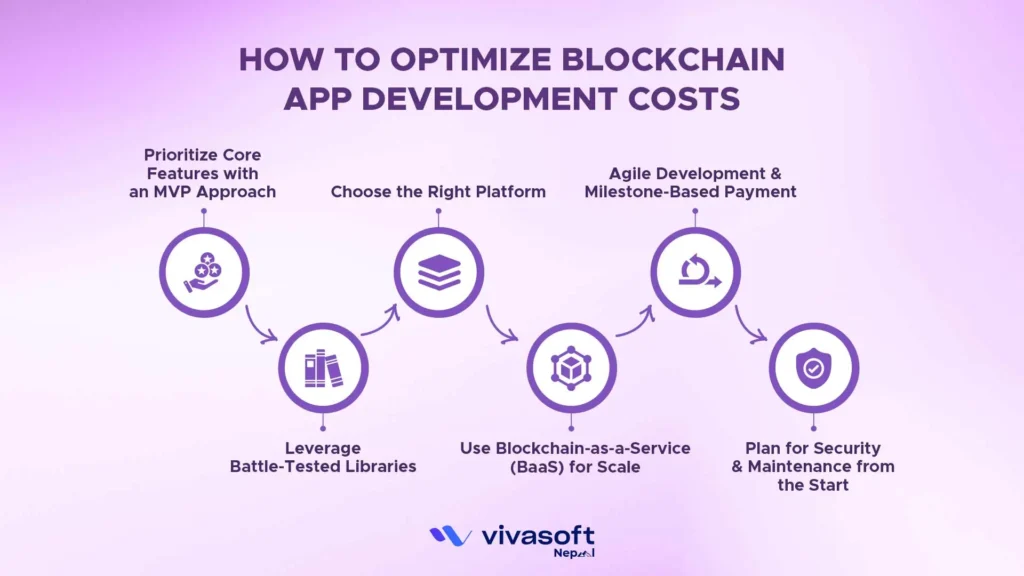
1. Prioritize Core Features with an MVP Approach
If you are building an MVP, focus on the essential features your app needs right now. Avoid overbuilding unnecessary functionality at this stage. The MVP increases complexity if you are adding unnecessary features. It just adds extra cost that adds no immediate value.
2. Leverage Battle-Tested Libraries
Instead of writing every smart contract or blockchain function from scratch, use pre-built and trusted code. For example, OpenZeppelin provides smart contract templates that are audited and secure. It is widely used by developers worldwide. This saves money and helps reduce errors.
3. Choose the Right Platform (L2 vs. L1)
The platform choice for your blockchain app development also determines your budget. Layer 1 offers maximum security, but transaction fees are higher. As a cost-effective option, you can use Layer 2 solutions built on top of L1. These significantly reduce costs, often by 90% to over 99% compared to the Ethereum mainnet.
4. Use Blockchain-as-a-Service (BaaS) for Scale
BaaS provides a ready-to-use blockchain framework for development. Businesses don’t need to build or manage servers, nodes, or security updates from the start. You can also avoid hiring specialized DevOps teams, saving costs. Additionally, it shifts large upfront investments or CAPEX to predictable ongoing expenses or OPEX.
5. Agile Development & Milestone-Based Payment
In agile development, developers divide the project into smaller and manageable sprints. You have the flexibility to pay only when a project is complete. Businesses can find issues early and plan improvements.
6. Plan for Security & Maintenance from the Start
Security and ongoing maintenance are both must-know factors in your app development. You must plan for it first. Focus on implementing end-to-end encryption and secure key management from day one. Regular audits help reduce vulnerabilities and protect sensitive data.
Blockchain MVP vs. Enterprise: A Strategic Financial Comparison
MVPs are built based on the core features. Plus, quick validation helps test the project with minimal investment. But if you want a full-featured app with high infrastructure and security assurance, the complexity, requirements, and high security setup usually drive the cost up.
Here’s a quick comparison table:
| Factor | MVP Approach | Enterprise Approach |
|---|---|---|
| Initial Investment | $8,000 - $50,000 | $100,000 - $1,500,000+ |
| Time to Market | 2-3 months | 6-18 months |
| Annual OPEX | $5,000 - $25,000 | $50,000 - $200,000+ |
| ROI Timeline | 3-6 months | 18-24 months |
| Risk Level | Low (capped investment) | High (integration complexity) |
| Strategic Value | Market validation, investor signaling | Competitive moats, industry leadership |
How to Choose the Right Blockchain App Developers in 2026?
To choose the best blockchain app developers, focus on their expertise in blockchain facts and, most importantly, smart contract development. They should know security best practices and have already handled multiple projects with success. Follow the list of some more essential factors you should consider:
Technical Expertise & Platform Proficiency
First of all, check and ensure the developers are skilled in that specific blockchain platform you plan to use. They should have strong knowledge of consensus mechanisms. Plus, they must know on-chain or off-chain interactions. This way, you cna easily reduce the development costs and deploy the project faster.
Smart Contract & Security Knowledge
Check the smart contract knowledge of the developers. The developer must know how to design and audit smart contracts that runs effeciently. A strong team understands common attack vectors and takes necessary action by following industry practices before deployment.
Previous Project Experience & Case Studies
Before finalizing one, ensure you have reviewed their portfolio and case studies. Find out the similar blockchain solutions they have handled previously. Find projects on cryptocurrency wallets or anything done on the NFT marketplaces. This helps you select the developers who have the true capability of handling your app’s complexity.
Cultural Fit & Agile Mindset
Developers who perfectly go with your company culture and follow Agile methodologies should be on your top priority list. They should be committed to clear communication and regular updates. Moreover, you can ensure meeting deadlines and be quite responsive to changing requirements.
Up-to-Date Knowledge of Blockchain Trends
Blockchain trends change quickly. There will be new marketplaces and tools being introduced constantly. To keep pace in the competition, hire developers with strong knowledge of current trends. Ask and evaluate their expertise in new trends and technologies.
Summing Up
To make your blockchain app development project more cost-effective and successful, you need to carefully plan between building in-house, hiring experts, or using Blockchain-as-a-Service.
Choose in-house if you have a large, skilled team and want full control. BaaS is ideal for startups or small projects that need a framework without the overhead.
On top of that, partnering with an domain expert blockchain development company to build secure and efficient solutions. The expert software development team helps you grow faster in the industry and maximize your investment.
Frequently Asked Questions
How much does it cost to build a blockchain app?
Blockchain app development costs anywhere from $40,000 to $300,000+ based on complexity. A basic cryptocurrency wallet starts at $12,000, while enterprise DeFi platforms exceed $90,000.
How much does a blockchain developer cost?
Blockchain developers charge around $60–$150 per hour. Freelance junior developers may charge $40–$100, whereas senior developers with hands-on experience can charge up to $150.
What is the average cost to develop blockchain app?
On average, blockchain app development costs vary heavily by scale. An MVP can be built for $8,000 to $15,000 in 4-8 weeks. Mid-level applications average $30,000 to $90,000 (10-16 weeks), while complex enterprise solutions require $100,000 to $200,000+ and over 20-30 weeks
What are the typical annual maintenance costs of a blockchain app?
Maintenance costs range from 15% to 25% of the initial development cost annually. For example, if it costs about $100,000 to develop your blockchain app, you can allocate around $15,000 to $20,000 annually for maintenance. Some complex apps may go around 30–35% of the overall project cost.
How can maintenance costs be reduced?
Never store large files directly on the blockchain. Use decentralized storage like IPFS or Arweave and only keep the “hash” on-chain. If your app runs on Ethereum, migrate to Layer 2. It helps reduce recurring “gas” or transaction costs by up to 80%.