


If you’ve been paying any attention to the crypto space lately, you already know taking decentralized finance (DeFi) seriously is no longer optional. By the time we hit 2026, the global DeFi market size has comfortably smashed past the $100 billion mark in Total Value Locked (TVL), with absolutely no signs of putting on the brakes. In fact, most conservative data projections put the Compound Annual Growth Rate (CAGR) of the broader DeFi industry at a staggering 46% over the next five years.
So what’s driving all this massive liquidity? A huge chunk of it comes down to staking. Before staking, crypto was basically just digital gold sitting in a wallet waiting for the price to go up. DeFi staking platforms totally disrupted the crypto world by changing that narrative. They turned static, idle tokens into active, yield-generating assets. It’s basically the equivalent of taking your money out from under your mattress and putting it to work, but without a traditional bank taking a 99% cut of your interest.
If you are a builder or an entrepreneur eyeing the Web3 landscape right now, DeFi staking platform development might be the single most lucrative vertical you can jump into. Let’s break down exactly what goes into building a staking platform from scratch.
What Is a DeFi Staking Platform?
At its core, a DeFi staking platform is a decentralized ecosystem where users can lock up their cryptocurrency to help secure a network or provide liquidity. In exchange for temporarily parting with their tokens, the platform’s smart contracts automatically distribute rewards back to the user usually in the form of an Annual Percentage Yield (APY) paid out in native tokens.
The big difference between this and traditional finance is pretty stark. If you put money into a traditional savings account, the bank lends your cash out at 7% and pays you back a measly 0.5%, keeping the massive spread as profit. With DeFi staking, the middleman is completely stripped away. Through non-custodial reward platform creation, smart contracts enforce the rules on-chain. The rewards generated by network validation or loan fees go directly to the users. No bank managers, no hidden custody fees and absolute transparency from a day one.
What Are the Types of DeFi Staking Platforms?
Not all staking is created equal. Depending on the goal of your protocol, you’ll want to build specific mechanisms to attract liquidity. Here are the main types currently dominating the market:
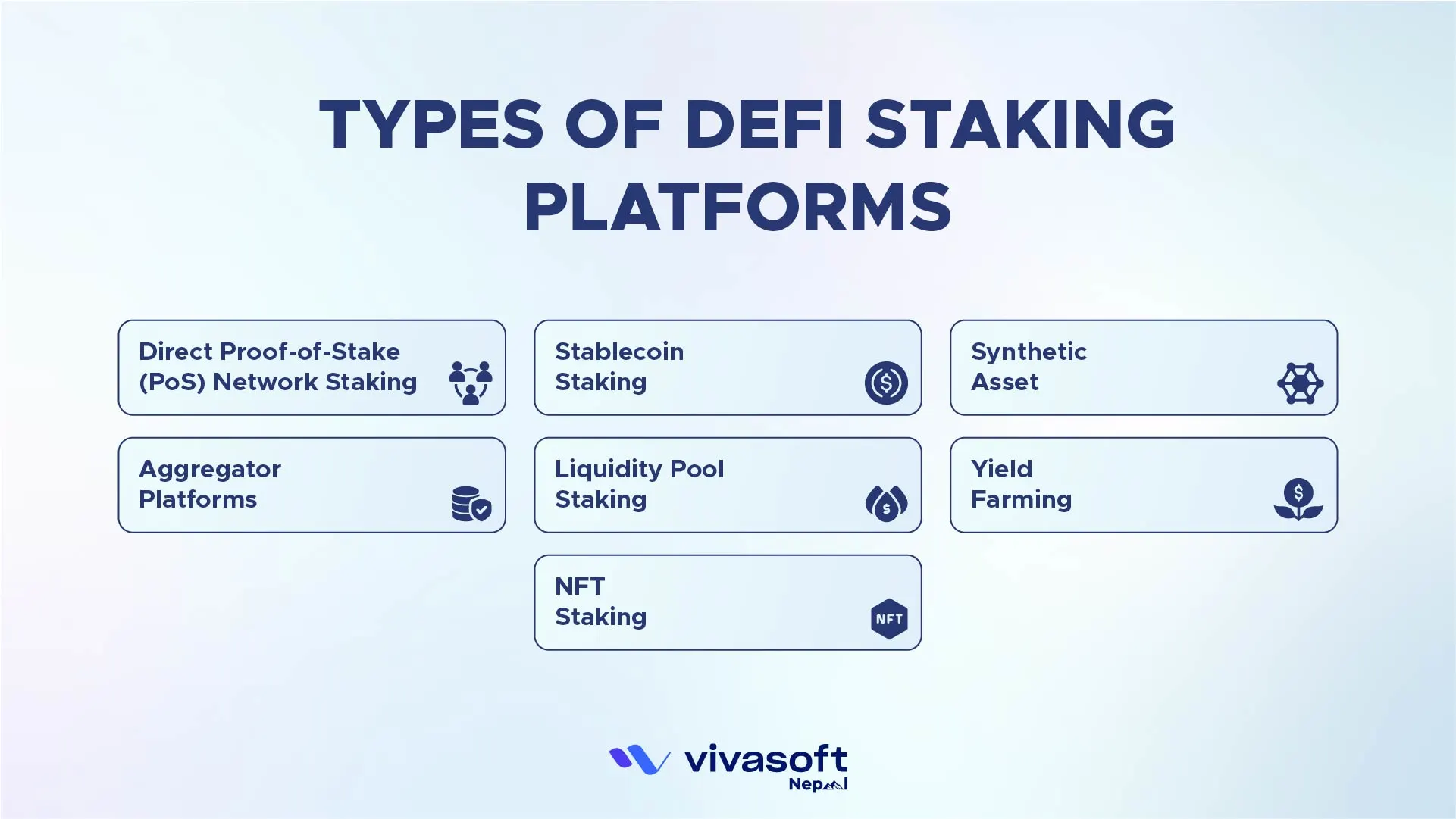
1. Direct Proof-of-Stake (PoS) Network Staking
This is the vanilla version of staking. Users lock their native tokens (like ETH or SOL) to become validators or delegate to an existing validator node. In return for securing the network’s consensus; they earn fresh token unlocks.
2. Stablecoin Staking
Crypto volatility scares a lot of people away. Stablecoin staking fixes this by allowing users to stake USD-pegged tokens (like USDC or USDT) for modest but highly predictable APY, completely avoiding market price swings.
3. Synthetic Asset
This gets a bit more complex. Users stake collateral to mint a synthetic asset that tracks the real-world value of something else like gold, stocks, or fiat currencies. Stakers earn fees generated from the trading of these synthetic assets.
4. Aggregator Platforms
Think of these as the “Google Flights” of DeFi. Aggregator platforms don’t have their own native staking pools. Instead, they scan the entire DeFi ecosystem and automatically route user funds to whichever third-party pools offer the highest yields at any given moment.
5. Liquidity Pool Staking
This type forces the ecosystem to function. Users provide equal parts of two different tokens to a trading pair on a DEX. In exchange for providing this liquidity so others can trade, they receive LP (Liquidity Provider) tokens, which they then “stake” to earn a cut of the trading fees.
6. Yield Farming
If you want to be aggressive, Decentralized yield farming solutions are where you go. Yield farmers constantly move their assets between multiple different lending, borrowing, and staking protocols, chasing the absolute highest promotional yields and governance token airdrops available.
7. NFT Staking
It’s not just for JPEGs anymore. Users lock their utility-based NFTs into a smart contract to earn fungible token rewards, whitelist access, or in-game currencies. It heavily incentivizes holding rather than rapidly flipping NFT collections.
Why Should You Build a DeFi Staking Platform?
Building out architecture like this takes time and capital but the incentive alignment for both the end-users and the protocol founders is massive.
Key Benefits for Users
- Passive Income: It’s the ultimate set-it-and-forget-it way to grow a crypto portfolio.
- Flexible/Fixed Staking: Users can choose high-yield, long term locks or slightly lower yields with the ability to withdraw anytime.
- Token Rewards: Users earn fresh tokens which can dramatically compound over time.
- Governance Participation: Staking often grants voting rights; letting users dictate the future of the platform.
- Liquidity Retention: Through liquid staking tokens (like stETH) , users can earn staking rewards while still spending a derivative token elsewhere in DeFi.
Key Benefits for Businesses
- Revenue: Protocols usually take a very small percentage or performance fee from the overall rewards generated.
- User Acquisition: High APYs are the ultimate marketing tool to attract initial users.
- Liquidity Growth: Locked tokens secure the network and provide deep liquidity making the token far less volatile.
- Global Scalability: Anyone with an internet connection can participate no geographical restrictions.
- Token Economics Optimization: It forces a reduction in circulating supply, which naturally protects the token price from dumpers.
- Competitive Advantage: As seen with the top DeFi development companies having a robust staking mechanism makes a brand look heavily established and trustworthy.
What Are the Key Features of a DeFi Staking Platform?
If you are planning a crypto staking app development project; you can’t just slap a “Stake Here” button on a webpage and expect millions in TVL. You need enterprise grade features.
1. User Interface & UX Design
DeFi is historically clunky and confusing. Your platform needs to look and feel like a modern banking app. APYs, lock-up periods, and reward accumulations must be displayed clearly without overwhelming the user with raw smart contract data.
2. Asset Support & Security Infrastructure
The platform should support multiple SPL, ERC-20, or other standard tokens. On the security side, it’s all about multi-sig wallets, intense rate limiting, and aggressive DDOS protection on the frontend.
3. Reward Calculation & Payout Mechanisms
This is the math engine. It automatically track exactly how long a user has been staked; checks their share of the total pool and fairly calculates payouts down to the block level without rounding errors.
4. Wallet Integration (MetaMask, Trust Wallet)
No one wants to create a new account login. Standard Web3 wallet integration via WalletConnect, MetaMask, Phantom or Trust Wallet is an absolute must for frictionless onboarding.
5. Validator Nodes & Node Infrastructure
If you’re building direct network staking, you’ll need robust cloud infrastructure running 24/7. Missing blocks leads to getting “slashed” (penalized by the network), meaning robust server redundancy is a non negotiable feature.
6. Cross-Chain & Layer 2 Staking Solutions
Single-chain dApps are slowly dying out. Users want the ability to bridge assets from Ethereum over to Layer 2s like Arbitrum or Base seamlessly to avoid brutal gas fees while staking.
7. Staking Analytics Dashboard
Users want dopamine. A rich dashboard showing total staked balances, projected annual earnings, historical performance charts, and current network health keeps users coming back daily.
8. Tokenomics & Incentive Mechanism Design
You need a system that prevents “farm and dump” behavior. This usually means implementing dynamic emission rates where APY scales down organically as more users enter the pool.
What Are the Technology Stack for DeFi Staking Platform?
Behind the scenes of every successful staking protocol is a surprisingly similar foundational tech stack.
1. Blockchain Layer
This is your foundation. Whether you are building on Ethereum (for deep liquidity), Solana (for extreme speeds), or an EVM-compatible Layer 2 like Polygon, this decides your consensus mechanism and transaction ceilings.
2. Smart Contracts
This is the absolute heart of staking software development. Smart contracts handle the deposit holding, the lock timers, and the mathematical distribution of rewards. The code is usually written in Solidity (for Ethereum) or Rust (for Solana).
3. Frontend
To build a highly responsive and sleek UI; almost all top tier platforms use React.js or Next.js paired with Web3.js or Ethers.js to let the website actually talk to the blockchain.
4. Backend & Indexing
While smart contracts handle the heavy lifting; you still need a traditional backend (Node.js or Python) and an indexing tool like The Graph to rapidly query on-chain data so your UI loads fast.
5. Deployment & Security
CI/CD pipelines, Docker containers, and rigorous testing frameworks like Hardhat or Foundry ensure that updates to the platform don’t break the live environment.
How DeFi Staking Platform Works?
It sounds like magic but the mechanics are beautifully straightforward. Here is exactly how it function:
- Mechanism: A user connect their wallet, selects a pool and signs a transaction approving the transfer of tokens into a decentralized smart contract. This is a Crypto locking protocol development standard; the tokens are locked by code not humans.
- APY (Annual Percentage Yield): The smart contract reads the amount of total liquidity in the pool and calculates the user’s specific percentage share. Based on the inflation schedule of the token, it assigns an APY.
- Rewards: Every day (or block by block), fresh tokens are minted or unlocked from a treasury and dispersed into the user’s pending balance. The user can then click “Claim” to withdraw their rewards back to their wallet, or “Compound” to add them back into their staked principal.
What Are the Steps to Build a DeFi Staking Platform?
Going from a rough idea on a whiteboard to a massive platform launching with millions in TVL takes a highly structured process.
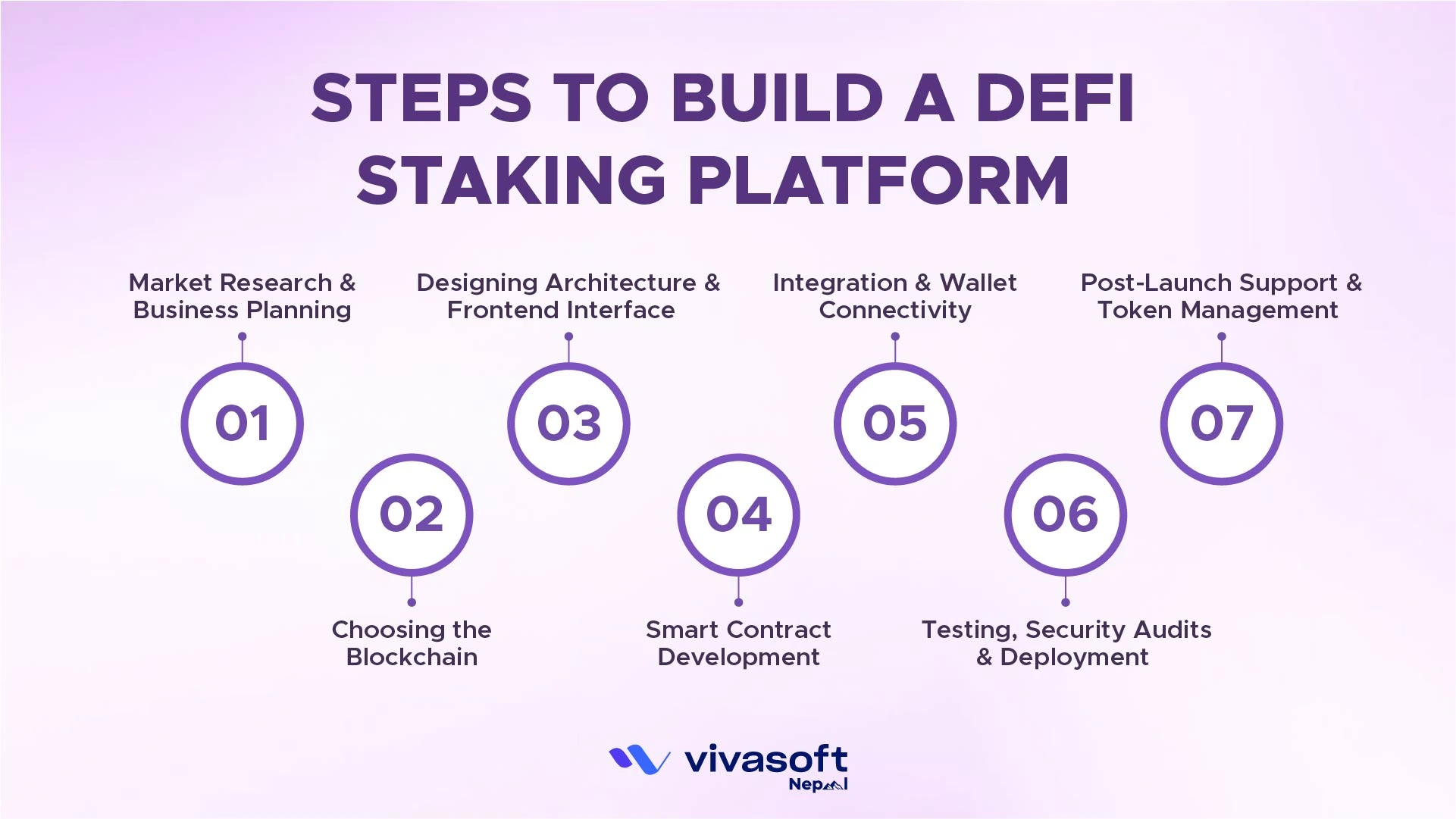
1. Market Research & Business Planning
Start by defining who your user is. Are you targeting retail investors looking for easy 5% yields on stables, or degens chasing 500% APY on micro-cap tokens? Figure out the tokenomics before touching code.
2. Choosing the Blockchain
- Ethereum: High security, massive liquidity, but brutal gas fees.
- BSC (Binance Smart Chain): Cheap, fast, heavily adopted by retail.
- Solana: Blistering fast, great for high-frequency trading and low-fee staking.
- Polygon/Avalanche: Perfect bridges between EVM compatibility and high scalability.
3. Designing Architecture & Frontend Interface
Map out the user journey. Wireframe the dashboard. Decide where the connect wallet button goes, how the APY is visualized, and how a user clearly sees their lock-up penalty if they withdraw early.
4. Smart Contract Development
This is where the actual building happens. Your devs write the code dictating the exact rules of the staking pools. If you need a deep dive on this process, check out DeFi smart contract development guide.
5. Integration & Wallet Connectivity
Link the shiny Next.js frontend to the robust Solidity smart contracts running on the blockchain testnet using Web3 connection libraries to ensure transactions actually sign properly.
6. Testing, Security Audits & Deployment
Never launch without testing. Run the platform on a testnet. Put the code through hell with automated stress tests. Finally, hire an external auditor to try and hack the contracts. Only when it’s flawless, do you push to mainnet.
7. Post-Launch Support & Token Management
Launch day is just the beginning. The dev team monitor network congestion, ensure node uptime, handles bug bounties and eventually manages the migration if the contract ever need to be upgraded.
What Makes a Defi Staking Platform Enterprise Ready?
If you want heavy institutional money to stake their bags on your platform, a basic fork of an old protocol won’t cut it. You need features built for scale.
Multi-chain Staking Platforms
Whales don’t keep all their assets on one chain. An enterprise platform effortlessly routes funds across Ethereum, Arbitrum, and Solana natively without forcing users to use shady third-party bridging sites.
Liquid, Delegated, Auto-compounding Platforms
- Capital efficiency is everything to big money. Liquid staking gives them a receipt token so they can actively use their staked equity elsewhere in DeFi (like on a DeFi lending platform).
DAO & Governance Token Staking
Enterprise platforms use staking as a tool to decentralize power over time. Users staking governance tokens are given voting weight proportional to their lock time to steer protocol treasury decision.
On-chain & Off-chain Reward Systems
Sometimes rewards aren’t just tokens. Enterprise platforms might offers off-chain rewards like discounts on trading fees, VIP access to OTC desks or even a priority RPC support for massive stakers.
Flexible vs Fixed Staking Models & Lock-in Periods
Institutional players need specific risk profiling. Offering multiple tiers like an open flexible pool earning 4% and a strict 12-month locked pool earning 10% gives large funds the exact tooling they need to manage their treasury.
Compliance & Enterprise Features
Institutions cannot interact with anonymous, tainted crypto mixers. Enterprise platforms bake KYC (Know Your Customer) and AML (Anti-Money Laundering) checks directly into specific permissioned staking pools to remain legally compliant.
What Are the Cost of Developing a DeFi Staking Platform?
Budgeting for Web3 is tricky. Several massive variables dictate the final invoice.
- Technology Stack Choices: Building custom Rust program on Solana is generally pricier and harder to find talent for than forking a generic EVM contract on Binance Smart Chain.
- Number of Supported Networks: Every new blockchain you support requires custom RPC nodes, distinct contract deployments and totally separate auditing process.
- UI Complexity: If you want a basic terminal UI, it’s cheap. If you want fluid animations, custom data indexing, and heavy real-time analytics, you have to pay top-tier frontend devs.
- Rigor of third-party audits: A good audit from a firm like Certik or Hacken can easily run you $15,000 to $50,000+ alone, but skipping it is corporate suicide.
Approximate Budget Estimates
| Development Phase | Maximum Estimated Cost (USD) | Minimum Estimated Cost (USD) | Time Estimate |
|---|---|---|---|
| Discovery & planning | $5,000 | $15,000 | 1–2 weeks |
| UI/UX design | $8,000 | $20,000 | 2–4 weeks |
| Smart contract development | $15,000 | $60,000 | 4–8 weeks |
| Backend & API integration | $12,000 | $40,000 | 4–7 weeks |
| Frontend development | $10,000 | $30,000 | 4–8 weeks |
| Blockchain integration | $8,000 | $25,000 | 3–6 weeks |
| QA & security audits | $10,000 | $50,000 | 2–5 weeks |
| Post-launch support & updates | $5,000 | $20,000+ | Ongoing |
What Are the Top DeFi Staking Projects?
To understand how high the bar actually is, you just have to look at the giants in the space doing this right now.
1. Lido Finance (Ethereum, Solana, Polygon)
Lido is the undisputed king of liquid staking. Instead of locking up 32 ETH and running a node yourself, you send ETH to Lido. They stake it for you, and give you back ‘stETH’ (staked ETH) which you can freely trade while passively earning daily rewards.
2.Rocket Pool (Ethereum)
Rocket Pool took the Lido model but hyper-focused on decentralization. Instead of huge institutional node operators securing the ETH, they built a protocol where anyone with a decent computer and just 8 ETH can become a validator, driving massive community support.
3. PancakeSwap Staking (BSC)
PancakeSwap isn’t just an exchange; it’s a prime example of Automated market maker (AMM) staking development. Users provide liquidity to the DEX and then stake their LP tokens into ‘Syrup Pools’ to earn aggressive yields in CAKE or other newly launched partner tokens.
Why Choose Vivasoft Nepal for DeFi Staking Platform Development?
When the stakes are this high, you cannot afford to hire developers who are “learning Web3 on the fly.” You need absolute veterans.
Development Services
We don’t just deploy contracts. Whether you’re aiming for a seamless DeFi app development process for retail, or heavy enterprise architecture, we provide true end-to-end building from tokenomics design all the way to mainnet launch.
Team & Technical Expertise
Our squad of 50+ engineers lives and breathes Rust, Solidity, and Node.js. We have walked numerous clients through the exact pitfalls of cross-chain bridging and complex yield aggregation logic, ensuring your app actually works the way you planned.
Enterprise & Custom Solutions
We don’t fork code and charge you for it. We build custom, modular protocols designed to integrate with KYC/AML tools if required, giving you a legally secure foundation to onboard heavy institutional liquidity.
Security-First Approach
We treat user funds like our own. Our internal code review process is vicious, and we build our smart contracts specifically to pass the most grueling third-party external audits in the industry on the very first try.
Want to see exactly how we operate? Head over to our DeFi development services and let’s talk about your next build.
Frequently Asked Questions
How to choose a blockchain for my staking platform?
It depends entirely on your target audience. For massive institutional whales, you need the security of Ethereum. If you are targeting fast retail trading and micro-transactions, you should look at Solana or Polygon.
What are staking rewards & APY?
Staking rewards are the newly minted tokens or transaction fees given to users for locking their assets. APY (Annual Percentage Yield) is just the mathematical rate of return those rewards generate over a full year, including compound interest.
How to integrate wallets like MetaMask or Trust Wallet?
This is handled on the frontend using libraries like Ethers.js, Wagmi, or Web3Modal. This allows your website to securely ping the user’s browser extension or mobile app, requesting permission to read their balances and sign transactions.
Can I build a multi-chain or institutional staking platform?
Yes, but it’s complex. Multi-chain requires deploying identical but separate smart contracts across multiple networks (like ETH and BSC) and using a bridging protocol (like LayerZero) if you want the data to sync perfectly between them.
How long does it take to deploy a custom staking platform?
Deploying a custom staking platform typically takes 16 to 24 weeks for full, custom-built solutions, although simplified or white-label solutions can be deployed in as little as 7 to 15 days.