


As decentralized apps have changed the way we interact with digital finances, DeFi wallets have become the main gateway to access them. People now trade, stake, and move assets directly through wallets, not exchanges. That shift has pushed a huge amount of value into wallet infrastructure, and it’s only getting bigger as more users and institutions come on-chain.
But as the wallet is dealing with private keys and real money at every step, even a small security gap can become a serious problem. That’s why for CTOs and product leaders, the real question isn’t just how to build a wallet. It’s also how to build one that can scale with usage, staying secure under constant on-chain pressure. Let’s discuss it in this comprehensive guide.
What Is DeFi Wallet Development?
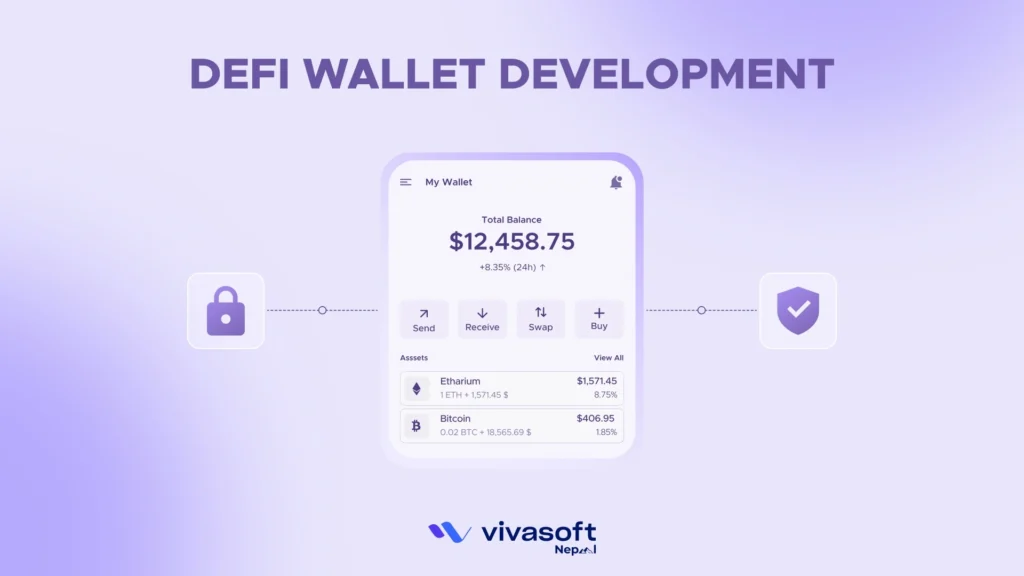
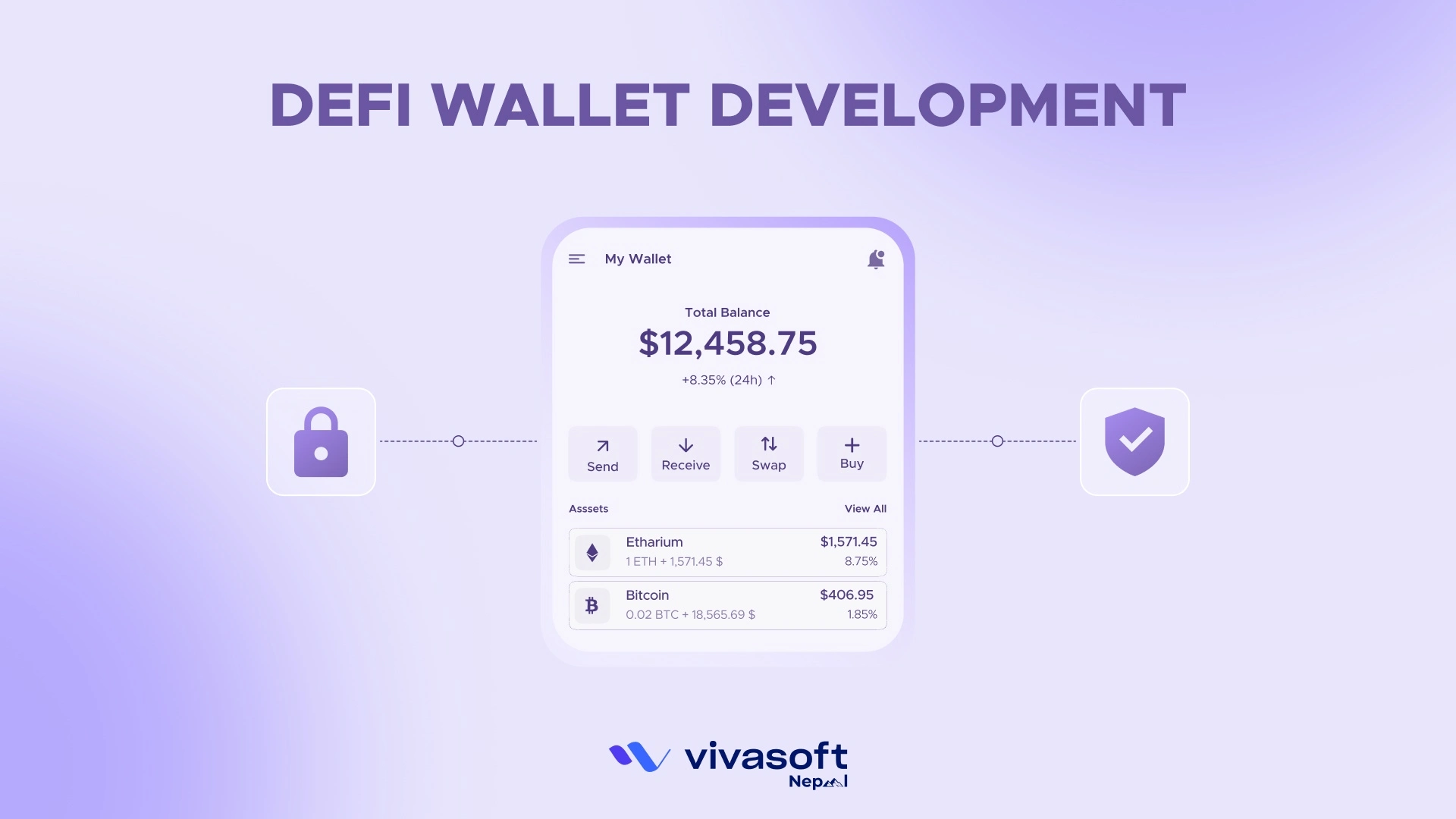
DeFi wallet development is the process of building crypto wallets that let users store and manage digital assets on their own. These wallets are unlike traditional banking apps. These wallets connect directly to blockchain networks and decentralized apps.
In DeFi platforms, most wallets are non-custodial. That means you have control of your private keys and recovery phrases. You don’t have to hand them over to an exchange or third-party company.
You can use a DeFi wallet for different purposes. For instance, to send crypto, swap tokens, buy NFTs, join blockchain games, or access DeFi platforms from phone or browser. The wallet simply acts as the connection between you and blockchain-based services.
DeFi Wallets vs Centralized Exchange Wallets: The Non-Custodial Difference
Usually, both wallets may look similar because they store crypto assets. But the way they work is different. With a DeFi wallet, the user stays in control. With an exchange wallet, the platform manages most of the access and security.
| Feature | Non-Custodial DeFi Wallet | Exchange (Custodial) Wallet |
|---|---|---|
| Custody | User controls private keys | Exchange controls private keys |
| Access | Users access funds directly through their wallet | Access depends on the exchange account |
| Recovery | Recovery happens through a seed phrase or a recovery phrase | Password reset and customer support are usually available |
| Control Over Funds | User has full ownership and transaction control | Exchange manages transactions and asset custody |
| Best For | DeFi access, Web3 apps, NFTs, long-term self-custody | Beginner trading, quick buying and selling |
Why Specialized "DeFi" Wallet Development is Required?
A normal crypto wallet can handle basic sending and receiving of tokens, but DeFi wallets need specialized development for Web3 and decentralized finance. That’s because they store assets and also actively interact with blockchain apps.
For instance, the first reason is transaction signing. Whenever you’re going to do any DeFi activities like swap tokens or add liquidity, the wallet has to sign the action using your private key. Nothing actually goes through until that signature confirms you approved it.
Then comes dApp connectivity. DeFi wallets connect with decentralized apps directly. So, you don’t have to create separate logins every time for decentralized exchanges, lending platforms, and NFT marketplaces.
Smart contracts are another reason these wallets need a special design. DeFi activities run on smart contracts. So, the wallets need to have specialized development to work effectively as per the smart contract and execution on-chain.
What are Types of DeFi Wallet?
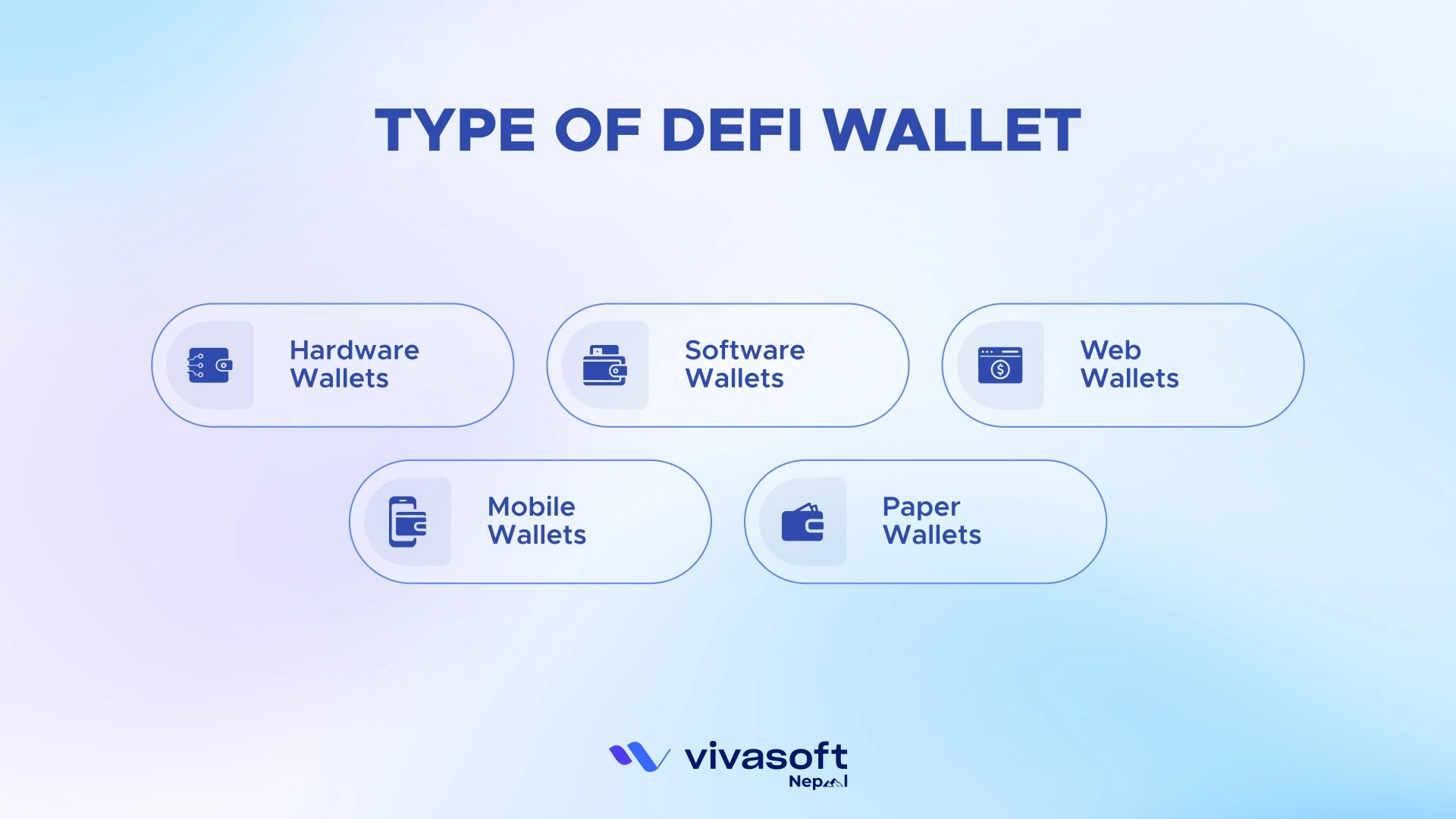
There are different types of DeFi wallets available, catering to a wide range of your needs.
1. Hardware DeFi Wallets
Hardware DeFi wallets like Ledger and Trezor are offline storage for your private keys. It also stores your crypto offline. As they are not connected to the internet, they offer you enhanced security for your DeFi tokens or crypto. That’s why most of the users use hardware DeFi wallets when they want to keep a large amount of crypto with maximum security for a long time.
2. Mobile DeFi Wallets (Software, Non-custodial)
These are apps you install on your phone. Here, apps like Walletverse, Trust Wallet, and Exodus let you manage all your DeFi assets and activities from your smartphone. Another benefit of these non-custodial wallets is that you have full control using a recovery phrase. So the company can’t access your funds. As they are simple to use and always with you, mobile wallets are good for daily use.
3. Browser Extension / Web Based DeFi Wallets
These wallets work inside your web browser. You connect them to DeFi apps with one click and approve transactions directly in your browser. You can use them for trading, swapping tokens, and interacting with DeFi platforms. Common browser extensions are MetaMask and Coinbase Wallet.
4. Custodial vs Non-Custodial DeFi Wallets
| Aspect | Custodial Wallet | Non-Custodial Wallet |
|---|---|---|
| Control of funds | Managed by a company | Controlled by the user |
| Private keys | Held by the platform | Held by the user |
| Recovery | Password reset or support | No recovery if lost |
| Ease of use | Simple for beginners | More responsibility |
| Security | Managed by a service provider | Depends on user safety |
| Example | Exchange wallets like Kraken or Binance | MetaMask, Trust Wallet, Ledger |
| Use case | Trading and quick access | DeFi, NFTs, full ownership |
5. Multi Chain / “Web3-hub” DeFi wallets
A Web3 wallet is basically an advanced and self-custody crypto wallet that lets you interact with blockchain apps, keeping control of your own funds. You can use dApps, swap tokens, and buy an NFT in multiple chains within a single unified app. For instance, Trust Wallet, OKX Wallet, MetaMask, Rabby Wallet, Phantom
Why Should Businesses Build a DeFi Wallet?
DeFi wallets are now at the center of on-chain finance. Most users don’t want to jump between multiple apps just to trade, stake, bridge assets, or track their holdings. Companies are building DeFi wallets to solve that problem by keeping swaps, payments, staking, and portfolio management inside one product. The longer users stay inside the wallet ecosystem, the more transaction activity the platform captures.
That user activity is also where the business value comes from. Wallets can generate recurring revenue in different ways. It includes swap fees, staking commissions, premium tools, treasury services, and enterprise licensing. As users keep trading and using the wallet, companies can earn continuously from that activity.
1. Market Size & Web3 Adoption Trends
The Web3 and DeFi wallet space is growing quickly as more people and businesses move on-chain. Recent market reports show that the sector will grow from nearly $7 billion in 2025 to around $8.9 billion in 2026. The ecosystem also has a strong adoption rate. According to research, there were more than 820 million active crypto wallet users in the previous year. Surprisingly, it accounts for 15% of the global internet population.
2. Key Drivers for Enterprise Adoption
Companies are adopting DeFi wallets as they’re solving real business problems.
- For instance, Faster cross-border payments
- Direct access to on-chain liquidity
- Better control over digital assets
- Multi-chain support for flexible operations
- Institutional security and treasury management
- Integration with financial and fintech systems
3. Wallet Monetization Models That Actually Work
Wallets don’t usually make money by charging users once. They earn small amounts many times when people use the app. The more users trade, stake, or manage assets, the more the wallet earns.
- Swap fee routing & DEX aggregation: When you swap one token for another, the wallet helps you find the best price across exchanges. After the trade, there is a small fee. Since people swap tokens often, this becomes a steady income source.
- Staking or Yield commissions: When your users lock their crypto to earn rewards, the wallet can take a small amount of commission from those rewards. So, your wallets can make more as your users stake more.
- Premium features & analytics: In some wallets, you can also have some additional features. For instance, profit tracking, on-chain transaction analysis, or getting tax reports. Users pay for these features like a subscription.
- White-label SaaS licensing: Some companies don’t build wallets from scratch. They pay wallet providers to use ready-made wallet systems. The wallet company earns by licensing its software to other businesses.
- Enterprise licensing & treasury solutions: Big companies need strong security and team control for crypto. Wallet providers give them special systems for approvals, storage, and asset management, and charge service fees for it.
4. White-Label vs. Custom DeFi Wallet Development
When a company builds a DeFi wallet, it usually has two choices. It can either use a ready-made wallet system (white-label) or build everything from scratch (custom). Here is the difference between them.
| Factor | White-Label DeFi Wallet | Custom DeFi Wallet |
|---|---|---|
| Cost | Lower upfront investment | Higher development cost |
| Timeline | Faster launch cycle | Longer development timeline |
| Control | Limited customization and infrastructure ownership | Full control over architecture and integrations |
| Scalability | Suitable for MVPs | Better for complex ecosystems |
| Compliance | Depends on vendor capabilities | Fully customizable compliance |
How DeFi Wallet Infrastructure Works?
A DeFi wallet works through a few basic building blocks. It creates keys to prove ownership and uses those keys to approve actions. After it, it sends those approvals to the blockchain, where smart contracts complete the work.
1. Private Keys & BIP-39 HD Derivation
Every DeFi wallet starts with a private key, and that key proves you own your funds. Generally, wallets use a seed phrase made up of 12 or 24 words and use this seed phrase to generate many addresses through hierarchical deterministic (HD) derivation. In simple terms, one master seed creates many child keys. Each address stays separate, but they all come from the same seed.
2. Smart Contract Interaction & Signing Mechanisms
When you use DeFi apps, your wallet doesn’t move money directly. It signs a message that means you approve a transaction, and then only the wallet sends the transaction to the blockchain. Smart contracts read it and carry out the action.
3. Account Abstraction (ERC-4337) Architecture
Account abstraction changes how wallets work by making them more flexible. Instead of only relying on a private key, wallets can behave like smart contracts that follow custom rules.
With ERC-4337, you don’t send a normal transaction. You send a “user request,” and it goes through a system that processes and validates it before execution in different blockchain layers. Here is the difference between EOA and ERC-4337 Smart Accounts.
| Feature | EOA Wallets | ERC-4337 Smart Accounts |
|---|---|---|
| Control | One private key controls everything | Wallet follows programmable rules |
| Transactions | Direct blockchain transaction | Sent as a user request first |
| Gas fees | Paid by the user | Can be sponsored or abstracted |
| Recovery | Not possible if the key is lost | Can include recovery options |
| Flexibility | Limited features | Highly customizable wallet behavior |
What Are the Core Features of a High-Retention DeFi Wallet?
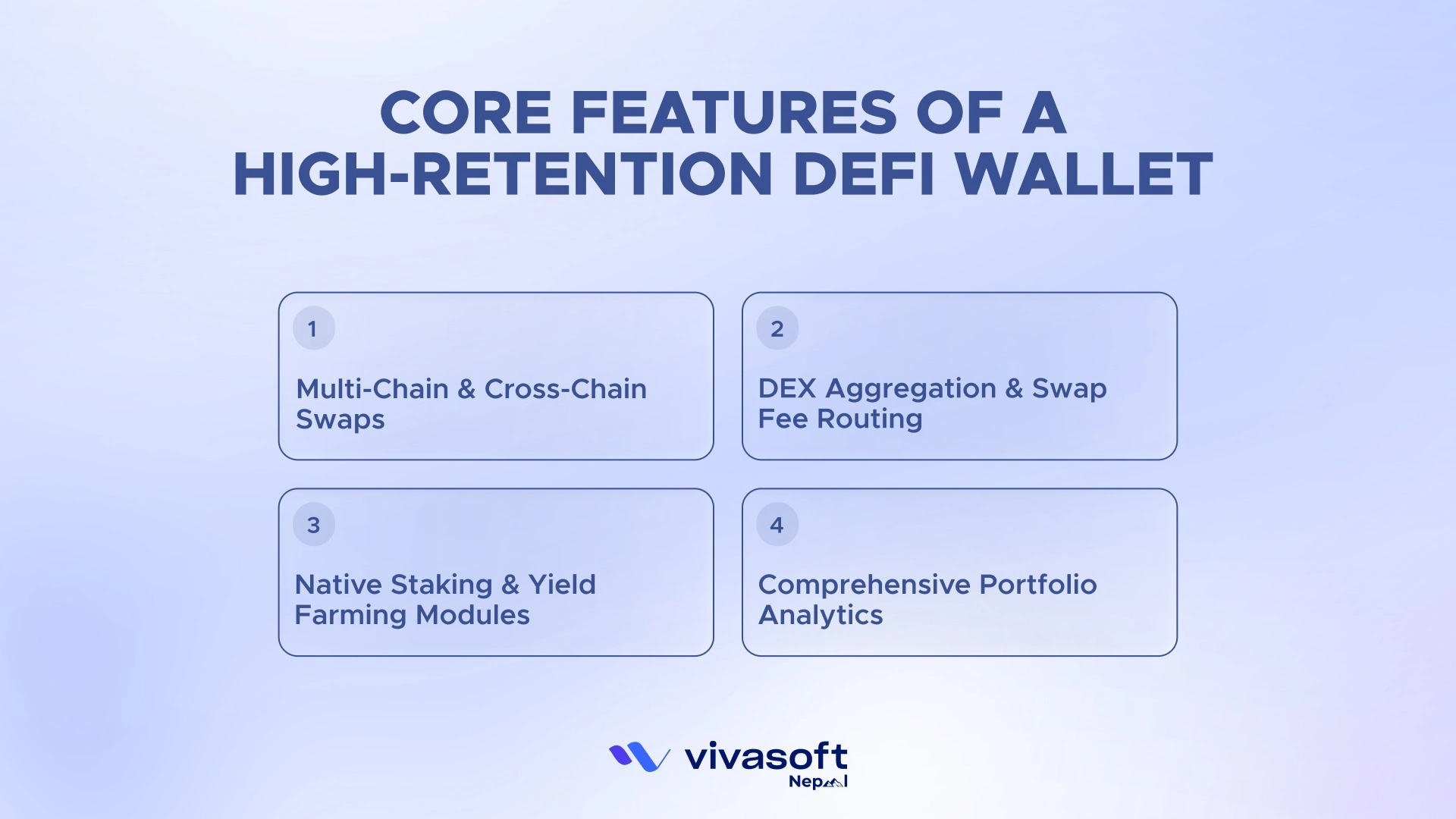
A high-retention DeFi wallet keeps users active. It lets you handle every activity on the DeFi platforms without switching apps.
1. Multi-Chain & Cross-Chain Swaps
A strong DeFi wallet lets you manage assets across Ethereum, Polygon, Arbitrum, BNB Chain, and other major chains from a single dashboard. Some advanced wallets also include non-EVM networks like Solana.
Cross-chain swaps are another key part. They let you move assets between chains using integrated bridges.
2. DEX Aggregation & Swap Fee Routing
Modern wallets don’t just let you swap tokens. The wallet pulls liquidity from platforms like Uniswap, Curve, or SushiSwap and routes your trade where you get the best price and lowest slippage.
In some cases, the swap is split across different liquidity pools. It removes the need for you to compare prices manually every time you trade.
4. Native Staking & Yield Farming Modules
High-retention wallets also help you earn from your assets. You can stake tokens directly inside the wallet and start earning rewards. That’s especially true for Proof-of-Stake assets. Many wallets also include yield farming options like lending or liquidity pools.
5. Comprehensive Portfolio Analytics
A good DeFi wallet also acts like a financial dashboard. You can see all your holdings across different chains in one place. It shows your total balance, token distribution, and performance over time.
More advanced wallets track profit and loss, staking rewards, yield earnings, and even liquidity positions. Some tools also give breakdowns of risk and returns so you can adjust your strategy.
What Are the Advanced Capabilities for Enterprise Wallets?
Enterprise-grade DeFi wallets are built to handle institutional security and large-scale transactions where failure isn’t acceptable in enterprise blockchain solutions.
1. MPC (Multi-Party Computation) Key Management
In enterprise wallets, Multi-Party Computation or MPC splits the private key into smaller encrypted parts and stores them across different systems. That means it doesn’t keep the whole key in one place.
When a transaction happens, the system brings these parties together to sign it through a threshold process, where each one contributes its share. It removes the single point of failure you usually see in traditional wallets and lowers the risk of theft or internal misuse.
2. Gasless Transactions via Paymasters
Gasless transactions work in a way where you don’t directly pay blockchain gas fees. Instead, a Paymaster smart contract sponsors the transaction on your behalf. In the ERC-4337 account abstraction model, the Paymaster gets called during the validation stage of a user operation and decides whether it will cover the gas cost. If it approves, the EntryPoint contract later deducts the gas fee from the Paymaster’s deposited funds instead of taking it from your wallet.
3. Social Recovery Mechanisms
Social recovery uses a guardian-based recovery system. Rather than depending on a single private key, the wallet assigns trusted guardians who can collectively approve recovery if access is lost. In most setups, a threshold like 2-of-3 or 3-of-5 is used, where only a minimum number of approvals is required to restore access. Guardians don’t control funds or private keys. They only take part in the recovery approval when needed.
DeFi Wallet Security & Compliance Architecture
In DeFi, security for wallets is built as a layered process, not a one-time audit. A strong wallet security system reduces risks before launch and keeps monitoring for issues after deployment.
1. Smart Contract Audit Pipeline
A smart contract audit pipeline is the security stage before anything goes live on-chain. As contracts can’t be changed easily after deployment, teams rely on multiple layers of testing to detect issues early.
The process usually starts with automated tools. They generally scan the code for known security issues. After that, the expert teams test the contracts with different random inputs to check how they behave under unusual conditions. At last, security engineers go through the logic line by line to spot deeper issues. For instance, flawed economic design or risky integrations.
2. Cross-Chain Bridge Risk Mitigation
Most bridge risks come from a few common problems. Attackers often target validator or multisig keys, break message verification between chains, or exploit weak checks during deposits and withdrawals.
To reduce these risks, modern bridge systems use multiple layers of protection. They spread security across decentralized validator sets, independent verification, strict transaction rules, and circuit breakers. They can pause the activity if something unusual happens.
3. MiCA Regulation & FATF Travel Rule Compliance
MiCA, or Markets in Crypto-Assets Regulation, is a set of rules by the European Union for crypto companies. It explains how crypto businesses should operate, protect users, and follow legal requirements for offering services in Europe. Alongside this, the EU applies the Transfer of Funds Regulation (TFR). It enforces the FATF Travel Rule in crypto transactions. So they ensure compliance standards in crypto transfers.
4. Embedding On-Chain KYC Without Sacrificing Decentralization
In on-chain KYC, identity checks happen outside the blockchain. Here, the system keeps proof verification proof only. It doesn’t store any personal information of the users. When a user interacts with a protocol, smart contracts only verify these proofs instead of accessing or storing personal identity data. This keeps sensitive information off the blockchain.
Step-by-Step DeFi Wallet Development Process
DeFi wallet development follows a clear step-by-step process. Typically, the whole process starts with planning. Then goes through all the way to development and ongoing updates.
Step 1: Discovery & Architecture Design
This is the planning stage where the teams decide the main purpose of the wallets, target users, and how the users will use their features. They also pick the basic setup for how the wallet will hold and manage assets, whether fully user-controlled or managed through advanced security setups.
Step 2: Protocol & Blockchain Selection
Now you decide in which blockchain network the wallet will run. Teams look at cost, network activity, and where most users already operate. As Ethereum has a large liquidity and strong security, most developers choose it. Moreover, they choose Layer 2 networks for their lower costs and transaction speed.
After that, teams decide on blockchain services and DeFi platforms that the wallet will connect with. For instance, token swaps, lending protocols, and cross-chain bridges.
Step 3: Smart Contract & UX Development
This is the stage where the wallet starts working or becomes functional. Here, the developer built the basic actions of the wallets. It includes sending tokens, swapping, and staking so that the wallet can actually work with blockchain networks. They also ensure to keep the UX simple so that the users can easily understand everything.
At the same time, they build smart contracts and connect them to the wallet. Many teams also use already tested contract standards to avoid unnecessary risk.
Step 4: Security Audits & Remediation
Before launch, everything gets reviewed from a security angle. After deployment, smart contracts are very hard to change, so teams target to find anything that could go wrong with user funds, permissions, or transaction logic before real users use it. They check the system many times to make sure nothing is broken. The developer team continues the checking process until they ensure the wallets are secure enough to launch.
Step 5: Testnet-to-Mainnet Migration
Now the wallet leaves testing and goes live. Teams switch everything from test networks to real blockchain networks and make sure the final audited contracts are in place. Settings like network IDs, RPC connections, and test features are also cleaned up before launch.
This is generally the final checklist (production standard) before launch.
- Switch RPC from testnet to mainnet
- Update chain IDs in the wallet
- Verify smart contracts on the blockchain explorer
- Transfer final admin or multisig control
- Turn off test features like faucets and logs
- Test real transactions (send, swap, sign)
- Enable monitoring and alerts
- Final approval for launching
6. Step 6: Post-Launch Support & Maintenance
After launch, teams monitor the transactions and network performance. Blockchain conditions can change anytime due to network updates or higher fees. That’s why the wallet needs regular checks to keep it reliable.
Fixes and updates also continue in the background. If a bug appears or a protocol changes, the wallet gets patched and adjusted. Teams also offer bug bounties and continuous security checks to report issues early.
How Much Does It Cost to Develop a DeFi Wallet?
DeFi wallet costs change a lot depending on what you’re building. Simple wallets cost less, whereas the price increases with the advanced features.
| Wallet Type | Estimated Cost | Timeline | Typical Features |
|---|---|---|---|
| Basic MVP Wallet | $15,000 – $50,000 | 2–4 months | Works on one chain, Basic send/receive, and Simple storage |
| Standard Multi-Chain Wallet | $80,000 – $150,000 | 4–7 months | Supports several chains, token swaps, staking, and NFT access |
| Enterprise / Institutional Wallet | $150,000 – $400,000 | 6–12 months | Strong security setup, MPC-style key handling and compliance needs |
| White-label wallet (licensed) | $10,000 – $40,000 setup | 4–8 weeks | Ready-made system with limited customization |
| Full-featured exchange wallet | $200,000 – $500,000+ | 9–18 months | Trading system integration, liquidity tools, and advanced infrastructure |
Key Factors That Drive DeFi Wallet Development Costs
There are several factors that affect the total cost of building a DeFi wallet. Some projects only need basic wallet functions. At the same time, some others require advanced integrations and multi-chain support.
- Features and complexity: A simple wallet costs less than a feature-heavy one. In the DeFi wallet development, the addition of NFT support, staking, token swaps, portfolio tracking, cross-chain transfers, or gasless transactions usually increases development cost quickly.
- Chains and integrations: Supporting multiple blockchains adds more than UI work. Each network has separate APIs, signing methods, and testing requirements. Integrating DEXs, bridges, or DeFi protocols also adds more backend work.
- Security and audits: Security often becomes one of the biggest expenses in DeFi projects. Teams may need encrypted key storage and stronger login protection. In some projects, they also invest in phishing detection tools and third-party security audits. It ultimately increases the development cost of the DeFi wallets.
- Compliance (KYC/AML, licensing posture): Your wallets may also need KYC or AML systems, depending on your target market and business model. Projects working with fiat payments or regulated regions may also face additional legal and infrastructure costs.
- Team location and model: The final budget also depends on who builds the wallet. Generally, in-house blockchain teams or specialized Web3 agencies have very different pricing structures. Security auditors and smart contract engineers can also increase overall costs.
Tech Stack for DeFi Wallet Development
Different DeFi wallets use different technologies. Which one you should choose depends on the features of your wallets and supported blockchains.
| Category | Technologies / Tools |
|---|---|
| Blockchain Networks | Ethereum, Polygon, BNB Chain, and Solana |
| RPC & Node Providers | Infura, Alchemy, QuickNode, self-hosted nodes, and redundant RPC endpoints |
| EVM Web3 Libraries | Ethers.js, web3.js, viem |
| Solana Libraries | Solana/web3.js |
| Account Abstraction & MPC | MPC-based key-sharing SDKs, and account abstraction libraries |
| Storage & Encryption | AES-256 encrypted local storage, and secure keystore management |
| Web Frontend | React.js, Next.js, and Tailwind CSS |
| Wallet Connection Tools | WalletConnect, Web3Modal, RainbowKit, and wagmi |
| Mobile App Development | React Native, Swift, and Kotlin |
| Backend Technologies | Node.js, NestJS, and Go |
| Database & Caching | PostgreSQL and Redis |
| Cloud & Infrastructure | AWS, Google Cloud Platform, and Firebase |
| DeFi & Smart Contract Integration | Ethers.js, viem, and solana/web3.js |
| Swap & Routing Integration | 1inch-style APIs, Rango-style SDKs, and DEX router services |
| Analytics & Indexing | The Graph, blockchain subgraphs, and Dune dashboards |
| Authentication & Sessions | SIWE (Sign-In With Ethereum), and WalletConnect session layer |
| Security Features | Touch ID, Face ID, biometric authentication, MPC workflows, and suspicious activity monitoring |
Industry Use Cases for DeFi Wallets
DeFi wallets are used for much more than storing cryptocurrency. They act as the access point for different blockchain-based financial services, decentralized apps, and digital asset platforms.
- Token Swaps and Decentralized Trading: DeFi wallets let you trade cryptocurrency directly through decentralized exchanges. Here, you can swap tokens for another without sending funds to centralized exchanges. During this swap and trading of tokens, you keep full control of your assets.
- Staking and Earning Rewards: Staking is also a common use of DeFi wallets. You lock your tokens into blockchain networks or DeFi platforms directly through your wallets. Some wallets also connect with liquidity pools and yield farming platforms. So, it gives you more ways to earn from your crypto holdings.
- Borrowing and Lending Crypto: You can also use your wallet to borrow or lend cryptos on platforms like Aave and Compound. In these platforms, the wallets connect directly, and the smart contracts manage the translation process automatically.
- NFT Storage and Marketplace Access: Many NFT collectors use DeFi wallets to store digital collectibles and connect with NFT marketplaces. Some DeFi platforms even use NFTs as collateral or as proof of ownership for digital assets.
Final Thoughts
Whether you are building your first liquidity pool platform or scaling to a multi-chain yield farming ecosystem, our DeFi development team delivers audited, scalable platforms from smart contract design to launch.
We’ve covered DeFi wallet development solutions across every major platform type, blockchain, and service layer. The next step is straightforward. Talk to a DeFi development domain expert, get technical questions answered before you commit to anything. Our team responds within 24 hours and provides a detailed scope and cost estimate within 48 hours of receiving your requirements.
Frequently Asked Questions About DeFi Wallet Development
How long does it take to deploy an enterprise DeFi wallet?
As you’re developing an enterprise DeFi wallet, it can take time due to its complex security requirements and integrations. Generally, White-Label/WaaS Solutions take 3 to 6 weeks to develop. On the other hand, if you build a custom enterprise DeFi wallet, it can take 6–12 months or longer.
What is the difference between an MPC and a seed-phrase wallet?
A seed-phrase wallet uses only one recovery phrase, and this phrase controls the entire wallet. So, it has a single point of failure if the phrase is stolen/loss or funds are gone. In contrast, an MPC splits the private key into smaller encrypted parts and stores them across different systems. That’s why there is no single point of failure.
How do you ensure regulatory compliance (KYC/AML) in a non-custodial wallet?
In most non-custodial setups, security is different from that of the centralized exchanges. As providers don’t hold or control the private keys, transaction monitoring, integrating compliance at fiat gateways, and using on-chain analytics ensure KYC and AML compliance.
What are the risks of a DeFi wallet?
The biggest risk is loss of keys or seed phrases. It’s because there’s no recovery if they are gone. Users also need to watch out for phishing attacks and approve transactions carefully, as you can’t reverse blockchain actions after confirmation.