


DeFi replaces traditional financial platforms with smart contracts, giving anyone with a digital wallet direct access to lending, earning, and trading. The DeFi market now stands at $238.54 billion in 2026 and is expected to reach $770.56 billion by 2031 with a growing CAGR of 26.43%.
At this growing scale, the top-level DeFi protocols only determine whether your capital grows or disappears. A single wrong choice can increase the risk of exploits, errors, or governance failures. Each protocol handles assets differently.
Some offer liquidity pools for trading, whereas others allow users to earn interest or staking rewards. So before you dive in, you should have a good understanding of their TVL, security audits, and yield performance. Read on to find the top 10 DeFi protocols of 2026, each analyzed on exactly that basis.
What Are DeFi Protocols?
DeFi protocols are mainly sets of code or rules that govern how digital assets are used on a blockchain network. These protocols make safe paths for users for various financial services like trading or staking without the need for any intermediaries. Codes are used to handle transactions directly between users and provide constant global access.
The protocols are run on smart contracts. It helps automate operations like escrow, loan approval, and interest payment. Users can earn rewards, trade assets, all with transparency and security. With ongoing innovations like cross-chain support and Layer 2 scaling, the protocols are making financial services faster and more accessible.
Top 10 DeFi Protocols of 2026
Before getting into the details, let’s have a short glimpse of the top 10 DeFi protocols of 2026, including their approximate TVL and key chain details:
| Rank | Protocol | Category | TVL (approx.) | Primary Use Case |
|---|---|---|---|---|
| 1 | Lido | Liquid Staking | $19.45B | Ethereum, Polygon, Polkadot, and Kusama |
| 2 | Sky (MakerDAO) | Lending | $7.52B | Ethereum |
| 3 | AAVE | Lending and Borrowing | $26.46B | Ethereum, Avalanche, Sonic |
| 4 | JustLend | Lending and Borrowing | $6.32B | Tron |
| 5 | Uniswap | DEX | $3.14B | Unichain, Polygon, |
| 6 | Curve Finance | DEX | $1.77B | Ethereum |
| 7 | Compound | Decentralized lending and borrowing | $1.4B | Ethereum |
| 8 | EigenLayer | Restaking | $15.8B | Ethereum |
| 9 | Pendle | Yield Management and Yield Trading | $3.44B | Ethereum, Arbitrum, BNB Chain |
| 10 | Synthetix | Synthetic Assets and Decentralized Derivatives | $38.81M | Ethereum |
1. Lido
Lido is the largest liquid staking protocol in DeFi, which is designed to make participating in Proof-of-Stake more accessible and efficient. Basically, when you stake your tokens through the Lido protocol, you will receive a “staked” version of that asset at a 1:1 ratio. Such as stETH for Ethereum. Even stETH can be traded, swapped, or used as collateral in other DeFi applications. Moreover, LDO is the native utility token used to manage the Lido DAO. It grants holders voting power to influence key aspects of the protocol. As of mid-March 2026, Lido holds $19.45 billion in TVL. It also generates $487M in annual fees and earns $48.7M in revenue
2. Sky / MakerDAO
MakerDAO is one of the earliest and most successful DeFi projects. Moreover, Sky is the next-generation version of MakerDAO. It was launched as part of the “Endgame” update. Gradually, it simplifies the ecosystem into a more accessible brand and introduces new tokens and modular structures. This transition just replaces the legacy tokens, such as DAI and MKR, with updated versions designed for better scalability. According to the reports, Sky projects $611.5M in gross protocol revenue for 2026, which is about an 81% year-over-year increase.
3. Aave
Aave is the leading decentralized liquidity protocol, which is constantly ranking as one of the largest in DeFi by TVL. Through this, users can lend and borrow cryptocurrencies through a peer-to-pool model. This is where assets are managed by smart contracts rather than a centralized intermediary. The protocol mainly functions as a digital, automated credit market. When you deposit assets, you receive aTokens. These tokens accrue interest in real-time. Even borrowers can take a loan.
4. JustLend
JustLend DAO is the primary lending and borrowing protocol within the TRON ecosystem. Similar to Aave on Ethereum, it basically establishes algorithmic “money markets.” This is where interest rates are dictated by real-time supply and demand for TRON-based assets. Mainly, the protocol uses a peer-to-peer model. When you deposit tokens, you will receive jTokens. As the newest report, it holds $6.71 billion in TVL with over 480,000 active users. You can supply TRX, USDT, or USDC to earn yield, or borrow against collateral at algorithmically determined rates.
5. Uniswap
Uniswap is the industry-standard decentralized exchange, which has transformed how crypto trading works by replacing traditional order books with an automated system. After Uniswap V4 launched, users started using this newer version of the exchange, and the trading volume has crossed $110 billion. You can connect your wallet, select a token pair, and execute trades, which is fully on-chain. To make the trading cost more affordable, it has launched Unichain. It is a dedicated Ethereum Layer 2, designed specifically for DeFi, featuring 1-second block times and “Smart Value Recapture.”
6. Curve Finance
Curve Finance is the “liquidity backbone” of DeFi, which is specifically optimized for high-efficiency stablecoins and pegged assets. It uses a specialized “StableSwap” invariant. This mathematical approach is designed to make trading affordable. You can trade millions of dollars between stablecoins with minimal price impact. Moreover, LPs can earn fees on assets in value against each other. It helps minimize impermanent loss. By 2026, it has evolved from a simple exchange into a full-scale credit protocol. One of them is crvUSD, Curve’s native decentralized stablecoin.
7. Compound
Compound is a foundational decentralized lending protocol that has established the “money market” model on Ethereum. This makes it possible that users can effectively earn interest on their digital assets or borrow against them using a completely efficient algorithmic system. Compound’s primary innovation is the cToken. When you supply an asset to the protocol, you receive an equivalent amount of cTokens. Instead of paying interest separately, Compound uses a smarter approach. Your cTokens increase in value over time compared to the original asset. You can also use your deposited assets as collateral to borrow other cryptocurrencies.
8. EigenLayer
EigenLayer is a foundational “restaking” protocol on Ethereum. It introduced a new primitive where users can take their already-staked ETH and “reuse” that security to power other decentralized services. As of March 2026, EigenLayer manages about $19.7 billion in total value locked with more than 4.6 million ETH staked. It generates $75.4M in annualized protocol fees and controls around 68% of the $26 billion restaking market.
9. Pendle
Pendle is a yield-trading platform that lets you split a yield-bearing asset into two parts. One is Principal Tokens, which is the initial investment amount, and the other one is Yield Tokens. It represents the yield generated by the asset, such as interest or rewards. If the actual yield ends up being higher than the price you paid for the YT, users get profit. In early 2026, Pendle underwent a major structural upgrade. It moves away from the “vePENDLE” system to sPENDLE. The protocol even now uses a portion of its revenue to buy back PENDLE from the market.
10. Synthetix
Synthetix is a decentralized liquidity layer that provides the backend for high-performance derivatives trading. Participants stake SNX or ETH as collateral to mint synthetic assets. These are called synths, which track stocks, commodities, currencies, and indices entirely on-chain. Traders gain exposure to a wide range of assets without holding the underlying instruments. It is ideal for hedging, speculation, and portfolio diversification. Moreover, synths can be traded directly on Synthetix’s decentralized exchange or integrated into other DeFi protocols.
Our Key Selection Criteria for Choosing the Best DeFi Protocols
We have gone through 4 key metrics to select the high-value DeFi protocols for 2026, suitable for modern investors:
Market Cap to TVL Ratio (MC/TVL)
We have compared a protocol’s market capitalization against its total value locked. This helps us find overvalued or undervalued tokens and assess risk-adjusted growth potential.
Tokenomics (Inflation, Vesting, and Utility)
Our professionals assess the emission schedule, vesting periods, and actual utility of the token. This ensures the rewards and governance mechanisms align with long-term growth.
Security Audits and Bug Bounties
We review institutional audit reports and active bug bounty programs. This way, we confirm that the protocol has strong protections against smart contract exploits.
Revenue and Economic Sustainability (P/S Ratio in Crypto)
We have analyzed how the protocol generates revenue, whether through fees, spreads, or service charges. Some protocols rely only on token inflation, so you ensure sustainable economic performance.
How Does DeFi Protocols Work?
DeFi protocols run entirely on smart contracts. Without any intermediaries required, you can connect a wallet, and the protocol executes automatically.
Lending: Through lending protocols, users can deposit assets into a “liquidity pool” and earn interest. Borrowers can then take loans from these pools by providing more collateral than they borrow. With expert DeFi lending platform development, businesses can keep the system stable and liquid.
Staking: Staking helps secure the blockchain, along with rewarding you. For example, you can stake ETH to validate transactions and, from there, earn rewards. In return for committing your assets and helping maintain the system, you will get rewards in the form of additional tokens. This is why an expert-level DeFi staking platform development has become a core part of any serious DeFi protocol today.
DEX: A DEX mainly facilitates the direct swapping of one cryptocurrency for another through an AMM instead of a traditional order book. These platforms mainly function through user-provided liquidity pools. It ensures trades can happen instantly at any time.
Yield Farming: Yield farming is the process of moving assets across different DeFi protocols to find the highest possible returns. You deposit tokens into a liquidity pool and receive LP tokens. Then you can stake those LP tokens elsewhere to earn extra rewards.
What Are the Key Metrics to Evaluate DeFi Protocols?
To check a DeFi protocol properly, you have to look for a few core metrics that help users know about capital effectiveness and yield performance. Let’s have a look at some key ones:
TVL: TVL is mainly the total amount of assets currently deposited in a protocol’s smart contracts. It works as the primary indicator of market trust and liquidity. A higher TVL generally suggests a more established and stable platform for large trades.
APY: The APY metric measures the real rate of return earned on a deposit over one year. Many times, it is your projected annual return, compounded over time. Though high APYs can attract users quickly, they are often risky if the rewards come from newly issued tokens instead of real revenue
Governance: Governance mainly refers to the decentralized system where token holders vote on key changes, such as fee structures or new asset listings. A healthy protocol features active community participation and a transparent proposal process.
Security: Security is the evaluation metric to understand how well a protocol protects user funds. This includes smart contract audits or bug-finding programs. Even large protocols can fail here, so it is important to maintain consistent security measures.
Why Do Users Choose DeFi Protocol for Financial Services?
DeFi protocols offer direct control over their money with no intermediaries involved in it. It is one of the biggest advantages for those who want complete transparency and effective investment. Here is more you need to know:
Centralized vs Decentralized Finance
Centralized finance mainly runs on intermediaries that can censor transactions or hamper accounts. On the other hand, through DeFi protocols, you can maintain full custody of your assets. This removes the need for credit checks and gives a transparent environment where code or any bank manager can’t control the management.
High Yield vs High Risk
Traditional savings accounts offer minimal interest. But with DeFi protocols, you can generate much higher yields as you are cutting out corporate overhead and distributing fees directly to users. With this advantage, you may also encounter some risks like smart contract vulnerabilities and market volatility.
Liquidity and Transaction Fees
Deep liquidity pools ensure that users can swap large amounts of capital instantly. They don’t need to wait for a buyer or seller to appear. Even modern protocols now focus on optimizing transaction costs. It ensures that decentralized trading remains cheaper than traditional brokerage commissions.
Multi-chain Compatibility and Interoperability
Modern users look for protocols that run across multiple blockchains. This helps users’ assets move freely between networks like Ethereum or Solana. Moreover, DeFi app development today focuses heavily on building cross-chain bridges and interoperability tools that make this possible.
What Are the Risks of Using DeFi Protocols?
Though the DeFi protocols remove the need for any intermediaries, they come with technical and financial risks. Users often have to consider smart contract bugs, market volatility, and evolving legal requirements.
Smart Contract Vulnerabilities and Oracle Manipulation
There are often coding errors or “bugs” in smart contracts. Hackers just get the chance to hamper entire liquidity pools instantly. Additionally, if a protocol runs on a single data source that is manipulated, it can cause false liquidations. Often, this leads to total loss of user funds.
Impermanent Loss in Liquidity Pools
When you provide liquidity to a DEX, the price of your deposited assets may change notably compared to when you joined. This is the impermanent loss, which occurs when the protocol’s mathematical formula rebalances your holdings as prices change.
Regulatory Compliance under New Global Frameworks
Governments worldwide are actively introducing regulatory requirements to safeguard the protocols. The EU’s MiCA framework and US SEC actions are already forcing protocol restructuring and geo-blocking. If a protocol isn’t compliant, there is a higher risk of being shut down, directly affecting the funds you’ve deposited.
Why Total Value Locked (TVL) is the Ultimate Metric for DeFi Protocol?
Here is what TVL really measures and why every serious DeFi user tracks it before committing capital.
How to Calculate TVL in DeFi
TVL is the clearest measure of a DeFi protocol’s size and user trust. There is a basic and simple formula to evaluate it:
Assets Locked × Live Market Price = TVL
Here, every asset deposited, such as ETH, USDC, or stETH, is calculated at its live market price. Then all are added together to get the protocol’s total TVL.
For example:
A lending protocol holds 10,000 ETH, and ETH is trading at $2,000. After multiplication, the protocol’s TVL is $20,000,000. Now, if ETH rises to $2,500 the next day, the TVL will rise to $25,000,000, even if no new deposits are made.
Bridged TVL vs. Total TVL
Total TVL mainly counts all assets locked on a protocol’s main blockchain. On the other hand, Bridged TVL counts only the assets that have been moved across networks using bridges. This is like using canonical bridges or often external bridges. When funds flow from Ethereum to Layer 2 networks, it expands the ecosystem’s reach.
The Drawbacks and Dangers of Relying Solely on TVL
- Large TVL makes a protocol a prime target for hackers. Even a single exploit can steal millions of dollars.
- Some users deposit funds just for short-term rewards and withdraw immediately when incentives drop. It causes sudden liquidity issues.
- High TVL doesn’t guarantee active usage. Funds may still be there for months, inflating the number.
- Certain protocols recycle the same funds through multiple layers to attract new investors.
What Are the DeFi Protocols by Blockchain Network?
DeFi protocols are built on blockchain networks. That specific blockchain network handles security and execution, like the complete processing of transactions and smart contracts.
Ethereum DeFi Protocols
It is likely the premier hub for high-value decentralized finance. Some of the top platforms, like Lido, allow users to earn staking rewards while keeping their assets liquid. In addition, Uniswap powers token trading through automated liquidity pools where users can swap assets. Besides, in Aave and Compound, users supply assets to earn interest or borrow against collateral.
BNB Chain DeFi Protocols
BNB Chain attracts millions of users through its fast and affordable services. For instance, PancakeSwap is the go-to exchange for swapping tokens quickly and easily. In addition, lending platforms like Venus Protocol allow users to supply assets to earn interest or borrow against collateral. Due to the low fees and high speed, BNB Chain is especially attractive for retail users and frequent traders.
Solana DeFi Protocols
Solana is mainly known for its high-speed transactions and extremely low fees. It is ideal for scalable DeFi applications. Jupiter, Raydium, and Kamino lead Solana’s DeFi stack in 2026. Besides, Raydium is known for token swaps and liquidity pools. Moreover, Kamino is rising in automating yield strategies and capital efficiency.
Polygon DeFi Protocols
This is mainly known for its low transaction fees and fast confirmation times. The protocol allows DeFi applications to operate efficiently while maintaining the best security. One of the top protocols on Polygon includes QuickSwap. This is where users trade tokens instantly through automated liquidity pools. Users also do yield farming and staking to maximize their return on crypto assets.
Arbitrum & Multi-chain Protocols
These networks focus on scaling and reducing gas fees while maintaining security. GMX is considered one of the top protocols on Arbitrum, allowing leveraged trading. Besides, Dopex focuses on decentralized options and derivatives. Through the multi-chain protocols, users move assets smoothly across different blockchains, such as Ethereum, BNB Chain, and Solana.
How Do You Choose a DeFi Protocol for Your Financial Services?
A wrong choice in selecting a DeFi protocol for your specific purpose can cost you money. Here is how you can choose the right DeFi protocol:
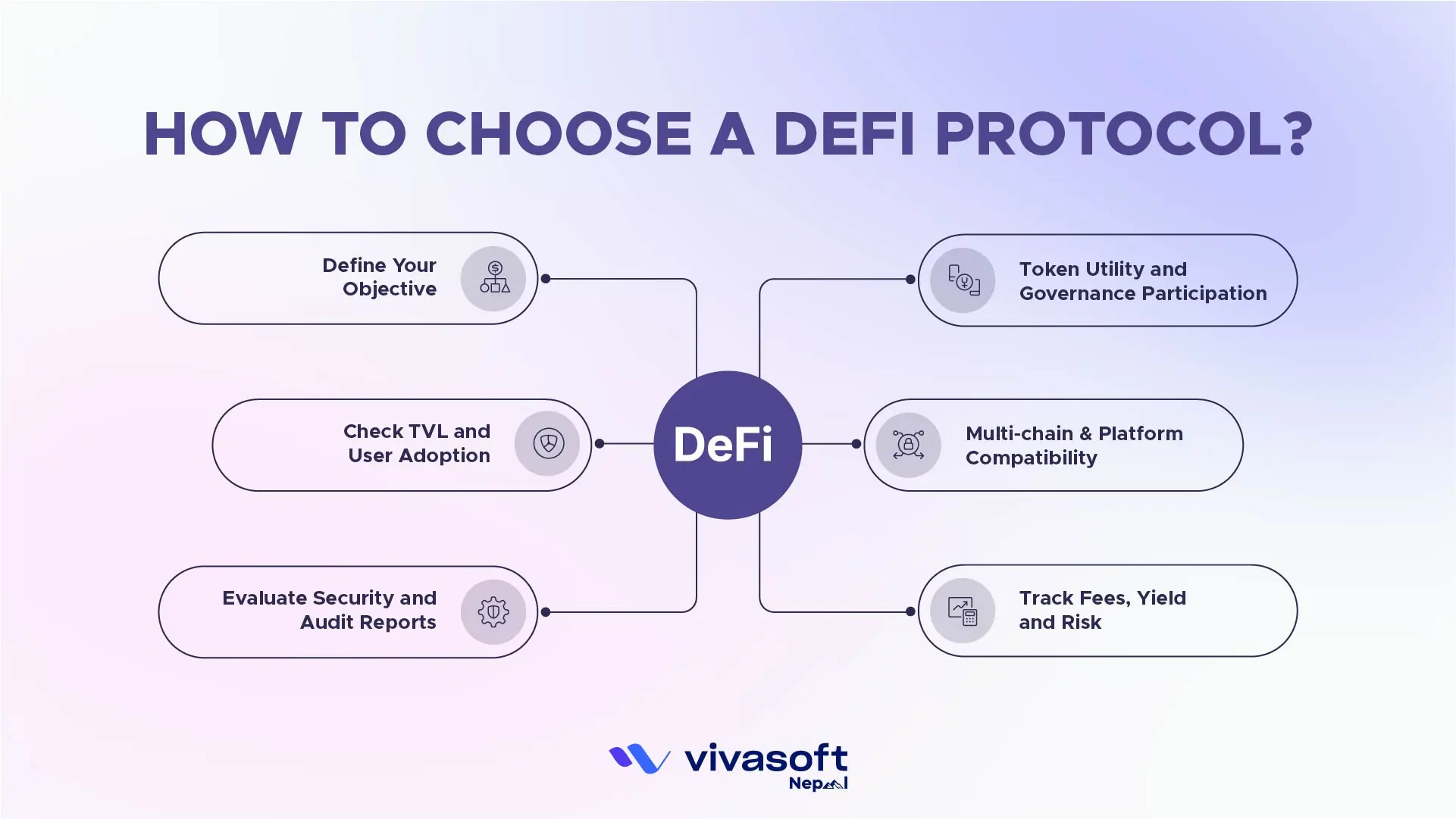
Step 1: Define Your Objective (Staking, Lending, Yield, DEX)
Start with one clear question: what do you want your capital to do? You can stake, lend, earn yield, or trade. Staking works best for long-term holders who want steady returns. Moreover, one can lend to earn yield on idle stablecoins. Yield farming maximizes returns with active management.
Step 2: Check TVL and User Adoption
Look at the Total Value Locked (TVL). Higher numbers and a trusted community show reliability. Also, check active users to ensure the platform’s stability and usability.
Step 3: Evaluate Security and Audit Reports
Examine smart contract audits and bug bounty programs. With expert DeFi smart contract development, you can track vulnerabilities effectively. Verify that the audit covers the exact contract version currently running.
Step 4: Token Utility and Governance Participation
Check if the native token offers real benefits like staking rewards, fee discounts, or voting power. Many leading defi development companies build strong governance models. This is where token holders can propose or vote on changes, ensuring the community can influence development and protocol upgrades.
Step 5: Multi-chain & Platform Compatibility
Look for protocols that operate on multiple chains or Layer 2 networks. This way, you can reduce fees and access larger liquidity pools. You will get more opportunities for yield and trading flexibility.
Step 6: Track Fees, Yield, and Risk
Before you finalize, compare transaction fees, expected yield, and protocol risks. Always compare APY to the protocol’s historical performance, not just current incentives. High APY backed by real trading fees or revenue is more reliable.
Emerging Trends Shaping DeFi Protocols
DeFi continues to evolve quickly, with new technologies making platforms faster, cheaper, and more user-focused. These trends are changing how users interact with decentralized finance.
Layer 2 Scaling Solutions (Optimistic & ZK Rollups)
Layer 2 solutions like Arbitrum, Optimism, and Base help reduce gas fees and speed up transactions by processing them off the main Ethereum chain. Users can trade, stake, or lend without paying high fees while still benefiting from Ethereum’s security. As DeFi platform development continues to evolve, these rollups are becoming essential for DeFi growth. These rollups are becoming essential for DeFi growth.
Cross-Chain Interoperability
Cross-chain interoperability connects liquidity and data across different blockchains. This allows users to move assets freely between networks like Ethereum, BNB Chain, and Solana. These are opening up new trading and yield opportunities. It also helps reduce congestion on a single chain and supports a more connected DeFi ecosystem.
Decentralized Autonomous Organizations (DAOs)
DAOs give users real voting power over protocol decisions, including treasury management, upgrades, and fee structures. Governance tokens let communities propose and vote on changes, creating more transparent and user-driven protocols where stakeholders directly influence the platform’s future.
Conclusion
DeFi is constantly changing finance with faster transactions and higher yields. Before making any decisions, you have to perfectly analyze protocol performance, historical APY, with expert security audits, and cross-chain support.
You can protect your capital while optimizing returns. Connect with our professional DeFi development services to explore DeFi safely and efficiently. Our top professionals will guide you to maximize your returns and navigate the decentralized ecosystem.
Frequently Asked Questions (FAQ)
What is the best DeFi protocol?
It depends on your goal. Lido leads in TVL and staking. Uniswap is key for DEX trading volume. Moreover, Aave and Compound are top for lending and borrowing.
How do DeFi protocols earn yield?
Protocols earn yield through lending interest, trading fees, and liquidity provision. Users can earn a share of these returns by supplying assets or staking tokens.
Are DeFi protocols safe?
Yes, DeFi can be safe if properly managed, but some risks exist, like smart contract bugs, oracle manipulation, and market volatility.
What is TVL, and why is it important?
TVL measures the total assets in a protocol. Higher TVL represents better liquidity and stability, ensuring smooth trading and lending operations.
How to choose the right DeFi protocol for beginners?
Before you get started, define your goals, check TVL and user adoption, review audits, ensure multi-chain support, and compare fees versus expected returns.
Can I use DeFi protocols on multiple blockchains?
Yes, many protocols support multiple chains or Layer 2 solutions, letting you move assets freely and access larger liquidity pools.
Which DeFi protocols offer staking rewards?
Lido, Aave, and Compound let you stake assets or tokens to earn rewards, either from protocol fees or newly minted governance tokens.