


Crypto payments are becoming a real part of everyday online business. Some companies still stick with banks and cards, but others are looking for quicker ways to accept money in Bitcoin, Ethereum, or stablecoins.
A crypto payment gateway works as a bridge for the payment here. It receives the payment request and checks what happens on the blockchain. Then it confirms whether the payment actually went through. In some setups, it also converts crypto into regular currency and sends it to the merchant.
With more cross-border transactions and Web3 tools getting used in real business, crypto payments are no longer just something experimental. They’re turning into a working option for many companies. However, crypto payment gateway development isn’t simply about connecting to a blockchain. You also need to ensure security, regulations, scaling issues, and all the small things related to real money exchange.
What Is a Crypto Payment Gateway?
A crypto payment gateway is a digital payment service that helps businesses accept crypto payments from customers. Here, instead of paying with a bank card, the customer pays with Bitcoin, Ethereum, or stablecoins. Here, when a customer chooses crypto as the payment method, the payment gateway checks the payment.
Then it creates a payment request with a wallet address or QR code and sends it to the blockchain network for confirmation. The gateway sends a success notification to the merchant and updates the merchant after the transfer is confirmed. The business can receive the payment in crypto or convert it into fiat currency.
How It Differs from Traditional Payment Gateways?
The main difference is that the traditional payment gateways depend on banks and cards where crypto ones use blockchain networks and crypto wallets for payment processing.
| Feature | Traditional Gateway | Crypto Payment Gateway |
|---|---|---|
| Settlement time | Typically 1-3 business days | Within seconds or minutes |
| Intermediaries | Banks, payment processors, card issuers, and clearing networks | Payments move through blockchain networks and wallets. |
| Currencies supported | Fiat currencies only include USD, EUR, or GBP. | Fiat and cryptocurrencies |
| Chargebacks | Customers can dispute transactions and request reversals through their bank or card provider | Confirmed blockchain transactions normally can’t be reversed |
| Geographic reach | International payments sometimes face limited banking hours, conversion delays, or regional restrictions. | Crypto payments can move between users in different countries without depending fully on banking networks |
| Transaction fees | Typically 2-3.5% + $0.20 to $0.30 fixed per transaction | Typically between 1-2% with no fixed per transaction |
What Are the Types of Crypto Payment Gateways?
Crypto payment gateways are not all built the same. They differ in how funds move, who controls the assets, and how much control a business wants over the payment setup.
- Custodial gateways: In a custodial setup, the payment provider temporarily holds the funds before sending them to the merchant. This works similarly to traditional payment processors, where the gateway manages the wallet, settlement, and transaction flow on behalf of the business.
- Non-custodial gateways: Here, the money never really sits with the provider. Once the customer pays, the funds go straight to the merchant’s wallet. The gateway’s role is mostly to detect the transaction on the blockchain and confirm it.
- Hosted vs self-hosted solutions: In hosted gateways, providers handle it completely. So just connect and start accepting payments. Self-hosted setups work differently. The business runs the system on its own infrastructure. That’s why it gives more control over configuration and data handling.
- White-label vs custom-built: White-label gateways let businesses launch crypto payment services using existing infrastructure under their own branding. This reduces development time and setup costs. Custom-built gateways are developed from scratch for a company’s own operational needs, payment flow, compliance process, or blockchain support requirements.
- SaaS crypto payment platforms: SaaS models are more about convenience. Here, merchants simply access the payment system through a dashboard or API, and the provider takes care of updates and technical maintenance.
Why Businesses Are Building Crypto Payment Gateways?
Businesses are using crypto payment gateways because normal payment systems can feel slow and expensive. That’s especially true for international payments. They want a faster and simpler way to get paid.
1. The Cross-Border Payment Problem
Sending money abroad still takes longer than it should. Payments usually pass through a chain of banks before they reach the final person in digital banking. That’s why international transfers often take a few days, not minutes.
Crypto payments reduce some of this waiting. Instead of moving through banks, value can move directly between wallets on blockchain networks. In many cases, it settles in minutes and works any time of day, without waiting for banking hours.
2. High Transaction Fees & Network Congestion
Crypto payments don’t always stay cheap. When the network gets busy, especially on Ethereum, gas fees can jump quickly and make even small payments feel expensive.
To handle this, payment systems often shift traffic to Layer 2 networks. These don’t process everything on the main chain. So they stay faster and cheaper during busy times. Some systems also move payments to lower-cost blockchains like Solana or Tron when needed.
3. Volatility Risk and Stablecoin Solutions
The Bank for International Settlements (BIS) explains that cryptocurrencies like Bitcoin and Ethereum are highly volatile since their prices depend on market demand and speculation, not a fixed backing system. This makes income planning harder for merchants who rely on stable cash flow.
Stablecoins like USDC, USDT, and DAI help solve this. They are designed to stay close to fiat values like the US dollar. Many payment systems also convert crypto into stablecoins or fiat automatically. That’s why you can avoid holding volatile assets and accepting crypto payments.
4. Limited eCommerce Integration Options
Most merchants want to accept crypto payments, but they usually don’t have developers who can build a blockchain e-commerce platform. So they stick with what they already use.
Shopify doesn’t take crypto payments on its own, but it lets merchants add apps that connect crypto checkout to their store. WooCommerce works the same way through plugins for WordPress sites. For merchants, it feels straightforward. They just install the tool, do a basic setup, and the rest runs in the background without changing their store structure.
5. Regulatory Uncertainty and Compliance Burden
As crypto payments don’t have one global regulation, it creates hesitation for many businesses. Different countries apply different rules, especially around KYC and AML checks, and FATF guidance expects crypto service providers to follow similar controls as traditional financial systems. There is also confusion around PCI DSS. On top of that, crypto rules change from country to country. It makes compliance planning harder for businesses working across borders.
Core Crypto Payment Gateway Architecture
A crypto payment gateway works like a chain of connected systems where each part handles a specific step.
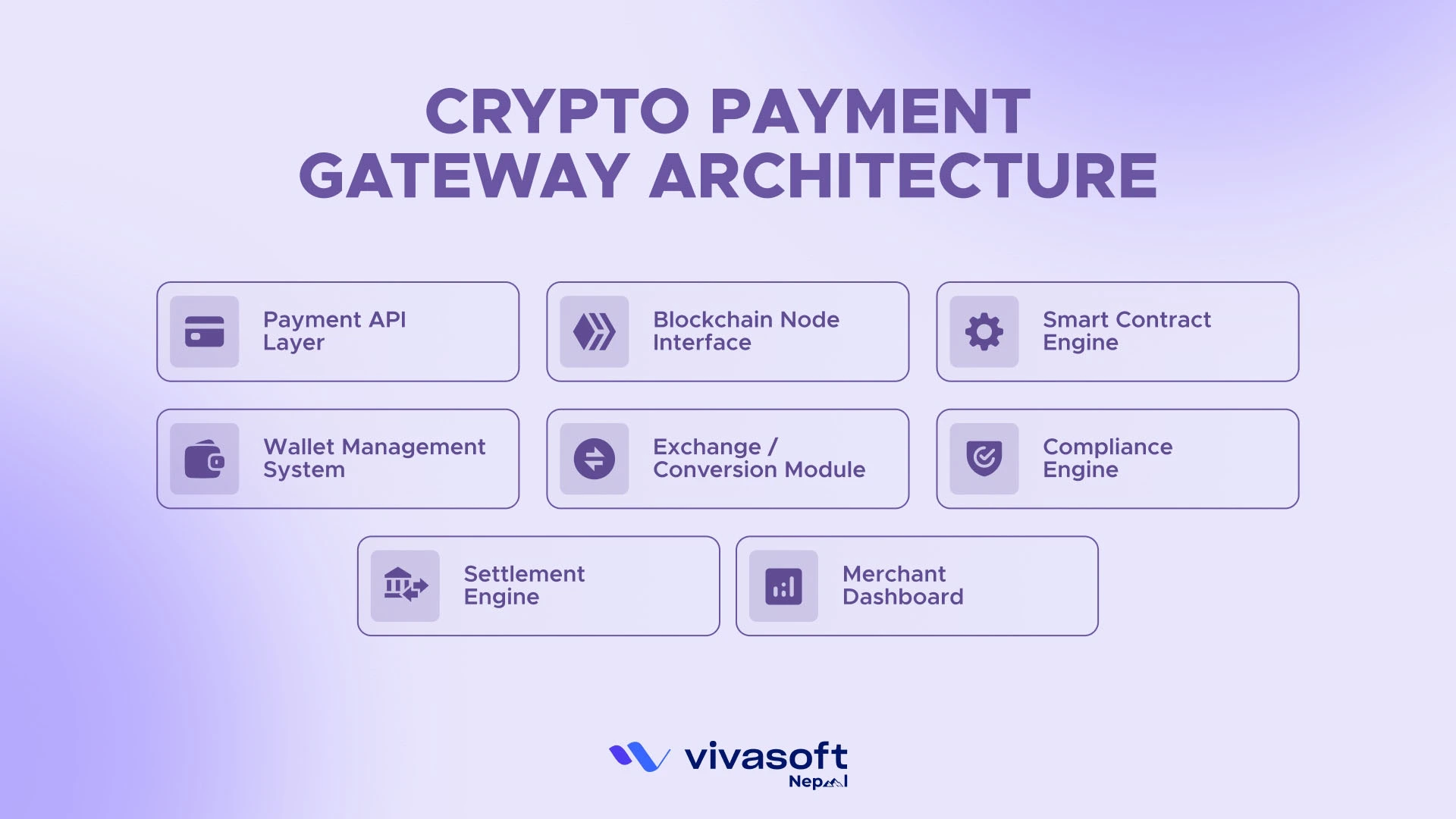
| Component | Function | Technology Examples |
|---|---|---|
| Payment API Layer | It takes payment requests from merchants and take them to the system | REST, GraphQL APIs, Node.js, Kong, or AWS API Gateway |
| Blockchain Node Interface | It connects to blockchain networks to send and check | Ethereum, Bitcoin nodes, Infura, or Alchemy |
| Smart Contract Engine | It runs payment logic directly on the blockchain | Solidity on Ethereum, Rust on Solana, Hyperledger Fabric |
| Wallet Management System | Keeps wallets and private keys safe | MPC wallets, HSM security modules, and Fireblocks |
| Exchange / Conversion Module | It handles swapping or converting crypto into fiat | Binance, Coinbase APIs, liquidity pools, or OTC desks |
| Compliance Engine | Checks users and transactions for compliance | Chainalysis, Elliptic, and sanction screening tools |
| Settlement Engine | Moves funds to merchants | Banking APIs, SWIFT, SEPA |
| Merchant Dashboard | It lets merchants see payments and settlement updates | React-based dashboards, Grafana, and analytics tools |
Transaction Flow:
A crypto payment doesn’t move in one step. It passes through multiple systems that check, process, and confirm it before the merchant receives funds.
- The user starts a payment from a merchant website or app
- The request first goes to the Payment API Layer
- The Compliance Engine checks identity, risk level, and sanctions status
- If approved, the Wallet System prepares and signs the transaction
- The Blockchain Node Interface sends it to the blockchain network
- The transaction gets confirmed after network validation
- If needed, the Conversion Module handles crypto-to-fiat or crypto swaps
- The Settlement Engine finalizes and sends funds to the merchant
- The Merchant Dashboard updates and shows the completed payment
Security Architecture for Crypto Payment Gateways
Crypto payment gateways use multiple layers of security. Here is an overview of the security architecture.
Security Threat Model
Crypto payment systems check where attacks can happen and reduce those risks using basic security controls like encryption, access control, and monitoring.
| Threat Vector | Risk | Mitigation |
|---|---|---|
| Private key compromise | Loss of funds and full wallet access | Hardware security modules, cold storage, multi-signature wallets |
| Smart contract exploit | Code vulnerability leading to fund drain | Audits, formal verification, and bug bounty programs |
| API key theft | Unauthorized access to payment gateway systems | Token rotation, IP whitelisting, OAuth, rate limiting |
| 51% attack (small chains) | Blockchain manipulation or double-spending | Use of established networks, confirmation thresholds |
| Replay attacks | Transaction reuse across chains | Nonces, chain-specific signing mechanisms |
| Man-in-the-middle | Data interception during transmission | TLS encryption, certificate pinning |
| Insider threat | Internal misuse of access privileges | Role-based access control and audit logs |
Encryption & Key Management
Crypto payment gateways rely on strong encryption and careful key handling so that private keys never get exposed at any point in the system.
- Hierarchical Deterministic (HD) Wallets: HD wallets generate all wallet addresses from a single seed. BIP32 defines how keys are derived in a structured tree, and BIP44 helps organize them across different accounts and blockchain networks.
- Envelope Encryption: Instead of saving private keys directly in the system, they’re first encrypted using a data key. That data key is then locked using a master key stored in AWS KMS, Google Cloud KMS, or HashiCorp Vault.
- Key Rotation Policies: Keys are rotated on a schedule or when needed, including API keys and signing keys. This reduces risk. That’s because if a key is exposed, it only works for a limited time.
- Hardware Security Modules (HSMs): HSMs are physical security devices built specifically for handling cryptographic operations. Here, private keys are created and used inside the hardware itself. So it becomes harder for attackers to misuse the keys.
Multi-Signature Wallet Architecture
Multi-signature wallets require multiple approvals to authorize one transaction, like a 2-of-3 or 3-of-5 setup. So it eliminates the single point of failure.
Here, signing keys are kept with different people or systems. Many teams use tools like Gnosis Safe (Safe{Core}) to manage approvals and handle transactions in a controlled way.
Fraud Detection & Transaction Monitoring
Crypto payment gateways need continuous monitoring because fraud can happen at the transaction level. That’s why most systems start with simple rule-based checks, like spotting unusually large transfers or repeated failed attempts.
Blockchain analytics tools also trace fund origins and flag links to risky/suspicious addresses. Everything also runs under real-time monitoring. In more serious cases, the platform can even pause or freeze the transaction temporarily until it’s reviewed.
Regulatory Compliance for Crypto Payment Gateways
Crypto payment gateways follow strict rules to stop fraud, money laundering, and security problems.
- KYC/AML Requirements: Crypto payment gateways usually don’t let users start right away. They first check identity, sometimes look at business ownership, and may also ask where the money is coming from. These steps mainly stop fraud and money laundering.
- PCI DSS Considerations in Crypto: PCI DSS helps when a crypto payment gateway handles card payments or fiat on-ramps. In practice, platforms encrypt payment details, restrict who can access sensitive systems, and monitor their networks for unusual activity.
- Transaction Monitoring Systems: Crypto payment gateways check every transaction to detect risk. To do so, they check wallets and compare them with OFAC, EU, and UN watchlists. If they see something unusual, they alert the team so the team can check it.
- Risk Management Framework: Crypto gateways use simple rules to stay safe from fraud and security problems. They group users and transactions by risk level and apply stricter checks when needed. They also use limits, location checks, and device checks to keep everything under control.
How to Develop a Crypto Payment Gateway: Step-by-Step Process
Building a crypto payment gateway involves creating an effective payment system. Each development step just makes sure the flow works properly from payment request to settlement.
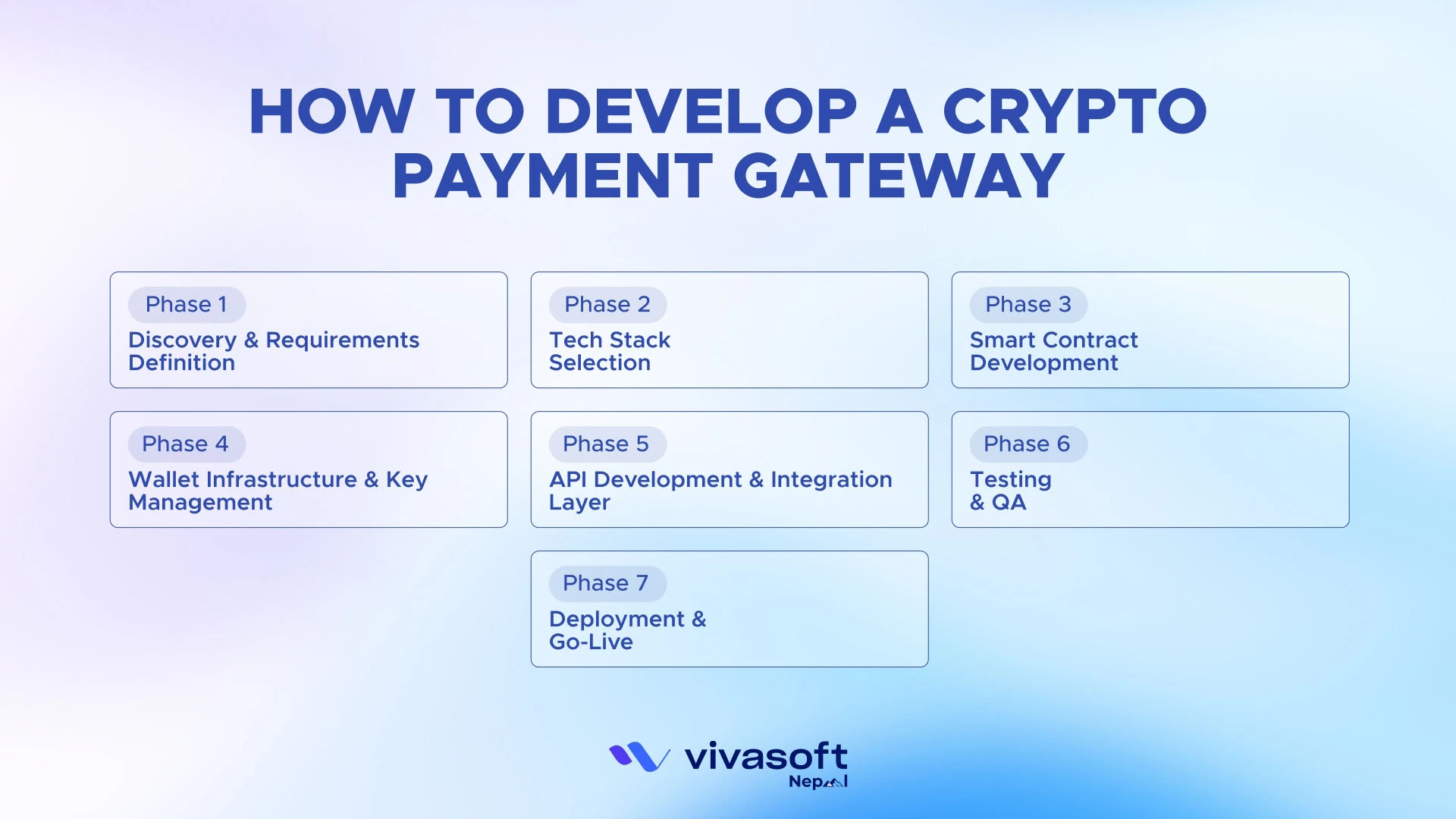
Phase 1: Discovery & Requirements Definition
This is the discovery step to decide what the system will actually support. You pick the cryptocurrencies and blockchains based on your use case, since each one behaves differently with fees, speed, and confirmations. You also choose whether funds will be held by the platform (custodial) or sent straight to the merchant (non-custodial). At the same time, you map basic compliance needs based on where you plan to operate, since rules around KYC and AML change from country to country. You also sort out how the settlement should work.
Phase 2: Tech Stack Selection
This next step is just about picking tools that are stable enough to run payments without adding unnecessary complexity.
| Layer | Options | Recommendation |
|---|---|---|
| Blockchain Networks | Ethereum, BNB Chain, Polygon, Solana, Bitcoin | Ethereum or Polygon usually works for most payment flows. Bitcoin is often kept for settlement |
| Smart Contract Language | Solidity, Vyper, Rust | Solidity is the default for Ethereum. Rust shows up mostly in Solana-based systems. |
| Backend | Node.js, Go, Python | Node.js handles APIs well, Go fits high-load systems, Python is often used for internal tasks. |
| Blockchain Libraries | Web3.js, Ethers.js, Viem | Ethers.js or Viem are commonly used because they’re simpler and more modern to work with. |
| Database | PostgreSQL, Redis | PostgreSQL stores the main records, Redis helps with fast and temporary payment states. |
| Wallet Infrastructure | BIP32/BIP44 HD wallets | A standard setup for generating multiple addresses safely from a single seed. |
| Frontend / Dashboard | React, Next.js | A common choice for building dashboards that show payments |
| Infrastructure | AWS, GCP, self-hosted nodes | Most start with cloud platforms like AWS or GCP, Some add their own nodes for more control. |
Phase 3: Smart Contract Development
Smart contracts are what handle the actual payment logic on the blockchain. They run automatically once conditions are met, so there’s no need for manual approval in between. In a payment gateway setup, they’re mainly used to make sure funds move in a predictable way between the customer and the merchant.
Different contracts handle different parts of the process. A payment receiver contract takes care of accepting funds. An escrow contract holds money until certain conditions are met, like order confirmation. Settlement contracts handle the final release of funds to the merchant. In some systems, conversion contracts are also used when crypto needs to be swapped into another token or fiat through external integrations.
Phase 4: Wallet Infrastructure & Key Management
In a payment gateway system, the wallet development is the most important part. Most gateways use HD wallets based on BIP32 and BIP44. This keeps payments organized and makes it easier to track funds.
In real systems, funds are usually split between hot wallets and cold wallets. Hot wallets handle day-to-day payments, and cold wallets store most of the reserves offline for safety. On the other hand, multi-signature setups are used for larger payouts and HSMs in production environments.
Phase 5: API Development & Integration Layer
The merchant API is basically the part of the system that businesses interact with the most. It usually follows a RESTful API with webhook support for payment events.
Developers also use idempotent endpoints to prevent duplicate payment processing and SDK libraries for major languages (JS, Python, PHP, Ruby). Some systems also add WebSocket support for real-time payment status updates
Phase 6: Testing & QA
Testing is where you make sure nothing breaks before real money is involved. Developers do Unit tests for smart contracts with a target 100% branch coverage. After that, the system is deployed on test networks like Ethereum Sepolia, BNB Testnet, or Polygon’s test environments to see how everything behaves in real blockchain conditions without risk.
Once the basic flow works, teams usually stress test the system by simulating high traffic, sometimes thousands of payment requests at once, to see how it holds up. Security testing is also done based on OWASP API guidelines to catch common API vulnerabilities.
Phase 7: Deployment & Go-Live
When everything is ready, the system is moved to the mainnet. This is where real payments start flowing. At this point, contract upgrades are usually protected with multi-signature wallets. After launch, the focus shifts to keeping things stable.
Teams watch transactions using tools like The Graph or Tenderly with custom alerts. If a blockchain node or provider goes down, fallback options are already in place so payments don’t stop. There’s also a basic incident plan ready, so issues can be handled quickly without affecting merchants too much.
Crypto Payment Scalability: Solving the Performance Problem
Crypto payments don’t always run smoothly when networks get busy. Transactions slow down, and fees can jump. Here, the following scalability solutions help out.
The Scalability Trilemma in Payments
Blockchain systems mainly balance three things
- Speed
- Security, and
- Decentralization
If one improves, the others usually get limited. That’s the core idea of the scalability trilemma.
In payments, this becomes clear during high network usage. Bitcoin and Ethereum stay secure and decentralized. But they can slow down when traffic increases. For payment gateways, this creates friction at checkout. Users expect quick confirmation, but the network doesn’t always respond at that speed, especially for small payments. Layer 2 networks here help by moving most activity off-chain and settling results back on the main chain.
Layer 2 Payment Integration
Layer 2 networks help payment systems handle transactions off the main blockchain, making payments faster and cheaper.
| L2 Network | TPS | Avg Fee | Best For | EVM Compatible |
|---|---|---|---|---|
| Polygon PoS | 65-100 | $0.01544 | Retail payments, gaming, high-volume microtransactions | Yes |
| Optimism | 2,000+ | $0.00059 | General Ethereum scaling, payment apps, DeFi | Yes |
| Arbitrum | 57 | $0.0129 | DeFi-heavy payment systems, trading platforms | Yes |
| Base | 117.1 | $0.0297 | Consumer apps, merchant onboarding, retail payments | Yes |
| zkSync Era | 300 | $0.02 | Fast settlement, account abstraction, scalable payments | Yes |
Lightning Network Integration for Bitcoin Payments
The Lightning Network is a Bitcoin Layer 2 that lets payments move much faster and at very low fees. Instead of waiting for confirmations, payments go through off-chain channels, which makes it useful for small and instant transactions.
For a payment gateway, this usually means running a Lightning node and keeping payment channels active so money can move in and out smoothly. Merchants create invoices, and the payment is routed through the network using Lightning’s built-in transfer system.
It’s fast when things are working well, but it still depends on channel balance and route availability. If liquidity is low or routes are not stable, payments can fail or take longer than expected. So gateways need to manage that in the background.
Network Fee Optimization Strategies
Blockchain fees keep changing based on network activity. For payment gateways, this can directly affect cost and pricing. To manage this, systems use a few simple methods to reduce unnecessary spending on fees.
| Strategy | How It Works | Savings Potential |
|---|---|---|
| Transaction batching | Group multiple payments into one transaction instead of sending each separately. | Reduces overall fees per payment |
| Dynamic gas pricing | Adjusts transaction fees based on current network demand. | Helps avoid overpaying during low congestion |
| Off-chain settlement | Moves transactions off the main chain and settles later in bulk. | High savings for frequent or small payments |
| Alternative chains | Uses cheaper blockchains when main networks are expensive. | Often reduces fees significantly |
| EIP-1559 optimization | Sends transactions with a better-calculated base fee and tip. | Reduces unnecessary overpayment |
Real-Time Crypto Payment Processing
Traditional blockchain payments often need confirmation time before a merchant treats them as final. For Bitcoin, this can take several minutes depending on network conditions and confirmation rules. To improve checkout speed, some gateways use zero-confirmation (0-conf) payments for low-value transactions, where payments are accepted once they appear in the mempool.
White Label vs Custom-Built vs SaaS: Choosing Your Build Strategy
Check out the difference between SaaS, white-label, and custom-built options to pick the best option.
| Model | Time to Market | Cost | Customization | Control | Best For |
|---|---|---|---|---|---|
| SaaS Platform | Very fast (days to weeks) | Low upfront, subscription-based recurring cost | Limited | Low | Startups, MVPs, and teams validating ideas quickly |
| White Label | Fast (weeks) | Moderate | Moderate | Medium | Agencies, resellers, and SaaS entrepreneurs |
| Custom Build | Slow (months to years) | High | Very high | Very high | Enterprises. compliance needs, or differentiation goals |
Crypto Payment Gateway Development Cost
The cost for a crypto payment gateway is variable. That’s because the more features, security, and blockchain support you add, the more time and development cost it takes.
Development Cost Breakdown
It requires an average of $90,000 and $300,000+ for a full enterprise build.
| Component | Scope | Cost Range (USD) |
|---|---|---|
| Core payment engine + API | Builds the main payment system. | $15,000 – $40,000 |
| Smart contract development + audit | Creates smart contracts and includes audits | $15,000 – $40,000 |
| Blockchain integration | Connects the gateway with blockchain networks | $3,000 – $8,000 per blockchain |
| Security & key management | Protects wallets and private keys | $10,000 – $30,000 |
| Compliance engine | Adds tools for KYC checks and AML monitoring | $15,000 – $30,000 |
| Merchant dashboard | Builds a payment dashboard for businesses | $10,000 – $20,000 |
| eCommerce plugins | Adds payment support for platforms | $3,000 – $10,000 |
| QA & testing | Tests the payment flow and system performance | $5,000 – $15,000 |
| Infrastructure setup | Sets up servers, cloud hosting, and blockchain nodes. | $3,000 – $15,000 setup |
| TOTAL (Custom Build) | $90,000 – $300,000+ |
Ongoing Operational Costs
Operational costs add up after launch.
- Blockchain node hosting: It’s the cost you need to keep the system connected to the blockchain. Generally, it takes $500 to $5,000 per month, and $10,000 to $30,000 per month for the system with many transactions.
- Smart contract audit renewal: For safety checks of the smart contract, you need to spend $10,000 to $30,000 per year.
- Compliance tools (Chainalysis/Elliptic): It takes $10,000 to $30,000 per year or more for compliance tools. The cost generally depends on how many transactions it checks.
- Infrastructure (servers, CDN, monitoring): To keep the gateway running online all the time efficiently, infrastructure maintenance needs about $500 to $5,000 per month.
- Maintenance & updates: Most companies spend about 15% to 25% of the original building cost every year for maintenance and updates.
Why Choose Vivasoft for Crypto Payment Gateway Development?
Vivasoft Nepal works with major blockchain networks like Ethereum, Solana, Polygon, BNB Chain, and Bitcoin and Layer 2 integration. That’s why building in different payment platforms and their different requirements is already familiar territory for the team.
On top of that, their expertise in compliance-ready architecture with KYC/AML integration and proven eCommerce integration ensure crypto payments are secure and easy to manage. Simply, their focus stays on building payment systems that actually work in real business use cases.
Frequently Asked Questions (FAQ)
What cryptocurrencies should my payment gateway support?
In payment gateways, you usually start with Bitcoin, Ethereum, and stablecoins like USDT or USDC. After that, you can add more based on your users and business needs.
Is a crypto payment gateway legal and compliant?
Yes, it’s provided that it maintains local financial regulations. Generally, your payment gateway needs to follow KYC and AML rules.
How do I integrate crypto payments into my WooCommerce or Shopify store?
You generally need to use a plugin or API from a payment provider. So you can add a crypto checkout to your store without rebuilding the whole system.
Can I accept stablecoins and settle in fiat?
Yes. You can accept stablecoins and convert them into fiat through exchanges or payment providers before payout.
How does Layer 2 improve crypto payment performance?
It moves transactions off the main blockchain, making payments faster. However, final settlement happens on-chain.
How long does it take to build a custom crypto payment gateway?
Usually, it takes 4–6 months for a basic version. However, it can take 9 months or longer for a full enterprise build.