


In February 2022, the Wormhole bridge lost $320 million in a single afternoon. The flaw? A signature verification bug that a proper audit would have caught. Stories like this one keep circulating because blockchain projects keep skipping the one step that actually protects them.
If you’re running a DeFi protocol, launching a token or building on a new L1, you already know the stakes. Investors won’t wire funds without an audit report. Exchanges won’t list your token. And regulators in the EU and US are slowly making security reviews non negotiable. The question isn’t whether you need a blockchain audit, it’s which kind you need and how to get one that actually matters.
This guide walks through everything you should know before hiring an audit firm in 2026, from types of audits and real-world pricing, to how the audit process works step by step, and what to look for in a final report.
What Is Blockchain Audit?
A blockchain audit is an independent technical and compliance review of a blockchain system including its smart contract code, infrastructure, transaction history or protocol layer. Unlike a traditional financial audit that focuses on financial statements , a blockchain audit goes deep into cryptographic logic, consensus mechanisms and on-chain behaviour.
The goal isn’t just to confirm things look right on paper. Auditors are trying to find out whether the code will hold up when someone actively attacks it because someone will.
Who usually commissions one? DeFi founders before launch, enterprise dev teams rolling out private chains, centralized exchanges, and increasingly, government agencies running blockchain-based registries or payment rails. Since the security risks change wildly depending on the network architecture, it really pays off to understand the types of blockchain technology your team is actually dealing with before scoping the audit.
How Blockchain Is Changing Traditional Auditing?
Blockchain is reshaping auditing with a faster, smarter and more transparent processes. Here’s what you should know about the key changes driving this transformation.
Real-Time Audit Trails Replace Periodic Reviews
The biggest shift in the audit profession is speed. Immutable on-chain records make transaction tampering detectable without human reconciliation. Smart contracts also create automatic, time-stamped audit trails at the moment of execution which means audit evidence exists by default instead of being reconstructed later.
How Industries Are Using Blockchain as an Audit Tool?
The industries like in supply chains, blockchain is used for end-to-end provenance tracking, where every movement of goods is recorded and verified, reducing the need for manual audits.
Blockchain in government systems, it help with public expenditure tracking and building anti-corruption audit trails, improving transparency in how funds are used.
In healthcare, blockchain is being used to store patient data access logs on-chain making every access event traceable and easier to audit later.
Impact on Audit Professionals
Traditional auditors now need smart contract literacy, which was a nice-to-have five years ago and is now basically a requirement. Audit cycles are shifting from annual to continuous. CPAs and internal auditors are adapting their practice to blockchain-native evidence standards, and it’s still a messy transition.
Traditional Audit vs Blockchain Audit
| Aspect | Traditional Audit | Blockchain Audit |
|---|---|---|
| Data source | Financial records | On-chain transactions + smart contract code |
| Frequency | Accounting software | Static analysers, pen testing, manual code review |
| Output | Financial statements | Security report with severity classifications |
Why Blockchain Audits Matter and What's at Stake?
Billions of dollars have been lost to exploits that a proper audit could have flagged. The Ronin Bridge breach cost $625 million. Wormhole lost $320 million. Nomad, Euler, Beanstalk, the list keeps growing and the pattern is always similar. Unaudited code or shallow audits or findings that got ignored.
Beyond the direct losses, there’s the softer damage that’s harder to recover from. Investor trust evaporates fast. Exchange listings get pulled. Regulators are now starting to pay closer attention, especially with MiCA live in the EU and the SEC issuing fresh guidance on DeFi protocols.
- Unaudited smart contracts have a roughly 5× higher exploit rate than audited ones.
- Around 73% of DeFi hacks in 2023 involved vulnerabilities that auditable code reviews could have flagged.
- Most exploits still target the same few categories: access control, reentrancy, and oracle manipulation.
What Are the Key Blockchain Audit Components?
A real audit goes beyond scanning code. There are several layers that need attention and skipping any of them opens gaps.
- Smart Contract Security: Line-by-line review of contract logic, looking for reentrancy, overflow, access flaws and unsafe external calls.
- Architecture & System Design Validation: Does the overall design hold up under stress, upgrades and edge cases?
- Access Control & Key Management: Who can call privileged functions, and how are admin keys stored and rotated?
- Economic & Tokenomics Security: Can someone game the incentive structure with flash loans or whale-sized positions?
- Testing Coverage & Verification: Unit tests, integration tests, fuzz tests. If coverage is thin, auditors flag it.
- Infrastructure & Integration Security: RPC nodes, oracles, cross-chain bridges and any third party dependency.
- Incident Response & Upgrade Strategy: What happens if something goes wrong post-launch? Is there a pause mechanism, a multisig, a plan?
What Are the Types of Blockchain Audits?
Not every project needs the same audit. The type depends on what you’re building and at what stage.
1. Smart Contract Audit
The most common one. Auditors dig through your contract code and look for logic errors, reentrancy vulnerabilities, integer overflows, access control mistakes, and oracle manipulation risks. Basically tearing apart how your DeFi smart contracts are built to see if they break.
- Who needs it: DeFi protocols, NFT platforms, token contracts, DAOs.
- Tools typically used: Slither, Mythril, Echidna, Foundry.
2. Blockchain Protocol Security Audit (L1/L2)
This is a much bigger undertaking, mostly because of how incredibly complex blockchain layers are structured. Here, auditors have to review the deep consensus mechanisms, node security, complex cryptographic implementations, and the entire validator infrastructure.
- Who needs it: new Layer 1 or Layer 2 chains, rollup projects, bridge protocols.
- Move VM note: Sui and Aptos projects need auditors with Move language expertise, and that’s still a scarce skillset in 2026
3.Compliance Audit
A compliance audit check whether your blockchain system meets regulatory requirements. Think about exactly how KYC works on blockchain alongside AML processes, data governance and overall alignment with strict frameworks like the FATF Travel Rule, GDPR and MiCA.
- Who needs it: regulated fintechs, exchanges, payment processors, government blockchain projects
4. Financial / Transaction Ledger Audit
This type of audit is closest to a traditional financial audit, but applied to on-chain assets and blockchain activity. It focus on verifying that transactions, balances and fund movements are accurate, traceable and properly accounted for.
- Who needs it: DAOs, custodians, institutional asset managers
5. Performance and Consensus Audit
This audit evaluates how a blockchain network performs and behaves under a real world conditions. Instead of just reviewing code, it looks at system level reliability, scalability and resilience.
- Who needs it: high-volume DeFi protocols, validator-heavy networks
Which Audit Type Do You Need?
| Project Type | Stage | Primary Audit |
|---|---|---|
| DeFi Protocol | Pre-launch | Smart Contract Audit |
| New L1/L2 Chain | Pre-mainnet | Protocol Security Audit |
| Regulated Exchange | Ongoing | Compliance + Financial Audit |
| DAO Treasury | Post-funding | Financial Ledger Audit |
| High-volume DEX | Post-launch | Performance + Security Audit |
How a Blockchain Audit Works: Step by Step
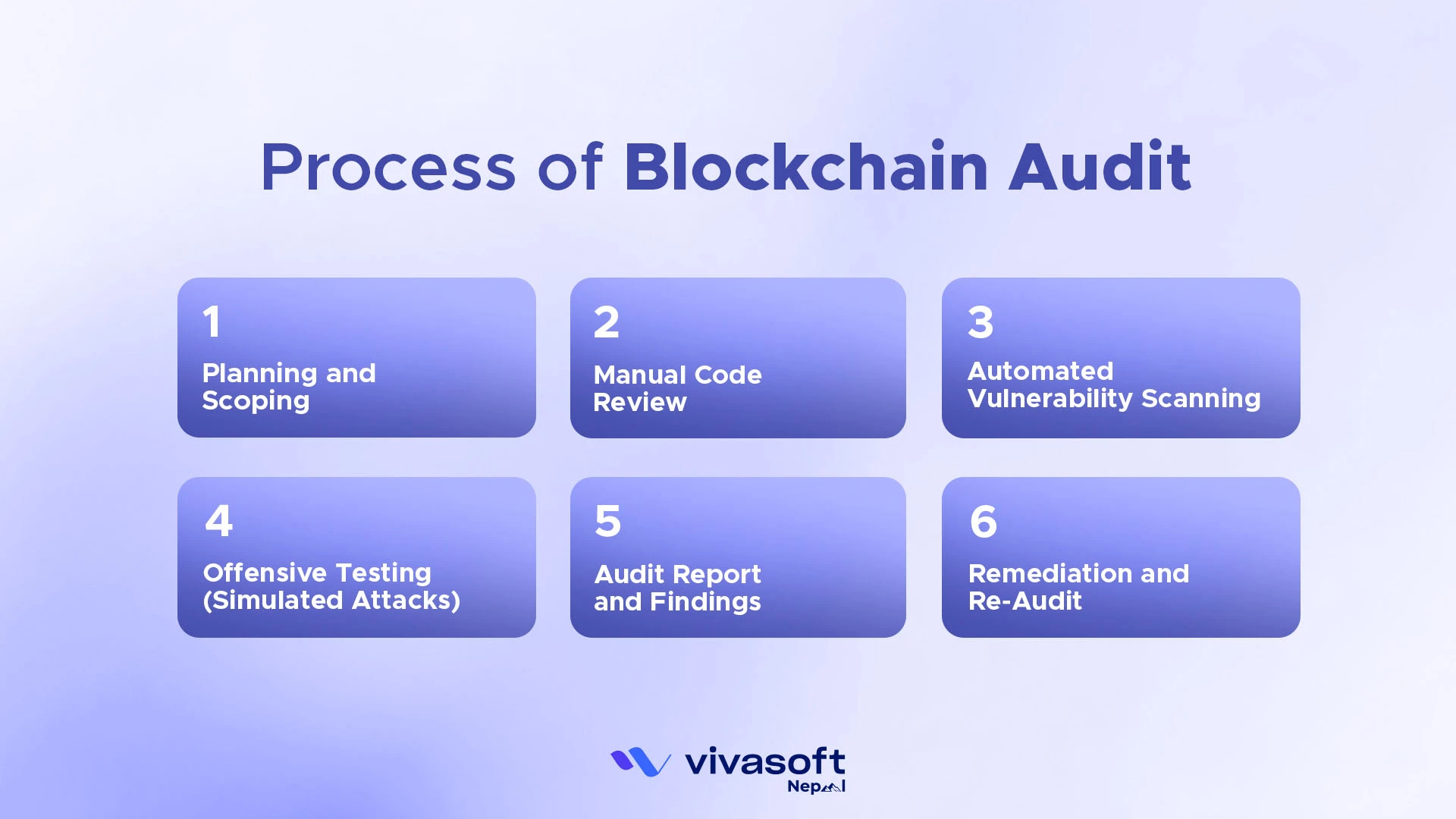
Most audits follow roughly the same flow, though the depth varies depending on scope and firm.
Step 1: Scoping and Planning
Before anything technical starts, the scope needs to be clearly written down. This means deciding which smart contracts are included, what third-party integrations are part of the audit and what deliverables and timelines both sides are agreeing on. It sounds straightforward but this step usually decides how smooth the rest of the audit will be.
One thing teams often miss is asking what is explicitly out of scope. It seems minor, but this is where confusion usually comes later. If something isn’t written clearly, it gets assumed and in audits, assumptions usually turn into gaps or missed risks.
Step 2: Manual Code Review
This is the core of any serious blockchain audit. Senior auditors go through the smart contract code line by line, trying to understand both logic and intent. Automated tools help, but they can’t catch everything, especially deeper design issues.
They usually look for logic errors, privilege escalation paths, incorrect state transitions, flash loan attack surfaces and anything that doesn’t match what the system was supposed to do. Even small mismatches between intention and implementation can become real vulnerabilities in production.
Step 3: Automated Vulnerability Scanning
In parallel with manual review, auditors run automated tools like static analysis, symbolic execution and fuzz testing. These tools scan the code quickly and flag known vulnerability patterns without much of a human effort.
They are useful for catching things like integer overflows, unreachable code or basic access control issues. But they don’t understand context or business logic so deeper problems like economic exploits or design flaws often go unnoticed.
Step 4: Offensive Testing (Simulated Attacks)
Here, auditors shift from reviewing to actively trying to break the system. They simulate real world attack scenarios like RPC abuse, validator compromise, admin key leaks or liquidity manipulation.
The goal is to see how the system behaves under pressure or unexpected conditions. Sometimes everything looks fine in normal testing but small combinations of actions can reveal hidden weaknesses that attackers might exploit later.
Step 5: Audit Report and Findings
After testing everything is compiled into a structured report. Findings are grouped by severity levels like Critical, High, Medium, Low and Informational. This help teams understand what needs urgent fixing and what can be handled later.
A proper report doesn’t just list issues. It explains impact, shows how an exploit could happen and includes recommended fixes so developers can actually act on it instead of guessing.
| Severity | Meaning | Required Action |
|---|---|---|
| Critical | Funds at immediate risk | Fix before any deployment |
| High | Major vulnerability, high exploit probability | Fix before launch |
| Medium | Conditional risk | Fix strongly recommended |
| Low | Minor risk | Remediate in next cycle |
| Informational | Best practice deviation | Review and document |
Step 6: Remediation and Re-Audit
After the report, developers start fixing the issues. Some are quick fixes, but others may require deeper changes in logic or architecture. Once updates are made, auditors re-check to confirm everything is properly resolved.
A re-audit is required if critical or high issues were found or if major changes were made. Otherwise, a quick verification may be enough. In real projects, this step often takes longer than expected not because audits are slow but because fixing and re-testing always takes extra time.
Blockchain Security Audit Checklist
Pre-Audit Checklist
Make sure everything is stable before the audit starts so the process doesn’t get messy later. This stage is all about the preparation, clarity and avoiding last minute surprises.
- Final codebase frozen and committed to a tagged version.
- Audit firm selected with verified track record and published reports.
- Scope document signed, with contracts, external integrations, and exclusions defined.
- Admin keys and privileged roles documented for auditor review.
- Test suite and natspec documentation provided to auditor
Post-Audit Checklist
This is where teams shift from review to execution, fixing issues and preparing for safe deployment.
- All Critical and High findings addressed before deployment.
- Re-audit completed if significant code changes were made.
- Audit report published openly (this is now the DeFi standard for trust).
- Monitoring and alerting set up post-launch, with on-chain anomaly detection.
- Incident response plan documented in case of a post-launch exploit
What are the Benefits of Blockchain Audit?
Blockchain audits bring notable advantages to enhance security and improve cost-efficiency. Here are some key benefits with detailed insights:
- Instant Access to All Data: Blocks create a detailed and immutable ledger that is assigned to all the connected nodes. You can retrieve every transaction instantly without waiting for permission or confirmation from third-party and any intermediaries. This speeds up audit sampling and thorough analysis.
- Real-Time Fraud Detection: In blockchain, you can ensure continuous monitoring of transactions to spot anomalies immediately. Such transparency in the process helps find out suspicious activities and fraud smarter quickly than traditional systems. At a great advantage, you can reduce the financial loss risks.
- Trust and Credibility: With the audited blockchain systems, you can find out the verified integrity. The users and the stakeholders get assurance that everything is secured and on track. It notably impacts enhancing credibility and improves trust. This way, you can gain reliability in the eyes of new investors as well.
- Lower Costs Over Time: Blockchain automates many audit tasks through cryptographic proofs and smart contracts. You don’t have to go through manual inspection or time-consuming paperwork hassles. These efficiencies lower labor costs and shorten audit cycles, helping you save money.
Complete Financial Transparency: Every transaction on blockchain is fully traceable and time-stamped. You can get access to the audit report, clearly highlighting asset origins, transfers, and final ownership. This transparency reduces disputes and simplifies regulatory compliance. Everyone involved can safely run the transaction..
What Are the Challenges of Auditing Blockchain Technology?
Not every part of blockchain auditing is clean and solved. There are real limits.
- Pseudonymity Limits Traceability: On-chain data is public but wallet identity stays pseudonymous unless KYC is layered in. Cross-chain transactions make this even harder to trace cleanly.
- Upgradeable Contracts Create Audit Blind Spots: Proxy patterns and upgradeable contracts mean the audited code can be quietly replaced after deployment without any re-audit. Diamond standard contracts in particular are complex to audit comprehensively.
- Smart Contract Code ≠ Business Intent: Auditors verify what the code does, not whether it does what the founders meant for it to do. Business logic vulnerabilities need both technical review and domain expertise, and that combo is rare.
- Shortage of Qualified Auditors: Demand far exceeds supply in 2025 and into 2026. The knock-on effects: longer wait times, inflated pricing for the reputable firms, and a proliferation of low-quality auditors filling the gap at the bottom.
-
Limitations of Blockchain in Financial Auditing
Here are the key limitations that still affect financial auditing in blockchain systems today.
-
Not all settlement is on-chain. Layer 2 systems and off-chain agreements create gaps.
-
Cross-jurisdiction regulatory conflicts complicate compliance.
-
Immutability means errors cannot be corrected, only documented
-
How Much Does a Blockchain Audit Cost?
Here’s the honest breakdown.
What Drives Audit Pricing?
Audit cost isn’t random, it usually depends on how complex the system is and how much work is needed to fully understand it. Bigger protocols with more moving parts naturally take more time, deeper analysis, and more experienced reviewers.
- Lines of code and contract complexity
- Number of contracts and external integrations in scope
- Audit type: a simple smart contract review is nothing compared to a full protocol audit
- Auditor’s reputation, team size, and methodology depth
- Turnaround time (rush audits cost significantly more)
| Audit Type | Typical Cost (USD) | Timeline |
|---|---|---|
| Simple Smart Contract (1–3 contracts) | $5,000 – $15,000 | 1–2 weeks |
| Complex DeFi Protocol (5–15 contracts) | $20,000 – $80,000 | 3–5 weeks |
| L1/L2 Protocol Full Audit | $50,000 – $250,000+ | 6–12 weeks |
| Ongoing / Continuous Security Audit | Custom retainer | Monthly |
| Compliance + Security Combined | Custom enterprise | 4–8 weeks |
Red Flags in Blockchain Audit Pricing
If the pricing looks too good to be true, it usually is. Proper blockchain audits take time, expertise and multiple layers of review so extremely low cost offer often mean something is missing behind the scenes.
- A quote under $2,000 for a DeFi protocol means the depth just isn’t there.
- No public audit portfolio on their website.
- Unnamed or uncredentialed audit team.
- Re-audit not included, or quoted separately without explanation.
- 48-hour turnaround offers for anything complex, which is just impossible to do properly.
Audit cost is one line item inside a larger project budget. If you’re still in planning then a complete breakdown of blockchain app development costs can help you.
How to Choose a Blockchain Audit Firm?
Picking the right audit firm can make a huge difference in how secure your project actually is. It’s not just about finding someone who can run tools on your code but a team that understands real-world attack behavior and system design.
1. Questions to Ask Before Signing
The right questions early on usually save a lot of trouble later. Ask these questions before signing:
- Do you have experience auditing protocols in Solidity, Rust, or Move (whichever applies)?
- Can you share three published audit reports from the past 12 months?
- Is a re-audit included in the quoted scope?
- What’s your responsible disclosure policy?
- Will the full report be published after completion?
If they dodge any of these, that tells you something.
2. Reading an Audit Report
Check the severity breakdown first. Any unfixed Critical or High findings is a hard stop, not a negotiation.
“Acknowledged” is not the same thing as “Fixed,” and a lot of reports blur that line. A clean audit report also doesn’t mean zero risk, it just means the known risks were caught and addressed. Always look for monitoring recommendations in the final section, and verify report authenticity by checking the auditor’s official report registry.
The Future of Blockchain Audit
The future of blockchain audit will bring major changes. It is expected to make the audits faster, smarter, and more valuable. Here’s what you should know about:
- AI-Assisted Vulnerability Detection: LLMs and ML models are starting to identify vulnerability patterns at scale. Useful, but with one real limit: AI still cannot replace adversarial reasoning. Human auditors remain essential for economic attack modelling because the attacker is always human and creative.
- Continuous and Real-Time Auditing: On-chain monitoring is replacing point-in-time audits for many high-value protocols. Tools like Forta and Hypernative flag anomalies in real time. Audit-as-a-Service (AaaS) models are also showing up alongside traditional engagements.
- Regulatory Standardisation: MiCA now mandates security standards for crypto-asset service providers across the EU. Global convergence toward unified audit standards is expected by 2027. Projects that build audit habits early will avoid costly retrofitting later.
If you look at this from a system design perspective, all of this ties back to how enterprise blockchain solutions are built for compliance because audits and compliance are becoming something that needs to be designed in from the start, not added later
Why Choose Vivasoft Nepal for Your Blockchain Audit?
One of the biggest challenges businesses face today is the concern about even a single overlooked flaw in a blockchain system. It risks financial loss and reputational damage.
All you need is to head over to a reliable blockchain development company that understands the complexities of blockchain technology and audits, with a focus on strong smart contract security expertise and risk-focused audit practices that actually lead to actionable findings.
Vivasoft Nepal stands out in this arena. We have a skilled team highly experienced in advanced audit methodologies with blockchain’s inherent transparency.
Our team focuses on protecting your digital assets as well as keeping them compliant and efficient. Contact us today for a free consultation and start the new journey toward the safest blockchain ecosystem.
FAQs
How can blockchain improve the accuracy and frequency of audits for business owners?
Blockchain offers immutable data transactions, which means once a transaction is recorded, it cannot be altered or deleted. Plus, by introducing the automation process, there are minimal chances of errors that are common for humans. It improves accuracy and speeds verification with higher precision.
What are the main technical risks in blockchain-based auditing practices?
The key technical risks in auditing the blockchain are finding bugs in smart contracts. Often, you have to handle integration-related issues with other enterprise systems. Other challenges include fixing recorded mistakes and slow processing due to large data volumes.
How long does it take to audit a smart contract?
The actual timeline varies depending on the blockchain size and complexity. A contract with simple tokenization may take 3-4 days. But with the completely decentralized application, you may need to consider multiple weeks for auditing.
How do blockchain audits differ between public and private networks?
Public blockchains are open to anyone who can view and verify all transactions. Auditors check open, shared data. On the other hand, private blockchains are permissioned systems that restrict access to authorized users. Auditors need to focus on internal controls and who has permission to do what.
What is the difference between a blockchain audit and a smart contract audit?
A smart contract audit is one type of blockchain audit. The broader blockchain audit can cover protocol security, infrastructure, compliance and financial ledger reviews in addition to contract code.
How long does a blockchain audit take?
Anywhere from 1–2 weeks for a simple contract, up to 12 weeks for a full L1/L2 protocol audit. Most DeFi protocols fall in the 3–5-week range.
Is a blockchain audit mandatory?
Not legally in most jurisdictions yet but practically yes. Exchanges, investors and major partners will expect one before engaging. MiCA in the EU is also starting to formalize requirements for specific categories.
Can an audited smart contract still be hacked?
Yes and it happens. An audit reduces known risks but doesn’t eliminate every possibility specially for novel attack vectors or post-audit code changes. That’s why continuous monitoring matters.
How do I know if a blockchain audit firm is reputable?
Look for published audit reports, named senior auditors, a clear methodology document and responsible disclosure history. Anyone who refuses to share past work is a red flag.
What happens if critical vulnerabilities are found?
The dev team fixes them then the auditor re-verifies. You don’t launch with unfixed Critical or High findings; that’s the hard rule.
How much does a blockchain security audit cost?
Typically, $5,000 – $250,000+ depending on scope. See the pricing table earlier in this guide for a full breakdown.
What is included in a blockchain audit report?
Scope summary, methodology, findings categorized by severity, proof-of-concept exploits where applicable, recommended fixes, auditor commentary and remediation status after re-audit.