


When it’s about NFTs, people usually focus on the artwork or collection. But in reality, there are smart contracts that make every NFT project work. It basically controls how you create NFTs, who owns them, or how they move between wallets.
As NFT use cases continue to grow, smart contracts now support many more project-specific features. It may include royalties, metadata, access permissions, or gaming assets. That’s the reason these smart contracts are the foundation of each of your NFT projects.
So, you need to ensure a well-designed NFT smart contract for security and reliability when your project goes live on the blockchain. That’s why your focus shouldn’t be just on making the contract work. Instead, you need to ensure it behaves correctly when real users start minting, trading, and scaling the system.
What Is an NFT Smart Contract?
NFT smart contracts are self-executing computer programs. It stores unique data on blockchain and manages non-fungible tokens or NFTs. It also keeps ownership data through an owner address and automatically handles minting, transferring, and tracking NFTs. NFT contracts do all this according to predefined rules.
You can think of it as the operating system behind an NFT collection. Here, users typically see the artwork, collectibles, or gaming assets associated with NFTs, and the smart contract defines how those assets function. It also makes sure to record all this information on the blockchain, so it can’t be changed later.
That’s why NFT projects depend on smart contracts. Instead of a company keeping track of ownership in a private system, everything runs on-chain where anyone can check it themselves. Ultimately, you can verify NFTs very easily. Moreover it makes them harder to duplicate or fake.
How Does an NFT Smart Contract Differ from a Regular Smart Contract?
A regular smart contract is basically a general program on a blockchain. You can use it for all kinds of things like moving funds, setting up rules between parties, or building decentralized applications. What it does really depends on what the developer writes into it, and it doesn’t focus on managing unique digital assets by default.
But on the other hand, an NFT smart contract is more specific. It’s built on ERC-721 or ERC-1155 standards. On top of that it tracks every token separately. Moreover, it keeps a record of every NFT using a tokenId and connects it to its owner address on-chain.
NFT Smart Contract vs. Minting on a Marketplace
You can create NFT contracts mainly in two ways. You can either use a custom smart contract that a project team deploys or mint it through a shared contract from NFT marketplaces.
| Aspect | Your Own Contract | Marketplace Shared Contract |
|---|---|---|
| Best for | Full NFT projects, brands, games, and long-term ecosystems | Quick launches, testing ideas, and simple NFT drops |
| Ownership | Full control over how ownership is written and managed on-chain | Ownership is still on-chain, but controlled by the marketplace’s contract logic |
| Royalty enforcement | You can encode royalty logic | Often dependent on marketplace rules |
| Custom logic | Fully customizable | Limited to what the marketplace contract allows |
| Branding | Uses a custom contract address tied to the project | NFTs are minted under the marketplace’s shared contract |
| Upgradeability | Can be designed with upgrade patterns | Controlled entirely by marketplace infrastructure |
| Cost | Higher upfront deployment cost | Lower cost since no contract deployment is needed |
How NFT Smart Contracts Work?
NFT smart contracts basically follow standards as defined in ERC-721 and ERC-1155. The contract here maintains a state mapping of tokenId. All operations update or read this mapping through the defined interface functions. Here is an overview of the main standard functions of the NFT smart contract.
- mint(): It creates a new tokenId and assigns it to an address. Moreover, it updates the ownership mapping, and emits a Transfer event.
- ownerOf(): It reads the ownership mapping and returns the current owner address
- balanceOf(): It returns the number of tokens owned by an address from stored balances.
- transferFrom() / safeTransferFrom(): It updates the ownership mapping after validating the caller’s permissions.
- approve() / setApprovalForAll(): It stores authorization rules allowing another address to transfer specific or all tokens.
- tokenURI() (tokenId): It returns a metadata URI pointer associated with the token.
NFT smart contracts don’t store images or media files. They store only a metadata pointer (URI). That URI points to external storage such as IPFS or Arweave.
Minting: How New NFTs Are Created?
Minting is the process of creating a new NFT inside the smart contract. It begins when a user calls mint(). The contract then executes a series of checks before creating a new NFT.
A typical public mint follows this execution flow:
- User calls mint() + sends ETH
- Contract checks: supply < maxSupply?
- Contract checks: msg.value >= mintPrice?
- Contract checks allowlist / mint rules (if enabled)
- Assigns tokenId to msg.sender
- Updates ownership and balance mappings
- Emits Transfer(address(0), msg.sender, tokenId)
- NFT now exists, owned by caller
Each step must succeed for minting to continue. If any condition fails, the transaction reverts, and no NFT is created.
Ownership and Transfers
After an NFT is minted, the contract becomes the source of truth for ownership. Ownership is not determined by the image, metadata, or marketplace listing. It is determined by the contract state. Four ERC-721 functions handle most ownership and transfer operations.
- ownerOf: It returns the current owner of a specific NFT.
- balanceOf: It returns the number of NFTs an address owns.
- transferFrom(from, to, tokenId): It moves ownership of a token from one address to another.
- safeTransferFrom: It performs the same ownership transfer but adds an extra validation step.
Metadata: What Makes Each NFT Unique?
NFT metadata defines what a token represents. For instance, its name, image, traits, and attributes. Here, every tokenId points to a separate metadata file.
When an application needs information about a token, it calls tokenURI(tokenId). Example of commonly used NFT metadata structure [an ERC-1155 Metadata JSON file follows]
					"name": "Asset Name",
	"description": "Lorem ipsum...",
	"image": "https:\/\/s3.amazonaws.com\/your-bucket\/images\/{id}.png",
	"properties": {
		"simple_property": "example value",
		"rich_property": {
			"name": "Name",
			"value": "123",
			"display_value": "123 Example Value",
			"class": "emphasis",
			"css": {
				"color": "#ffffff",
				"font-weight": "bold",
				"text-decoration": "underline"
			}
		},
		"array_property": {
			"name": "Name",
			"value": [1,2,3,4],
			"class": "emphasis"
		}
	}
}
Token Standards: ERC-721, ERC-1155, and When to Use Each?
NFT standards mainly differ in how assets are organized and scaled. The choice is simple at the product level whether each item must stand alone or whether assets are managed in groups.
ERC-721: The Original NFT Standard
ERC-721 is a token standard for creating unique NFTs. Here every token has its tokenId and has its own ownership record on-chain. It also follows a fixed set of interface functions that ERC-721 standard defines. Below are some of them:
- balanceOf(owner)
- ownerOf(tokenId)
- safeTransferFrom(from, to, tokenId)
- transferFrom(from, to, tokenId)
- approve(to, tokenId)
- getApproved(tokenId)
- setApprovalForAll(operator, _approved)
- isApprovedForAll(owner, operator)
- safeTransferFrom(from, to, tokenId, data)
That’s why there is no concept of batch ownership or shared token instances. This makes the model straightforward- one token equals one asset. It’s best for the following.
- Projects where every asset must be unique
- NFT art collections
- Profile picture (PFP) drops
- Membership NFTs tied to identity
- One-of-one digital or real-world assets
ERC-1155: The Multi-Token Standard
The ERC-1155 token allows you to manage more than one type of token in a smart contract. That’s because it doesn’t require separate contracts for each asset. Instead, one contract can handle an entire system of tokens.
Each token type has its own identifier, and balances are tracked separately per identifier for each wallet. Because multiple token types can be handled together in a single contract and processed in batches, it leads to massive gas savings (40–60%) for projects that require multiple tokens. It also reduces deployment costs and complexity.
The following are its best use cases.
- Games with multiple in-game items
- Large-scale asset systems (tickets, rewards, vouchers)
- Platforms requiring bulk transfers
- Mixed fungible + non-fungible ecosystems
| Feature | ERC-721 | ERC-1155 |
|---|---|---|
| Token uniqueness | One NFT = one token = one unique asset | One contract can manage multiple token types |
| Batch transfers | Not supported | Supported |
| Gas per mint | Higher per operation | Lower due to batch processing |
| Fungible token support | Not supported | Supported |
| Marketplace support | Separate contracts per collection | Single contract for multiple assets |
| Complexity | Simple structure | A more flexible system |
| Best use case | Collectibles, Digital art, Identity, and , Digital assets | In-game items, Currencies, Consumables, and Upgrades |
So, when should you choose which one? Here is a simple example.
- If every token represents a unique collectible → ERC-721
- If you are building a digital art collection → ERC-721
- If you’re building a game with many item types → ERC-1155
- If you need batch transfers or bulk rewards → ERC-1155
- If your system mixes fungible + non-fungible assets → ERC-1155
After this choice, the real work shifts to how the contract is structured, how minting, ownership, and metadata logic are wired into the system.
Structure of an NFT Smart Contract
An NFT smart contract contains a few core parts that work together to manage tokens on the blockchain. These components handle minting, ownership tracking or other control within a single contract.
This structure represents the implementation layer of NFTs, where conceptual behaviors such as minting and ownership are expressed through code-based components and functions. Developers also extend this base structure with additional features such as royalties, allowlists, and supply controls.
What Are the Components of NFT Smart Contract?
An NFT smart contract is built from a small set of standard components that handle storage, minting, ownership, and control.
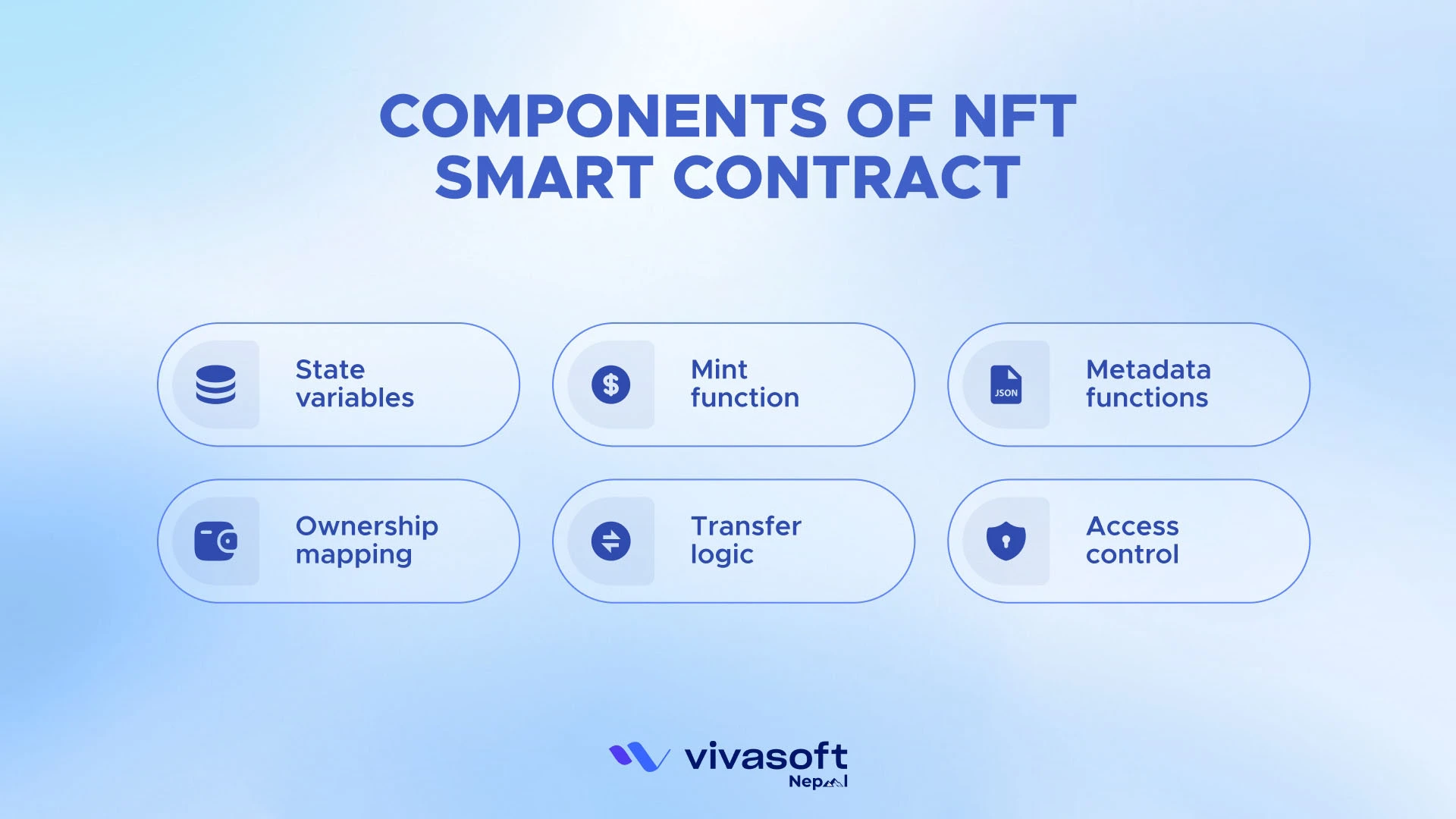
- State Variable: These store the contract’s core data like total supply, mint price, and limits such as maximum NFTs allowed.
- Mint Function: It controls how new tokens are generated and assigned to users.
- Metadata Functions: These define how NFT data is linked, usually through a URI system such as tokenURI or a base URI setting.
- Ownership Tracking: This manages who owns which NFT using internal mappings. It supports functions like ownerOf and balance tracking.
- Transfer Logic: This handles movement of NFTs between wallets, including approvals and safe transfers like transferFrom and safeTransferFrom.
- Access Control: It explains who can perform restricted actions or owner/admin roles. Such as minting limits, setting metadata, or withdrawing funds.
Common Extensions and Add-Ons
For NFT smart contract development, most extensions come from OpenZeppelin’s battle-tested library. It lets you plug in only what you need.
| Extension | What It Does? | Standard/Library |
|---|---|---|
| Royalties | Gives creators a small cut when NFTs are resold | EIP-2981 via OpenZeppelin ERC721Royalty |
| Allowlist | Allows only selected wallets to mint | Custom logic. It uses OpenZeppelin Ownable or AccessControl |
| Reveal | It keeps NFTs hidden at first. Then it shows the final artwork later | Custom tokenURI() logic with OpenZeppelin ERC-721 |
| Max per wallet | It limits how many NFTs one wallet can mint | Custom rules using mappings or counters |
| Pausable | Stops minting or transfers when needed | OpenZeppelin ERC721Pausable |
| Burnable | Allows NFTs to be destroyed permanently | Allows NFTs to be destroyed permanently |
NFT Smart Contract Example: Simplified ERC-721
					// SPDX-License-Identifier: MIT
pragma solidity ^0.8.20;

import "@openzeppelin/contracts/token/ERC721/ERC721.sol";
import "@openzeppelin/contracts/access/Ownable.sol";

contract MyNFT is ERC721, Ownable {
    uint256 public totalSupply;
    uint256 public constant MAX_SUPPLY = 10000;
    uint256 public constant MINT_PRICE = 0.05 ether;
    string private _baseTokenURI;

    constructor() ERC721("MyNFT", "MNFT") Ownable(msg.sender) {}

    function mint(uint256 quantity) external payable {
        require(totalSupply + quantity <= MAX_SUPPLY, "Sold out");
        require(msg.value >= MINT_PRICE * quantity, "Insufficient ETH");
        for (uint256 i = 0; i < quantity; i++) {
            _safeMint(msg.sender, totalSupply);
            totalSupply++;
        }
    }

    function setBaseURI(string calldata baseURI) external onlyOwner {
        _baseTokenURI = baseURI;
    }

    function _baseURI() internal view override returns (string memory) {
        return _baseTokenURI;
    }

    function withdraw() external onlyOwner {
        payable(owner()).transfer(address(this).balance);
    }
}
It’s a simple NFT contract following the ERC-721 standard. When you pay some ETH, they can mint (create) a new NFT and it goes straight to your wallet. There is a limit, so only a fixed number of NFTs can ever be made.
The contract owner can update the metadata source using setBaseURI. All ETH collected from minting stays inside the contract until it is withdrawn. The owner can retrieve these funds using the withdraw() function.
NFT Metadata Architecture: On-Chain vs. Off-Chain
You can store NFT metadata in different ways based on cost and permanence. Here, you basically get two choices.
- You can store everything directly on the blockchain
- Store it somewhere outside the blockchain and just point to it.
- Check out the core reference point below for choosing the right approach.
| Approach | Where Stored | Cost per NFT | Permanence | Best For |
|---|---|---|---|---|
| IPFS (Pinata/Filecoin) | Off-chain |
| Medium | NFT collections and scalable projects |
| Arweave | Decentralized permanent storage | $0.48–$5 per GB one-time | High | Long-term NFTs, digital art, and archives |
| On-chain (SVG/JSON) | Stored directly inside the smart contract itself | Very high. A 10KB SVG could easily run you $50-100+ on the Ethereum mainnet. | Very high | Fully on-chain NFTs and generative art projects |
| Centralized (AWS/S3) | Off-chain | $0.02 per GB | Low | MVPs, prototypes, and early-stage projects |
How IPFS Works for NFT Metadata?
IPFS is basically a peer-to-peer storage system where files aren’t kept in one place. Instead of using a normal URL, each file is identified by a content hash called a Content Identifier. If anything in the file changes, that CID changes too, so you always know if the data has been modified.
In real NFT setups, the smart contract doesn’t store the actual image or metadata. It just stores the CID and points to it through something like tokenURI(). The actual file lives off-chain, so it needs to stay “pinned” somewhere like Pinata or Filecoin. Here, services like Pinata are commonly used for that, while Filecoin adds longer-term storage through paid storage agreements.
Fully On-Chain NFTs
Fully on-chain NFTs take a different approach where everything — artwork, metadata, and logic — lives directly on the blockchain itself. There’s no IPFS link or external server involved, so the NFT is completely self-contained.
You’ll see this approach in projects like Loot, Nouns, and On-Chain Monkeys, where the NFT is often generated directly from on-chain data. The big advantage is permanence — nothing can disappear or be taken down. The trade-off is cost, since storing and generating everything on-chain increases gas usage quite a bit, which is why it’s usually used for smaller, high-value, or experimental collections.
The Metadata Reveal Pattern
Most NFT projects don’t show the final artwork at mint. Instead, they start with a placeholder and reveal the real metadata later, either after a specific time or once all tokens are minted. The main reason is simple — it keeps the mint process fair. If rare traits are visible early, bots and experienced buyers can “snipe” high-value NFTs before others get a chance.
A delayed reveal avoids that imbalance and gives everyone the same starting point. Projects that care about fairness and hype control usually go with a reveal pattern, while fully transparent generative projects sometimes skip it and expose traits from the start.
How to Create an NFT Smart Contract?
An NFT contract development starts with defining the rules of the collection. And then the process turns those rules into a secure and deployable on-chain system.
Step 1: Define Your Requirements
The process starts with teams deciding how the NFT collection should actually work. They define the rules for supply, minting style, ownership, and royalty. Moreover, they also decide whether the collection will need things like allowlists or reveal mechanics.
These decisions of the development teams guide everything that can come later. That’s why they decide very well, as changing them at this stage is much easier than fixing them after development starts.
Step 2: Set Up Your Development Environment
After the development team makes the direction of the development clear, they start focusing on setting up a workspace. It’s built so that the team can build and test the contract without friction.
Moreover, teams usually pick a development framework like Hardhat or Foundry to structure the project and manage the workflow. OpenZeppelin is often added here as a trusted base for standard NFT behavior. So teams don’t have to rebuild common logic from scratch.
Step 3: Write the Smart Contract
This is where the NFT is actually built on-chain. The teams now translate the earlier decisions into a working contract that defines how the collection behaves.
Instead of building everything manually, most teams rely on OpenZeppelin standards for core NFT functions and then layer project-specific rules on top. That could include limits on minting, access rules, or optional features like burning or reveal logic — depending on what was defined earlier.
Step 4: Write Tests
Now the focus moves to checking whether the contract behaves correctly in different situations. Teams simulate actions like minting, transfers, and ownership changes in a controlled setup.
This helps expose issues that aren’t obvious during development, such as incorrect limits or broken permission flows. The goal here is simple, make sure the contract behaves predictably before it ever leaves a safe environment.
Step 5: Deploy to Testnet
After testing locally, the development team moves the contract into a testnet environment like Sepolia or other Ethereum ones. In the testnet environment, it behaves like a real blockchain but without real value at risk.
Here, teams interact with it through wallets and run real flows like minting and transfers. This is usually where small issues around gas usage, permissions, or unexpected behavior start to show up before the final launch.
Step 6: Security Review
Before anything goes live, the contract goes through a dedicated security pass. Now the teams try to identify weak points or risky logic in the system.
They generally use tools like Slither here to scan for known vulnerability patterns, while teams also manually review permission structures, mint logic, and fund handling. In many cases, this stage also prepares the contract for an external audit if the project is going to production.
Step 7: Deploy to Mainnet
This is the final step. Now the contract is deployed to a live blockchain and becomes permanent. At this point, the development team and audit team have already tested and reviewed.
That is why now the deployment is more about execution than experimentation. After the NFT smart contract becomes live, it starts handling real transactions. Teams usually then shift focus to monitoring activity and ensuring everything behaves as expected in production.
What Are the Types of NFT Smart Contract?
NFT smart contracts can be built in different ways depending on what the NFT is meant to do.
1. Dynamic NFTs (dNFTs)
Dynamic NFTs are NFTs that can change after they are created. Unlike normal NFTs, their information is not fixed forever. Developers can update them when something changes in real life or inside a game. For example, a game character NFT that becomes stronger or upgrades its level after you complete missions.
- It is built on the ERC-721 or ERC-1155 base standards
- Its Metadata can be updated after mintin
- Smart contract functions or oracle-driven updates are its mechanism
2. Soulbound Tokens (SBTs / ERC-5192)
Soulbound tokens are NFTs that can’t be transferred to another person. Once they are given to a wallet, they stay there permanently. They are mostly used to prove identity or achievements. It generally uses the standard ERC-5192 reference. You can use it for identity and credential systems, like a digital certificate for completing an online course that cannot be sold or transferred.
3. ERC-6551 (Token Bound Accounts)
ERC-6551 is a newer NFT standard. It allows an NFT to act like a wallet. This means an NFT can hold other NFTs and tokens inside it. Here, NFTs can own assets and smart contract accounts. However, it needs to be built on ERC-721 compatibility. A game character NFT that owns weapons and in-game currency inside itself can be an example of ERC-6551.
Lazy Minting
Lazy minting means an NFT is not created on the blockchain immediately. Instead, it is created only when someone buys it. This helps reduce upfront costs for creators.
- The standard basis uses off-chain signed data combined with on-chain mint execution.
- The main feature is that minting happens at the point of sale.
- NFT marketplaces commonly use this approach to reduce upfront gas costs.
For example, an NFT artwork that only gets minted when a buyer purchases it.
4. Compressed NFTs (Solana)
Solana blockchain uses compressed NFTs to create NFTs in a cheaper and more efficient way. They store data in a compressed form. That’s why it can create millions of NFTs at low cost.
- The network used is Solana.
- The main feature is reduced on-chain storage cost.
- The mechanism uses a compressed state representation.
- A common example is large NFT collections where thousands/millions of NFTs are minted at very low cost.
How Does NFT Royalties Work?
As for NFT royalties, it’s a way for creators to earn a small percentage when their NFT is sold again in the secondary market. These royalty rules are shared through a standard and the marketplace decides how to handle and support royalties.
1. ERC-2981
ERC-2981 provides a standard way for NFT contracts to provide royalty payment information for ERC-721 and ERC-1155 tokens. The core of the standard is a single function. Here it is.
royaltyInfo(uint256 _tokenId, uint256 _salePrice).
It takes the token ID and sale price as inputs and returns two outputs.
- receiver: the address that should receive the royalty payment
- royaltyAmount: the royalty amount calculated from the sale price
ERC-2981 helps marketplaces and other ecosystem participants to get royalty information directly from an NFT contract. However, the standard doesn’t transfer funds or offer royalty payments. It only provides royalty information. The marketplace or protocol handling the sale handles the actual payment mechanism.
2. The Enforcement Problem
As mentioned above, ERC-2981 only provides royalty information. It only tells the marketplace who should receive a royalty and how much should be paid for a sale.
It’s because a smart contract can’t always tell what kind of transfer is happening. It can’t make a difference between a sale, a transfer between wallets, or a gift. Because of this, royalties are not automatically applied at the contract level.
As a result, royalty payments largely depend on marketplace support. Marketplaces can read the royalty information and decide whether to follow it. If they choose not to support royalties, the NFT contract cannot force payment.
3. Enforcement Approaches
This is why NFT royalties are not consistent across the ecosystem. The standard exists, but enforcement depends on platform behavior. Different projects use different approaches depending on their goals.
| Method | How It Works? | Trade-off |
|---|---|---|
| Marketplace-honored | The marketplace chooses to pay royalties when a sale happens | Only works where marketplaces support royalties |
| Operator Filter | The NFT contract restricts trading to approved marketplaces | Can limit where NFTs can be traded |
| Transfer fee in the contract | A fee is built into transfers inside the smart contract | Not always suitable because not every transfer is a sale |
| Harberger tax model | Owners pay a continuous fee based on a self-set value | More complex ownership experience |
NFT Smart Contract Security, Vulnerabilities and Best Practices
NFT smart contracts control both ownership and value on-chain, which means there’s no room for small errors. A single vulnerability can lead to stolen NFTs, lost funds, or a collection that doesn’t behave as intended.
Top 6 Vulnerabilities
Check out the six most common vulnerabilities of the NFT smart contracts.
| Vulnerability | What Happens | Prevention |
|---|---|---|
| Reentrancy on mint | An attacker can repeatedly call mint logic before state updates are complete. It can potentially mint more NFTs than allowed or disrupt supply rules | Use the checks-effects-interactions pattern and reentrancy guards |
| Unrestricted mint function | Anyone can call mint() and create unlimited NFTs. It can break supply control | Restrict mint access using onlyOwner, role-based access control, or allowlists. |
| Integer overflow on supply | Incorrect arithmetic in older contracts can break total supply tracking or allow invalid minting | Use Solidity ≥0.8.x (built-in overflow checks) or SafeMath in legacy systems |
| Unprotected withdraw | Attackers can drain contract funds if withdrawal functions are not access-controlled | Restrict withdrawal functions to the owner or the treasury address only |
| Frontrunning allowlist | Bots monitor mempool transactions and mint before eligible users during whitelist sales | Use commit-reveal schemes or private/merkle-based allowlists |
| Metadata rug pull | Project changes or removes metadata after minting, altering NFT appearance or value | Use immutable metadata links (IPFS), decentralized storage, and avoid mutable centralized servers |
Security Checklist Before Deployment
You should have a quick security review before launch. That is because it can help you identify issues that can be difficult to fix after launch.
- Ensure that privileged functions use proper access control and can’t be called by unauthorized wallets.
- Review minting logic carefully to ensure supply limits and whitelist rules. Moreover, ensure pricing conditions can’t be bypassed.
- You should review external calls and token transfer logic. It will help you identify potential reentrancy risks or unexpected behavior.
- Verify how metadata and URI settings are managed, especially if changes can be made after the collection goes live.
- Test withdrawal functions and treasury addresses to ensure contract funds can only be accessed by approved accounts.
How to Get Your Contract Audited?
By the time a contract is ready to launch, most projects go through a security audit which can review it from a different perspective and catch problems that might have been missed.
| Auditor Name | Cost Range | Known For |
|---|---|---|
| CertiK | $8,000 – $45,000+ | Formal verification, Skynet monitoring, Exchange-recognized audit reports |
| Hacken | $5,000 – $25,000 | Web3-focused security audits, Bug bounty programs, Ecosystem integrations |
| Trail of Bits | $40,000–$150,000+ | Advanced protocol reviews, Cryptographic research, Custom security tooling |
| Code4rena | $10,000–$300,000+ prize pools | Competitive crowdsourced audits and multiple independent researchers reviewing the same codebase |
Upgradeable vs. Immutable Contracts
NFT smart contracts usually fall into two approaches: upgradeable or immutable.
| Aspect | Upgradeable (Proxy) | Immutable |
|---|---|---|
| Bug fixes | Possible via upgrade | Not possible |
| User trust | Trust in admin/governance | Fully trustless |
| Complexity | Higher | Lower |
| Audit cost | Higher | Lower |
| Best for | Enterprise apps, stablecoins | DeFi primitives, DEXs |
How Much Does It Cost to Deploy an NFT Smart Contract?
The cost isn’t fixed — it’s what you end up paying in gas when the contract goes live on-chain. On networks like Ethereum, you’re paying for the computation needed to publish the contract and store its code on-chain, so the final cost changes depending on how busy the network is and how large the contract is. However, on average, it can cost around $8,000 – $40,000 for low–Medium complexity. Plus, it can take $8,000 – $25,000 for an audit.
In practice, a simple ERC-721 contract is cheaper to deploy than something with extra logic. Like whitelist minting or royalties. The chain you choose also makes a big difference. Ethereum mainnet tends to be more expensive, while Layer 2 networks like Polygon or Arbitrum keep the same kind of contracts but at a much lower deployment cost.
Gas Costs by Chain
Where you deploy your NFT smart contract directly affects how much you’ll pay in gas for both deployment and minting.
| Chain | Deploy Cost (est.) | Mint Cost per NFT | Best For |
|---|---|---|---|
| Ethereum mainnet | $100–$1,000+ | $10 – $80+ per mint. It can exceed $100+ during congestion | High-value NFT collections, blue-chip drops, and long-term assets |
| Polygon | <$1–$20 | < $0.01 to a few cents per transaction | Large NFT collections, gaming, low-cost minting |
| Base / Arbitrum / Optimism | $5–$100 | under $1 per transaction (often a few cents) | Ethereum-compatible apps needing lower fees |
| BNB Chain | $5–$50 | $0.05 – $0.20 per transaction | Consumer NFT projects, gaming ecosystems |
| Solana (compressed) | Collection-scale deployment can be only a few SOL | $0.0005 – $0.002 per NFT mint | Massive NFT distributions, gaming, loyalty systems |
Beyond Gas Full Project Cost Factors
There’s more to the NFT project cost than just gas. Check it out.
| Hidden cost | Typical impact | Notes |
|---|---|---|
| Post-audit fixes | +$5,000 – $20,000 per round | If issues are found, the code gets updated and may need another review |
| Gas fee changes | 10–50x spikes during congestion | Ethereum is especially unpredictable during high activity |
| Node / API services | $50 – $2,000+/month | Services like Infura or QuickNode usually run monthly plans |
| Legal review | $5,000 – $30,000+ | Common for serious NFT or token projects |
| Ongoing maintenance | 15–25% of the initial cost annually | Includes updates, fixes, and monitoring |
| Scope changes | +20–40% budget overrun is common | This usually increases time and overall cost |
| Re-audit after updates | $5,000 – $20,000 per pass | Any contract change often needs another audit |
Summing Up
Most NFT projects end up relying heavily on the smart contract once things go live. It quietly defines ownership, metadata behavior, and how the entire system holds up under real usage.
In practice, what matters most is keeping things simple early choosing the right token standard, structuring metadata properly, and not overloading the contract with unnecessary logic. Security and scalability usually become the real focus once users start using it and value starts.
That’s why, if you’re building or planning an NFT project, Vivasoft Nepal can help with smart contract development, audits, marketplace integration, and end-to-end Web3 engineering.