


Building an enterprise blockchain system is not just a technology decision, it’s a business architecture decision. Enterprise blockchain development is the process of designing, building and deploying distributed ledger infrastructure that lets multiple organizations share tamper-resistant data and automate workflows without relying on a central authority.
The opportunity is clear. Industries from trade finance to pharmaceutical supply chains have proven that shared ledger infrastructure can cut reconciliation costs, reduce fraud, and eliminate coordination overhead. But most projects that fail, don’t fail because of the technology, they fail because the architecture was misaligned with the actual business problem or governance wasn’t sorted before development started.
This guide is written for CTOs, VPs of Engineering, procurement leads, and product owners who need to understand what building enterprise blockchain actually involves.
What Is Enterprise Blockchain Development?
At its core, enterprise blockchain development produces a working distributed system, one where multiple organizations read and write to a shared record, execute business logic automatically and do this without trusting each other or depending on any single party to run the infrastructure.
That’s the key difference from a database. A conventional shared database has one owner who controls the schema and can alter records. Everyone else just has to trust them. Blockchain distributes both the data and the validation across multiple nodes, so no single participant can change history unilaterally.
How Enterprise Blockchain Differs from Public Blockchain
The most fundamental difference is identity. On public networks like Ethereum or Bitcoin, anyone can participate anonymously. Enterprise blockchain is the opposite, every participant is credentialed and verified before joining. You know exactly who wrote every transaction.
Because participants are known, governance can work through legal agreements rather than economic incentives alone. Transaction privacy can also be designed deliberately, on enterprise platforms like Hyperledger Fabric, private data collections and channels ensure only the right participants see the right data.
What Makes a Blockchain Solution "Enterprise-Grade"?
Not every blockchain platform is built for production business environments. When evaluating one four things should be non-negotiable.
- Security SLA: The vendor must commit to defined response times for threats and vulnerabilities in writing. Vague assurances don’t hold up when something goes wrong.
- Uptime requirements: Enterprise operations don’t pause. Look for 99.9% availability guarantees minimum; backed by redundancy and a tested disaster recovery plan.
- Audit trail completeness: Every transaction needs a full, tamper-proof record; who did what, when and why. Partial logs create compliance gaps that are expensive to explain later.
- Compliance readiness: The platform should already align with the regulations relevant to your industry whether that’s GDPR, HIPAA, SOC 2 or sector specific frameworks not require heavy customization to get there.
If a vendor can’t clearly answer all four, it’s not enterprise grade, it’s just enterprise priced.
Distributed Ledger Technology (DLT)
DLT is any database shared, replicated and synchronized across multiple nodes without a central administrator. Enterprise blockchain is a specific type of DLT, one that adds governance structures, permissioning and smart contract execution on top of that distributed data layer. The two terms are related but not identical, a distinction worth understanding when evaluating the blockchain layers that make up a platform.
Types of Blockchain Networks Used in Enterprise
Before writing a line of code, your team needs to answer one question : which network type fits the use case? The four options: private, consortium, public and hybrid each have different governance models, privacy characteristics and operational overhead. The table below captures the key differences.
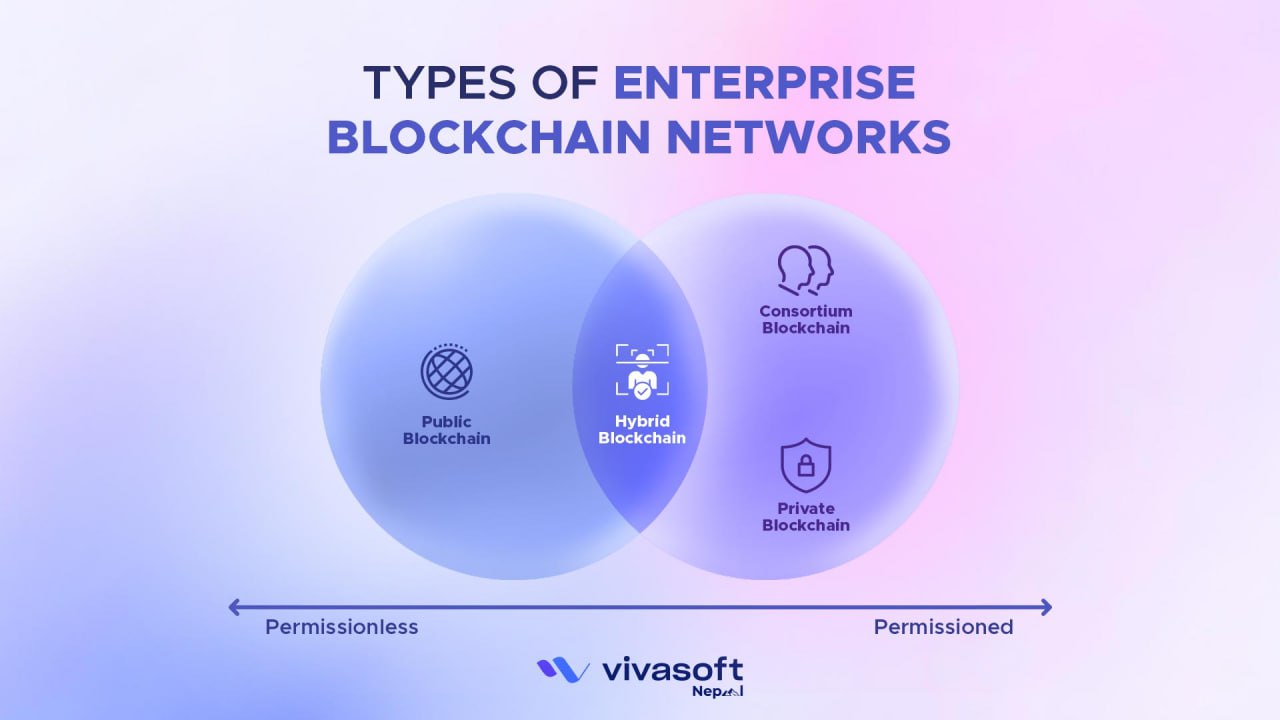
| Network Type | Access | Governance | Privacy | Best Enterprise Use Case | Example Platform |
|---|---|---|---|---|---|
| Private | Permissioned (single org) | Central authority | High | Internal audit, compliance ledger | Hyperledger Fabric |
| Consortium | Permissioned (multi-org) | Shared governance body | Configurable | Trade finance, supply chain | R3 Corda, Quorum |
| Public | Open to all | Protocol / token incentives | Low | Tokenization, public audit anchoring | Ethereum, Polygon |
| Hybrid | Mixed | Context-dependent | Selective | Supply chain with public verification | Dragonchain |
Private Blockchains
Private blockchains dominate enterprise adoption because controlled access makes compliance tractable and a single organization retaining network control means faster decisions on upgrades and rule changes. If your use case is internal like compliance trails, internal approvals or intra-company supply chain tracking. A private blockchain delivers immutability and auditability without the governance complexity of a multi-org network. The guide on how to create a private blockchain is worth reviewing early in scoping.
Consortium Blockchains
Picture five competing banks that all participate in the same trade finance ecosystem. Each has its own systems and no interest in giving competitors access to internal data but they share an expensive reconciliation problem. Consortium blockchain is built for exactly this: a shared ledger all parties write to and read from, governed by agreed-upon rules.
The technical build is usually the easier part. The harder part is defining the governance model before a line of code gets written such as who can join, how disputes get resolved, who controls upgrades. Skipping this is one of the most reliable ways to stall a project midway through.
Public Blockchain
These are open to anyone with no vetting process. Many don’t want to associate them with enterprise blockchains due to the lack of control. As you can guess, they are mostly unsuited for enterprises. However, a business may still find them helpful for specific tasks. Entities that enter a public blockchain can also validate transactions and join a consensus. Examples include Bitcoin or Ethereum.
Hybrid Blockchains
Hybrid blockchains combine a private data layer with a public settlement or audit layer. Sensitive operational data stays on the private network, cryptographic hashes are periodically anchored to a public chain for independent verification.
A practical example, a pharmaceutical company tracks drug provenance on a private Fabric network only authorized participants see the details while publishing batch hashes to Ethereum so regulators can verify data integrity without ever accessing the private network.
What Are the Business Problems Enterprise Blockchain Solves?
Blockchain generates real ROI in specific conditions: multiple organizations that need to share data and coordinate actions but don’t fully trust each other to do so without a verification mechanism.
Eliminating Trust Deficits in Multi-Party Processes
Most inter-organization workflows have a hidden trust problem. A manufacturer, supplier, logistics provider and customs authority each maintain their own records of the same transaction and when something goes wrong, those records often don’t agree.
Blockchain makes trust irrelevant. When all parties write to the same ledger and consensus validates each transaction, there’s no competing source of truth. Disputes resolve faster and many don’t happen at all.
Reducing Reconciliation Costs in Finance and Supply Chain
Reconciliation is one of the most expensive hidden costs in B2B operations, entire teams exist just to match invoices against purchase orders against delivery confirmations across organizations.
A shared ledger doesn’t just speed this up, in many cases it eliminates it. When a delivery is confirmed on-chain, that confirmation is the authoritative record. There’s nothing to reconcile against.
Achieving Compliance Without a Central Data Repository
GDPR and data residency laws create a specific challenge: you need comprehensive audit trails but centralizing all that data in one place controlled by one party creates regulatory risk and liability.
Blockchain distributes both the data and the accountability. No single company owns the full dataset and cryptographic controls determine precisely who sees what, a meaningful advantage for healthcare, finance and pharmaceutical organizations.
Automating Workflows with Smart Contracts
Smart contracts are self-executing programs that run when predefined conditions are met, no manual approval, no human intermediary, no delay. A supplier delivers goods and sensor confirms receipt: payment releases automatically. A flight is delayed beyond a threshold: the insurance claim pays out without a claims adjuster involved.
The business case is straightforward. The engineering challenge is that smart contract logic must be correct from the start, because bugs in production can’t be patched the way a conventional application’s bugs can.
Blockchain Adoption Challenges and Solutions for Enterprises
Every enterprise blockchain team will tell you the technology was the easy part. The hard parts are below.
Scalability, Layer 2 Solutions and Sharding
Most enterprise platforms handle hundreds to a few thousand transactions per second, sufficient for many use cases but not for high-frequency payments or capital markets settlement. Layer 2 solutions handle transactions off the main chain and settle final states back to it. Sharding partitions the network so different node subsets process transactions in parallel. Both involve trade-offs in complexity and finality guarantees that need to match the specific use case.
Legacy System Integration (SAP, ERP, CRM)
Most enterprises can’t start with a blank slate; existing SAP, Oracle or CRM systems have to connect to whatever gets built. A well-designed middleware API layer handles data transformation, authentication bridging and event driven synchronization between legacy systems and the blockchain network. Underestimating this work is one of the most common causes of cost overruns in enterprise blockchain projects.
Regulatory Compliance Across Jurisdictions
A consortium blockchain connecting organizations across multiple countries faces a compliance matrix that no single legal team can navigate alone. The practical approach is involving legal counsel from each relevant jurisdiction during the architecture phase not after the system is designed. Smart contract logic that triggers financial settlements may need structuring differently depending on whether participants are in the EU, US, or Asia.
Governance in Consortium Networks
When competing organizations run a shared network, every significant decision becomes a negotiation. Effective consortium governance requires a documented charter, a defined voting process, clear escalation paths and ideally a neutral coordinating entity. Networks that assume participants will sort it out informally tend to find they can’t reach consensus on anything once competing commercial interests come into play.
Data Privacy on a Shared Ledger (ZKPs and Private Channels)
Privacy on a shared ledger requires deliberate architectural choices. Private channels in Hyperledger Fabric allow transaction data to be shared only with the relevant participants. Zero-knowledge proofs (ZKPs) take this further, letting one party prove a statement is true without revealing the underlying data. A bank can prove a customer passed KYC to a regulator without exposing personal information. ZKP tooling is maturing fast and is increasingly practical at enterprise scale.
Enterprise Blockchain Development Process
Enterprise blockchain development moves step by step, turning an idea into a secure and scalable solution. Here’s how the process usually unfolds from start to finish.
Step 1: Discovery Workshop and Business Problem Scoping
Every discovery workshop should start with one honest question: “Does this use case actually require distributed consensus or would a well designed shared database solve the same problem at lower cost?”
The discovery phase maps the business workflow, identifies all parties involved, documents where trust breaks down and defines what success looks like in measurable terms. Teams scoping their first deployment should also review the blockchain MVP development approach to calibrate scope appropriately.
Step 2: Architecture and Network Design
Architecture phase designs the system to support the validated use case. Node topology is a key decision; validator nodes for consensus, observer nodes that replicate without voting and in some platforms, orderer nodes that sequence transactions.
On-premise versus cloud deployment is also significant. On-premise gives full infrastructure control and may be required in highly regulated contexts but increases operational burden. Cloud deployments on AWS, Azure or GCP reduce that burden but introduce data residency considerations that need careful evaluation.
Step 3: Platform Selection and Technology Stack
The platform decision like Hyperledger Fabric, R3 Corda, ConsenSys Quorum or another has a 3 to 5 year impact on every technical decision that follows. Fabric is the most widely adopted for cross-industry use cases. Corda was purpose-built for financial services. Quorum is EVM-compatible, making it the natural choice when public Ethereum integration matters.
Smart contract language follows from the platform: Fabric uses Go, Java , or Node.js; Corda uses Kotlin and Java; Quorum uses Solidity. These choices determine what technical talent you need. The programming languages for blockchain overview is a useful reference here.
Step 4: Proof of Concept (POC) Development
A POC validates that the chosen platform can support the use case; it’s not a production prototype. The critical step is defining success criteria before the POC begins : what questions must it answer, what performance thresholds must it hit and when does the team make its go/no-go call.
Teams that skip this end up iterating on a POC indefinitely, accumulating technical debt without ever producing a decision.
Step 5: Full-Scale Custom Blockchain Development
Full-scale development builds everything production needs: smart contract logic, node setup, network configuration, API development for external system integration, and frontend interfaces for human participants. This is also where legacy system integration gets built as a designed component not a workaround added at the end.
Step 6: Security Auditing and Smart Contract Testing
Smart contracts are immutable once deployed, bugs can’t be patched the way conventional application bugs can. The audit process covers unit testing, integration testing, formal verification, and penetration testing across both contract logic and network infrastructure.
A thorough blockchain audit report categorizes findings by severity. The rule is absolute: nothing goes to production until all Critical and High severity findings are remediated and re-tested. No timeline pressure changes this threshold.
Step 7: Staged Deployment and Network Launch
Deployment follows a staged sequence: testnet first, then staging, then production. Testnet lets participants run real node infrastructure before any live data is involved. Staging mirrors production for final integration and performance validation.
Participant onboarding deserves as much planning as the technical deployment such as documentation, training and support for the first 30 days significantly reduce launch friction.
Step 8: Ongoing Maintenance, Upgrades, and Support
A blockchain network requires ongoing care: smart contract logic evolves as business rules change, platform versions need security patches and network membership changes over time. Incident response processes need to be established and tested before an incident happens not during one.
Ongoing maintenance works best through a dedicated support model either an internal team with deep platform expertise or managed services from the development partner.
Should You Build a Custom Blockchain or Use a Platform?
The right blockchain approach depends on your scalability needs, budget, control and long term business goals. Here’s what makes the most sense for different use cases.
When to Build on an Existing Platform
For the majority of enterprise use cases, building on Hyperledger Fabric, Corda or Quorum is the right call. These platforms are battle-tested, actively maintained and cover what most enterprise requirement need out of the box.
Starting from an established platform compresses timelines and eliminates the risk of building consensus mechanisms or cryptographic primitives from scratch. If the use case fits within the existing platform capabilities there’s no compelling reason to build a custom chain.
When Custom Enterprise Blockchain Development Makes Sense
Custom development makes sense when transaction volumes, privacy requirements or consensus properties fall genuinely outside what established platforms support or when proprietary network infrastructure is a competitive moat.
The cost and timeline are substantially higher. This decision should be based on clear evidence that existing platforms can’t meet the requirements not a preference for building something novel.
How to Choose a Blockchain Development Partner?
Choosing the right blockchain development partner can make or break your project. Here are the key things to look for before making a decision.
Technical Expertise Signals (What to Look For)
Hyperledger Certified Service Provider status and ConsenSys Academy graduates signal verified platform expertise. Open-source contributions to Fabric or Besu repositories indicate engineers who understand these platforms at a level below typical client-facing work.
Ask to see redacted audit reports from previous smart contract engagements. A credible partner will have had client contracts independently audited and can share what findings looked like and how they were resolved. Partners who haven’t done this, or who won’t share it, are a production risk.
Engagement Models to Evaluate
Fixed-scope works well for defined POC development. Time-and-material suits discovery and iterative phases where the right architecture is still being worked out. For 12-month-plus enterprise builds, a dedicated team model; engineers who stay on your project and build genuine familiarity with your system, produces better outcomes than staffing models that rotate people across clients. The blockchain development outsourcing guide covers how to structure these engagements effectively.
How Much Does Enterprise Blockchain Development Cost and How Long Does It Take?
Cost ranges reflect how widely scope varies. Audit costs are listed separately because they’re frequently omitted from initial vendor quotes but are non-negotiable for production systems.
| Project Type | Scope | Cost Range | Timeline | Audit Cost (Additional) |
|---|---|---|---|---|
| Discovery + POC | Single use case, 1–2 smart contracts | $15K–$60K | 4–8 weeks | $15K–$25K |
| Platform-based MVP | 3–5 smart contracts, 2–3 participants | $80K–$200K | 3–5 months | $25K–$40K |
| Full Enterprise Platform | Multi-org, legacy integration, governance | $200K–$500K | 6–12 months | $40K–$80K |
| Custom Layer 1 | Proprietary consensus, full infrastructure | $500K–$1.5M | 12–24 months | $60K–$120K |
ROI Calculation Framework
ROI for enterprise blockchain combines three value types: cost reduction (reconciliation labor, fraud, manual compliance), revenue enablement (new business or customers the shared infrastructure makes possible) and risk mitigation (the cost of compliance failures or counterparty disputes the architecture reduces).
Quantify the baseline cost of the problem before the project starts then track the actual delta after deployment. Most well scoped deployments in supply chain and finance generate positive ROI within 18 to 36 months with reconciliation cost reduction and fraud prevention being the most consistently measurable benefits.
Emerging Trends in Enterprise Blockchain Development
Enterprise blockchain is evolving beyond crypto, enabling secure automation, transparent transactions and a scalable digital ecosystems. Here are some of the emerging trends shaping its future:
AI + Blockchain: Autonomous Smart Contract Execution
AI models are now feeding decisions directly into smart contracts, creating workflows that react to real world conditions without waiting on human approval. It’s fast but it comes with a responsibility when AI pulls the trigger on a contract, that decision needs to be traceable and verifiable not just the transaction it caused.
Cross-Chain Interoperability
Most enterprise blockchain networks still don’t talk to each other. That’s changing. Relay chains, bridge standards and protocols like Cosmos IBC are making it possible for separate consortium networks to share data and trigger actions across chains; no central middleman needed. For multi-industry supply chains where different groups built on different platforms, this is a practical problem finally getting practical solutions.
CBDCs and Enterprise Settlement Rails
Central bank digital currencies are no longer just concepts; pilots are live in several major economies. For financial services companies, the real opportunity right now is building the integration layer that connects internal systems to CBDC settlement infrastructure. As CBDCs move from pilot to production, that capability will shift from competitive advantage to baseline requirement
Real-World Asset Tokenization at Scale
Tokenizing real-world assets like property, commodities, private credit has moved well beyond early experiments. Illiquid assets can now be represented as digital tokens with programmable ownership rules and automated settlement built in. The technical side is ready. The legal frameworks are still catching up, but the gap is closing faster than expected.
Zero-Knowledge Proofs for Privacy-Preserving Compliance
ZKPs let you prove something is true without exposing the underlying data such as KYC is complete, a transaction falls below a reporting threshold, a counterparty meets a requirement. What was once a complex cryptographic concept is now entering real enterprise deployments. As tooling improves and processing costs fall, ZKPs are on track to become a standard layer in enterprise blockchain architecture.
Start Your Enterprise Blockchain Journey with Vivasoft Nepal
Building on blockchain isn’t just a technical decision, it’s a business one. From scoping the right use case to deploying a production ready network, every step carries real consequences for cost, security and long term scalability. Having the right team alongside you from day one makes that difference.
Vivasoft Nepal works with enterprises to turn complex blockchain requirements into systems that actually hold up in the real world. Whether you’re starting with an MVP or scaling an existing network; the team brings the technical depth and hands-on experience to move your project forward without the guesswork. Reach out early.
FAQs
Can blockchain integrate with our existing ERP or CRM system?
Yes. We build API gateways and adapters that translate ERP/CRM events into ledger transactions in real time.
What is a permissioned blockchain and why do enterprises prefer it?
In permissioned blockchain only approved participants can join. You control who sees what and who can do what which keeps things clean for compliance, audits, and internal governance. That’s why regulated industries tend to go this route.
What are the differences between Hyperledger Fabric, Quorum, and Corda?
Fabric is the most flexible, modular setup with private data channels. Quorum is Ethereum with enterprise permissioning bolted on, good if you’re already in that ecosystem. Corda was built for finance, it only shares data between the parties directly involved in a transaction, nothing gets broadcast wider.
What is the ROI of enterprise blockchain?
Enterprise blockchain does not have a single fixed ROI; rather, it yields quantifiable returns between 20% to 30% with payback periods of 18 to 24 months.
Is enterprise blockchain secure against cyberattacks?
Yes, when built with industry‑standard like cryptography, verified smart contract logic and regular penetration testing. It meets or exceeds traditional security benchmarks.
What are the biggest challenges in enterprise blockchain adoption?
Scalability, connecting it to legacy systems, getting stakeholders aligned on governance and navigating compliance across different regions. The technical side is often the easier part; the people and process side takes more work
Can we start with a small pilot before full deployment?
Always recommended. A POC surfaces real integration issues early and gives you something concrete to build the internal business case around. It’s not a trial, it’s phase one